William Weinstein Sheet Music Preview

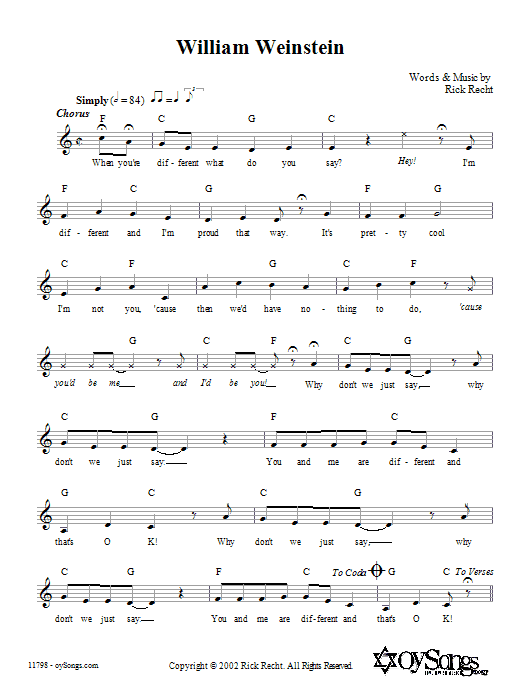
William Weinstein: Lead Sheet / Fake Book

As performed by Rick Recht

Item: 35-DS00090644

Digital Download
$3.99
Description

William Weinstein: Lead Sheet / Fake Book isn't in MakeMusic Cloud just yet...but it could be. Let us know you'd like to see it, and you'll help shape what comes next. In the meantime, start a free trial and dive into thousands of interactive titles your students can play along with today.

Sample Audio
No sample audio found.
Sample Video
Additional Details
Publisher: Hal Leonard
Page Count: 3
SKU: 35-DS00090644

More about this title

About the Artist: Rick Recht

Rick Recht is a Jewish music composer and educator whose work spans liturgical settings, educational arrangements, and contemporary Jewish music. His compositions have become staples in synagogue music programs and Jewish summer camps, where they support both spiritual practice and music skill development.

Why we love this

This lead sheet distills a Rick Recht composition into its essential melodic and harmonic content, giving pianists and vocalists the freedom to interpret within a clear harmonic framework. It's the kind of straightforward resource that works equally well for accompaniment practice, improvisation exploration, or preparing soloists.

What to expect

The piece carries the warmth and accessibility that characterizes Rick Recht's output. Expect clear melodic lines supported by functional harmony, with a character that feels both grounded and uplifting.

Who it's for

Pianists working with vocalists in synagogue, educational, or performance settings will find this lead sheet immediately useful. It's also valuable for student keyboardists learning to realize chord symbols and for anyone exploring Jewish musical traditions.

How to get the most out of it

  • Treat the lead line as a flexible starting point; reshape phrasing and articulation to match the vocalist's breath and style rather than locking into a single interpretation.
  • Explore the harmonic progression on the keyboard without strictly following the written chords; this builds deeper understanding of chord function and creates space for personal arrangement.
  • If accompanying a singer, listen for where they're pushing or pulling the tempo and follow their lead rather than keeping a metronomic beat.

How to use it

Incorporate this into a Jewish music unit or liturgical music rehearsal where students are learning to accompany singers from lead sheets. It works well as a teaching example alongside other traditional and contemporary Jewish pieces, or as a solo feature for a vocalist paired with piano.

Skills your students will build

  • Realizing lead sheet notation and chord symbols on keyboard
  • Accompanying vocalists with sensitivity to phrasing and interpretation
  • Harmonic analysis and chord progression recognition
  • Reading and interpreting melodic contour for expressive performance

You May Also Like