
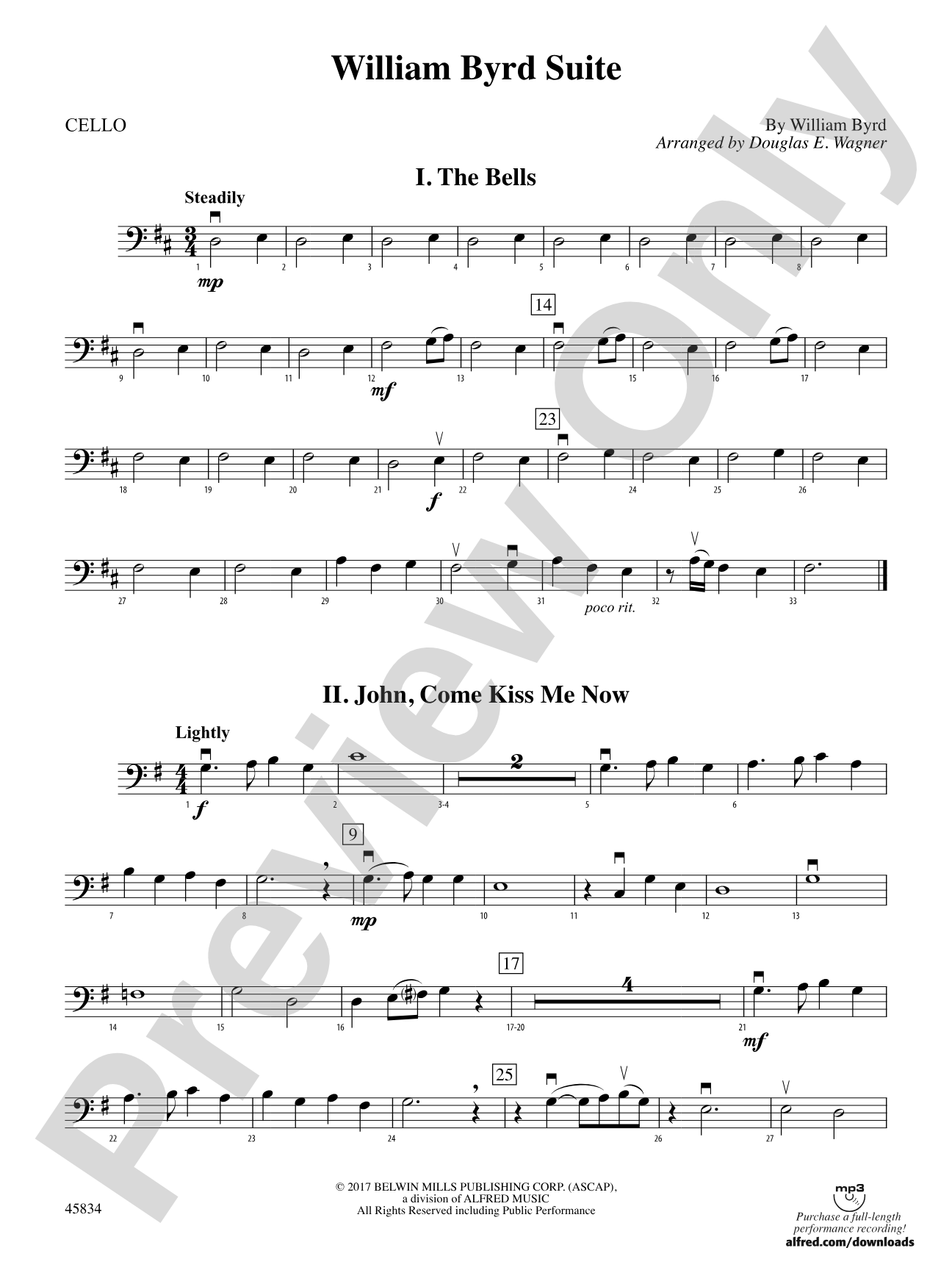

William Byrd Suite: Cello
By William Byrd / arr. Douglas E. Wagner
Grade: 2
Item: 00-PC-0017636_VC1
$5.99
Pickup currently not available
Description
The keyboard music of English composer William Byrd (1543--1623) has long been regarded as some of the most representative works produced during the late Renaissance period. The Fitzwilliam Virginal Book, the quintessential source of music for this idiom of the time, is also the source of the three Byrd titles included in this suite: "The Bells," "John," and "Sellinger's Round."
The arrangements by Douglas E. Wagner are richly scored to flatter the sound of ensembles of any size. Care has been taken to eliminate technical obstacles for younger players, with musically interesting individual parts a strong consideration. (4:25)


The arrangements by Douglas E. Wagner are richly scored to flatter the sound of ensembles of any size. Care has been taken to eliminate technical obstacles for younger players, with musically interesting individual parts a strong consideration. (4:25)
Don't just read it, hear it, play along with it, and watch your students grow with it. In MakeMusic Cloud, William Byrd Suite: Cello comes alive with professional accompaniment, adjustable tempo, and built-in practice tools that turn solo practice into real progress.
Open in the Player
Jump straight in and assign it today.
Start Your Free Trial
Open this title and explore the full library in minutes.
Sample Audio
1
Audio File
--:--
0:00
0:00
Sample Video
Additional Details
Series:
Belwin Intermediate String Orchestra
Publisher:
Alfred Music
Page Count:
144
SKU:
00-PC-0017636_VC1
More about this title
About the Composer: William Byrd
William Byrd (1543–1623) stands as one of the most prolific and influential composers of the English Renaissance. A master of both sacred and secular music, Byrd created an enormous catalogue spanning motets, masses, instrumental works, and vocal music that shaped the sound of his era and influenced generations of composers who followed. His keyboard music, preserved in sources like the Fitzwilliam Virginal Book, reveals a composer of exceptional technical skill and imaginative harmonic language.
Byrd's works remain central to music education because they demonstrate the sophistication possible within Renaissance forms and constraints. His pieces for virginals and other keyboard instruments showcase clear melodic writing, logical harmonic progression, and satisfying structural designs that make them ideal models for student musicians learning to hear and perform music from this foundational period.
Why we love this
Douglas E. Wagner's arrangement preserves the character and melodic charm of Byrd's virginal music while crafting parts that sit comfortably in the hands of developing string players. The suite gives young orchestras access to genuine Renaissance masterworks without the technical barriers that often keep this repertoire off school concert programs. Three distinct movements drawn from the same historical source provide musical variety while maintaining stylistic coherence.
What to expect
These pieces evoke the refined, contemplative world of the English Renaissance keyboard room. Dance rhythms and fanfare-like flourishes in "Sellinger's Round" alternate with the gentler, song-like quality of "John," while "The Bells" opens with the iconic cascading figurations that give the piece its name. Throughout, Wagner's scoring maintains clarity and lightness, inviting the listener into music written for elegance rather than grandeur.
Who it's for
String orchestras in Grades 2-4 seeking authentic Renaissance repertoire that balances musical substance with accessible writing. Directors programming concert or festival performances will find three contrasting movements that work as a complete suite or as individual selections. The arrangement accommodates flexible ensemble sizes without sacrificing string voicing.
How to get the most out of it
- Approach the articulation with a light touch. The original keyboard idiom calls for crisp, clean attacks rather than the sustained legato typical of 19th-century string writing. Short bows and careful attention to note endings will bring out the dance-like character of these pieces.
- Balance the parts so that melodic lines emerge clearly from the accompaniment. Wagner's scoring distributes thematic material across the ensemble, so each section must listen for who carries the principal voice in any given phrase.
- Shape phrases by subtle dynamic nuance rather than obvious swells. Byrd's keyboard writing tends toward stepwise melodic motion and organic phrasing; exaggerated dynamic contrast can undermine the music's Renaissance sensibility.
- Mark tempo relationships between movements in your rehearsal notes. Understanding how "The Bells," "John," and "Sellinger's Round" relate rhythmically and spiritually will help the ensemble build narrative across the suite.
How to use it
Program this suite on concerts exploring music history or Renaissance music. The four-and-a-half-minute duration makes it an ideal contrasting work alongside Baroque or early Classical string pieces, or pair it with modern arrangements that reference similar harmonic language. The three movements work equally well as a complete arc or as separate selections if programming flexibility is needed.
Skills your students will build
- Reading articulation patterns specific to Renaissance keyboard idiom
- Balancing transparent texture and clear melodic line in multi-voice writing
- Understanding historical context and performance practice of the English Renaissance
- Executing clean, non-vibrato tone appropriate to period style
- Responding to subtle dynamic shaping in phrase-based structures