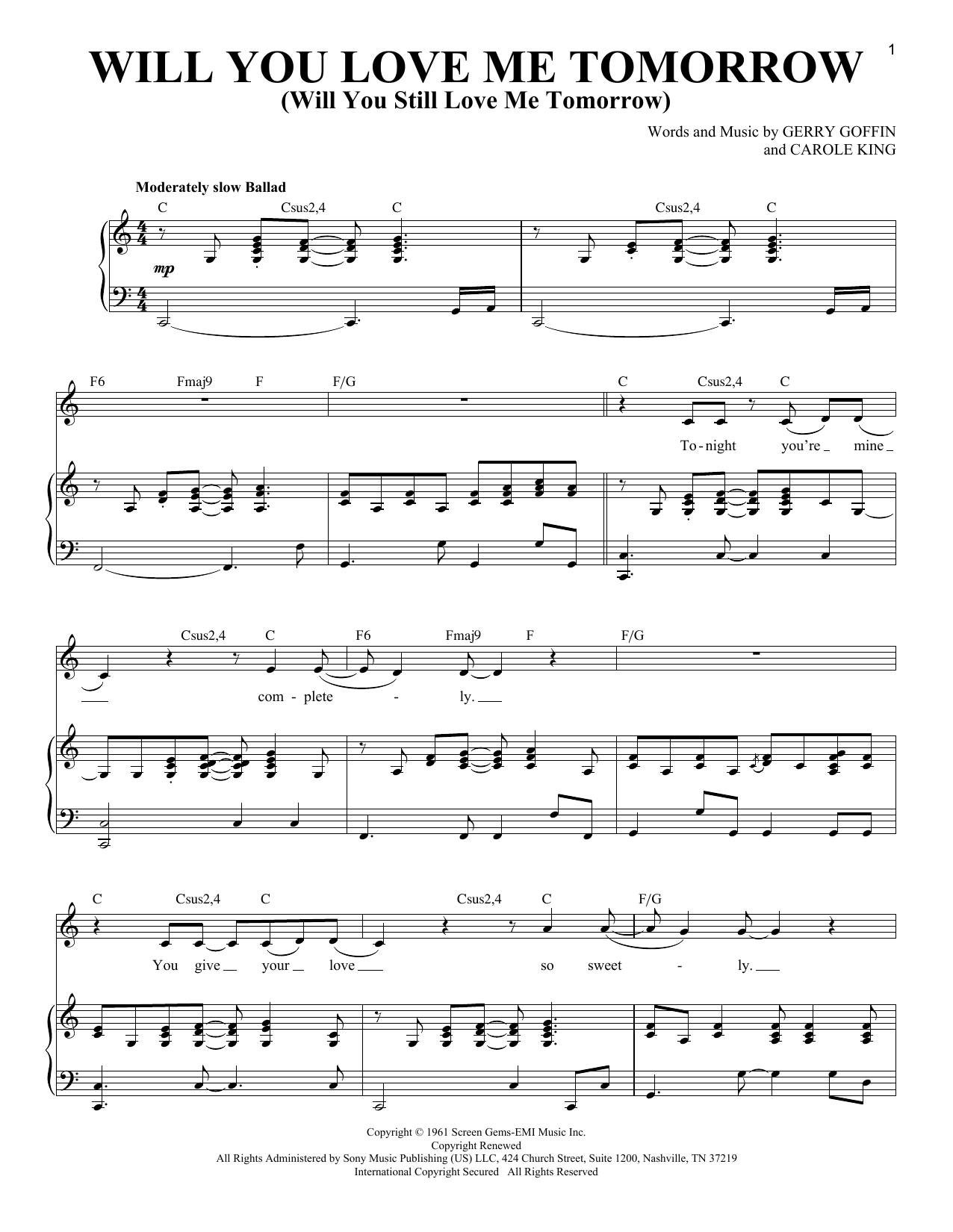
Will You Love Me Tomorrow (Will You Still Love Me Tomorrow) Sheet Music Preview

Will You Love Me Tomorrow (Will You Still Love Me Tomorrow): Piano Vocal

As performed by Carole King / As performed by The Shirelles

Item: 35-DS01464981

Digital Download
$5.99
Description

Will You Love Me Tomorrow (Will You Still Love Me Tomorrow): Piano Vocal isn't in MakeMusic Cloud just yet...but it could be. Let us know you'd like to see it, and you'll help shape what comes next. In the meantime, start a free trial and dive into thousands of interactive titles your students can play along with today.

Sample Audio
No sample audio found.
Sample Video
Additional Details
Publisher: Hal Leonard
Page Count: 7
SKU: 35-DS01464981

More about this title

About the Artist: Carole King

Carole King stands as one of the most consequential songwriters in American popular music. Her output as a composer and lyricist shaped the sound of the 1960s and beyond, and her own recordings as a performer demonstrated her gifts as an interpreter of her own material. Her work appears across countless arrangements and editions, making her an essential figure for students studying how popular song is constructed and performed.

King's ability to write melodies that lodge immediately in memory, paired with lyrics that capture genuine emotional vulnerability, makes her songs enduringly teachable. This particular composition remains a masterclass in how restraint and clarity serve emotional truth.

Why we love this

This arrangement preserves the intimacy of the original while giving students real interpretive choices within a compact format. The seven-page score balances accessibility with the sophisticated harmony that made King's writing remarkable. Singers find authentic emotional material here, not manufactured sentiment.

What to expect

A late-night conversation with someone you're afraid to lose. The harmony beneath the melody creates a sense of gentle inevitability, even as the lyrics express doubt and longing. Restless and uncertain, the piece moves forward not through driving rhythm but through the pull of unresolved harmonic tension.

Who it's for

Students with solid sight reading skills and enough vocal maturity to handle introspective material. This works beautifully for jazz vocal students, pop vocalists building a standards repertoire, and singers exploring how to convey emotional complexity through simplicity. Piano students accompanying vocalists will find this piece both supportive and revealing of their partners' interpretive choices.

How to get the most out of it

  • Shape the vocal line around the question itself. The title is not a statement but an inquiry, and your phrasing should reflect that uncertainty through subtle dynamics and tempo rubato in the opening phrases.
  • Let the piano establish the harmonic world clearly in the introduction. The foundation matters more than the vocal entry, so resist rushing the opening measures.
  • The lyrical content demands genuine vulnerability. Avoid over-singing; restraint and directness serve the material better than vocal embellishment.
  • Work the relationship between vocal phrasing and piano accompaniment in the verse sections. They should feel like conversation, not competition.

How to use it

Pair this with other King compositions or with standards from the same era to create a program about songwriting craftsmanship. It functions equally well as a solo recital piece or in a jazz vocal showcase. The modest length makes it suitable for a set that explores vulnerability in popular song, or simply as a vehicle for a strong vocalist on a mixed concert.

Skills your students will build

  • Singing with lyrical sensitivity and emotional restraint
  • Interpreting harmonic tension in popular song contexts
  • Accompanying vocalists with responsiveness to phrasing and interpretation
  • Understanding how simplicity in melody can coexist with sophisticated harmony

You May Also Like