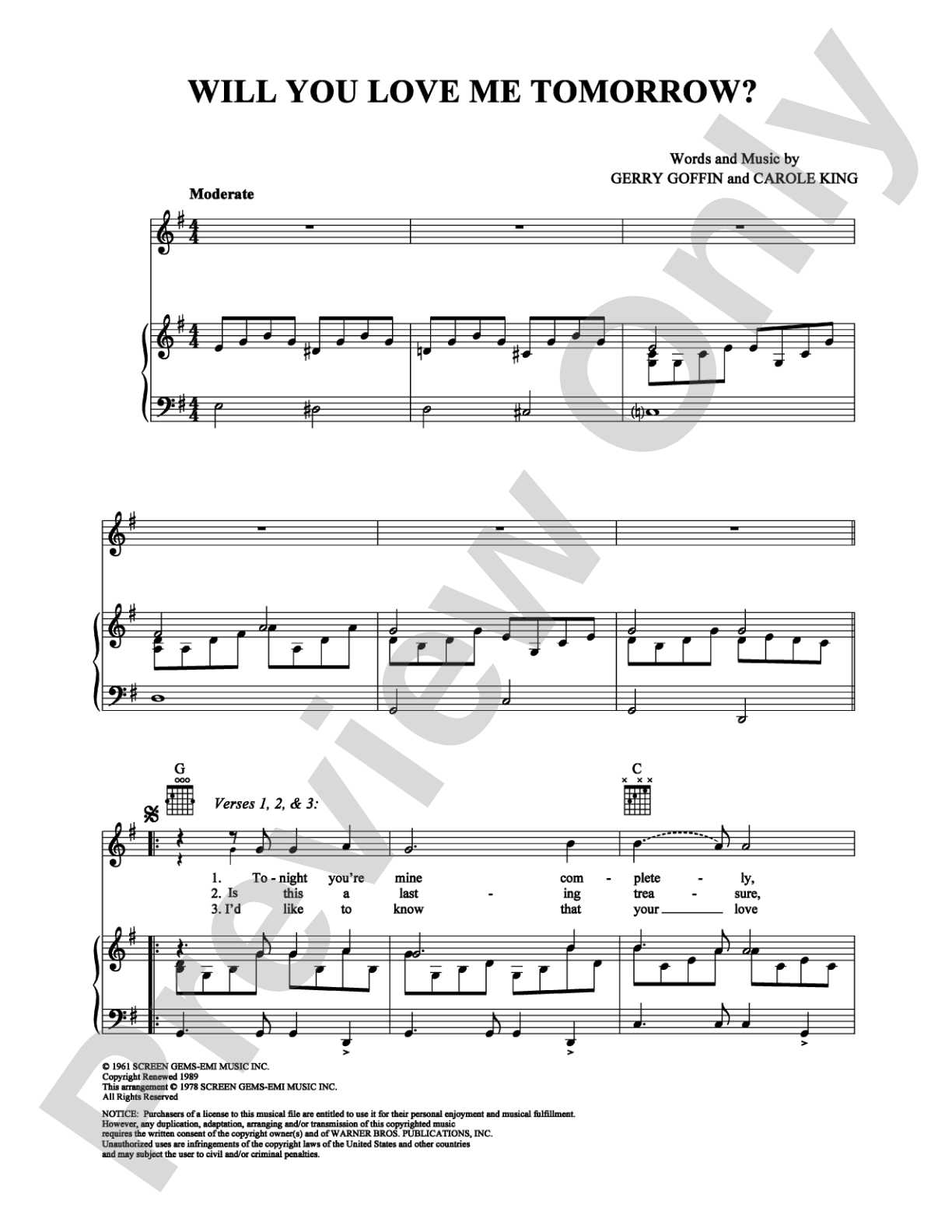
Will You Love Me Tomorrow?: Piano/Vocal/Chords Digital Sheet Music

Will You Love Me Tomorrow?: Piano/Vocal/Chords Digital Sheet Music

Carole King, The Shirelles, Gerry Goffin

Item: 00-PS-0009168

Digital Download
$2.95
Description

Will You Love Me Tomorrow?: Piano/Vocal/Chords Digital Sheet Music isn't in MakeMusic Cloud just yet...but it could be. Let us know you'd like to see it, and you'll help shape what comes next. In the meantime, start a free trial and dive into thousands of interactive titles your students can play along with today.

Sample Audio
No sample audio found.
Sample Video
Additional Details
SKU: 00-PS-0009168

More about this title

About the Artist: The Shirelles

The Shirelles emerged from Passaic, New Jersey in the late 1950s as one of the first all-female groups to achieve major chart success in rock and roll. Their tight harmonies, infectious energy, and genuine vocal chemistry made them pioneers of the girl group sound that would define much of 1960s pop music. The group's ability to balance sophistication with accessibility opened doors for countless female vocalists and ensembles in the decades that followed.

Beyond their commercial success, The Shirelles demonstrated the power of collaborative arranging and group interpretation. Their recordings showcase disciplined ensemble singing paired with contemporary production techniques, making them valuable models for understanding how vocal blend, dynamics, and timing create professional-quality performances. For music educators, their catalog offers accessible entry points into pop arranging and vocal harmony.

Why we love this

This enduring pop standard sits perfectly in the sweet spot between accessible and sophisticated. The song's straightforward harmonic movement and singable melody make it approachable for developing vocalists, while the lyrical vulnerability and classic arrangement invite genuine emotional expression.

What to expect

Tender and hopeful, with an undercurrent of nervous uncertainty. The melody floats conversationally over the piano part, creating an intimate setting that feels like an overheard conversation rather than a formal presentation. Despite its gentle surface, the song carries real emotional weight, asking questions about commitment and trust that still resonate today.

Who it's for

Vocalists comfortable with pop standards and pianists who enjoy accompanying singers will find this arrangement straightforward to learn and satisfying to perform. It works equally well for solo recitals, small ensemble showcases, or classroom demonstrations of pop vocal technique.

How to get the most out of it

  • Shape the vocal line with intentional phrasing rather than pushing through phrases mechanically. The lyrics deserve space to breathe, especially on questions like the title line.
  • Balance the piano accompaniment so it supports without overwhelming the vocalist. The chords provide harmonic color but shouldn't obscure the melody.
  • Pay attention to the rhythmic precision in the accompaniment pattern. Even small inconsistencies in timing will be noticeable in this relatively spare arrangement.
  • Explore the dynamics implied by the lyrical content. The opening verses benefit from a more conversational, intimate delivery before opening up emotionally in the chorus.

How to use it

Program this alongside other 1960s pop standards to explore vocal harmony and production during that era. It also pairs well with contemporary pop arrangements, allowing audiences to hear how the same song translates across different time periods and styles. The relative simplicity of the accompaniment makes it ideal for a vocalist featured in a mixed-repertoire recital or a classroom performance unit on pop music history.

Skills your students will build

  • Shaping vocal phrasing in conversational, lyric-driven contexts
  • Coordinating vocal and piano entries and releases
  • Interpreting harmonic changes to inform dynamic and emotional choices
  • Recognizing the structure and conventions of 1960s pop songwriting
  • Accompanying a singer with sensitivity and rhythmic precision

You May Also Like