Wild Blue Yonder: Oboe Sheet Music Preview

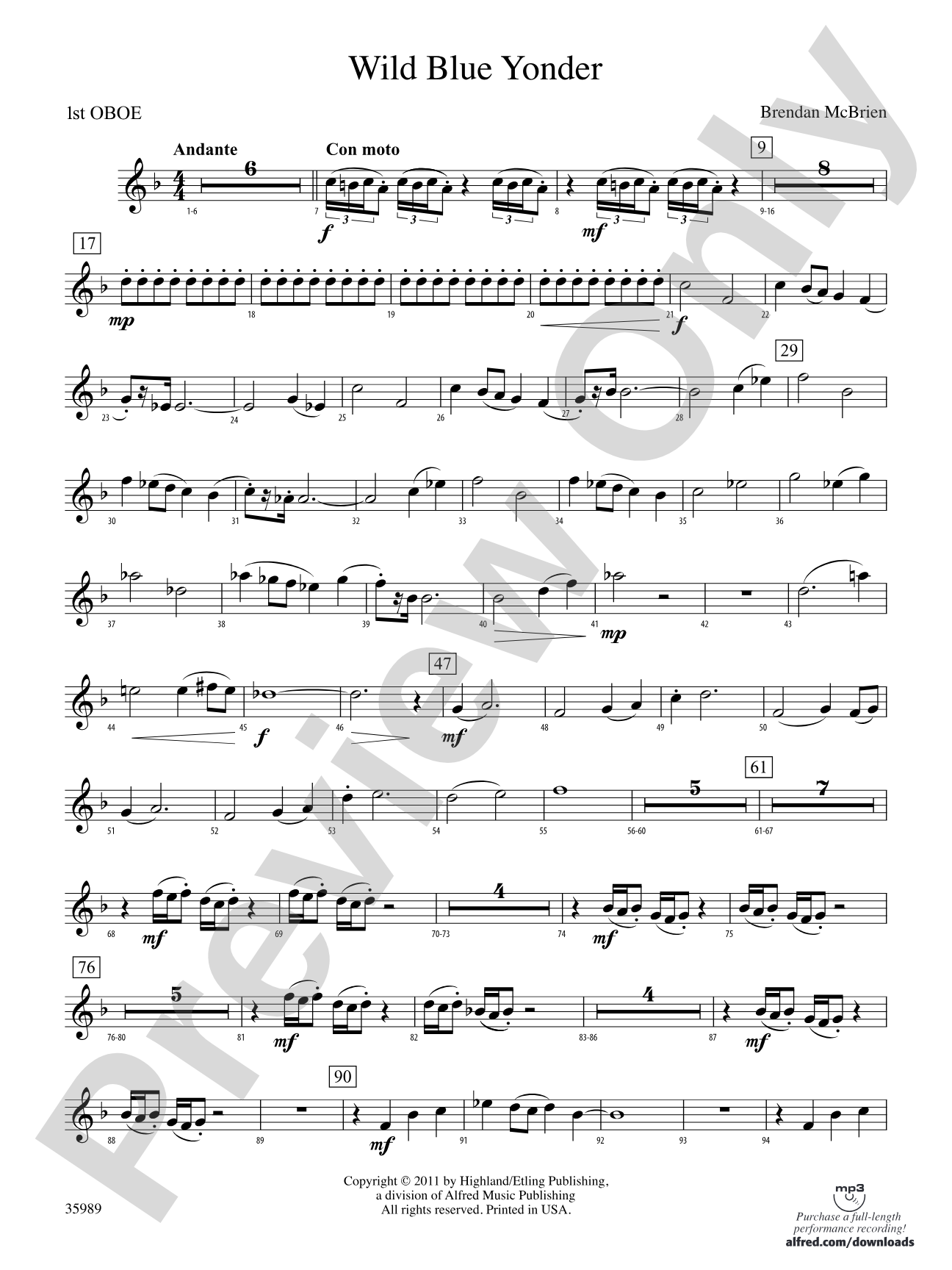
Wild Blue Yonder: Oboe

By Brendan McBrien

Grade: 3.5

Item: 00-PC-0015064_O1

Digital Download
$3.00
Description
From observation to experimentation---from kites to gliders---and from the Wright Flier to walking on the Moon, humans appear committed to leaving the ground! This work celebrates flight through sweeping themes and decorative accompaniments. Absolutely perfect for contest!

Don't just read it, hear it, play along with it, and watch your students grow with it. In MakeMusic Cloud, Wild Blue Yonder: Oboe comes alive with professional accompaniment, adjustable tempo, and built-in practice tools that turn solo practice into real progress.

Sample Audio
0:00
0:00
Sample Video
Additional Details
Series: Highland/Etling Full Orchestra
Publisher: Alfred Music
Page Count: 202
SKU: 00-PC-0015064_O1
Instrumentation: full (timp, suscym, bass, triangle)

More about this title

About the Composer: Brendan McBrien

Brendan McBrien

Brendan McBrien began his musical life on French horn in 4th grade in Sunnyvale, California, and went on to earn both bachelor's and master's degrees in composition and conducting from California State University, Long Beach. For three decades he worked as a professional French horn player throughout Southern California, performing with symphony orchestras and for film and television studios. His extensive catalog of band and orchestral works has been published by Alfred, Kendor, Kjos, and Wingert-Jones Music and is performed internationally.

McBrien has shaped music education as both a teacher and advocate. He directed bands and orchestras at Rancho San Joaquin Middle School in Irvine while also teaching music arranging at his alma mater. His contributions to the profession include four terms on the board of the Southern California School Band and Orchestra Association, numerous clinician presentations, and recognition as Middle School Teacher of the Year for Irvine Unified School District.

Why we love this

McBrien writes with clarity and emotional directness. The soaring melodic lines paired with inventive orchestration create genuine musical moments that student performers can feel, not just play through. Contest adjudicators respond to the craft here: the work demonstrates confident orchestration and thematic development without overcomplicating the parts for developing players.

What to expect

The piece soars with the spirit of human achievement and aspiration, moving from humble beginnings (observation, experimentation) toward triumph (flight, space exploration). Sweeping themes alternate with moments of decorative detail, creating a sense of forward momentum and wonder that captures the emotional arc of the Wright Flier to the Moon landing.

Who it's for

This work suits orchestras at the intermediate level (Grade 3.5) who are ready to handle full instrumentation and want contest-ready material with genuine musical substance. It appeals to conductors seeking patriotic repertoire that avoids cliché while remaining accessible to student musicians.

How to get the most out of it

  • Balance the sweeping themes so they sing above the decorative accompaniments. The supporting figures should enhance, not compete with, your main melodic line.
  • Establish steady ensemble pulse early in rehearsals. This piece rewards precise rhythmic coordination, especially where multiple sections carry the decorative figures.
  • Shape phrase endings with intention. Even subsidiary voices benefit from gentle tapering and dynamic shaping that emphasizes the overall arc of the piece.

How to use it

Program this as a centerpiece for a concert or contest set where you want to showcase your orchestra's ability to shape larger structures and balance ensemble texture. It pairs well alongside other patriotic works or as a standalone contest entry that demonstrates musicianship beyond technical facility.

Skills your students will build

  • Balancing melody against accompaniment figures in an ensemble setting
  • Sustaining long phrases with proper dynamic shaping and direction
  • Coordinating complex rhythmic textures across multiple instrumental sections
  • Reading and executing full orchestra scores with expanded instrumentation (timpani, suspended cymbal, bass drum, triangle)

You May Also Like