Wie Melodien Sheet Music Preview

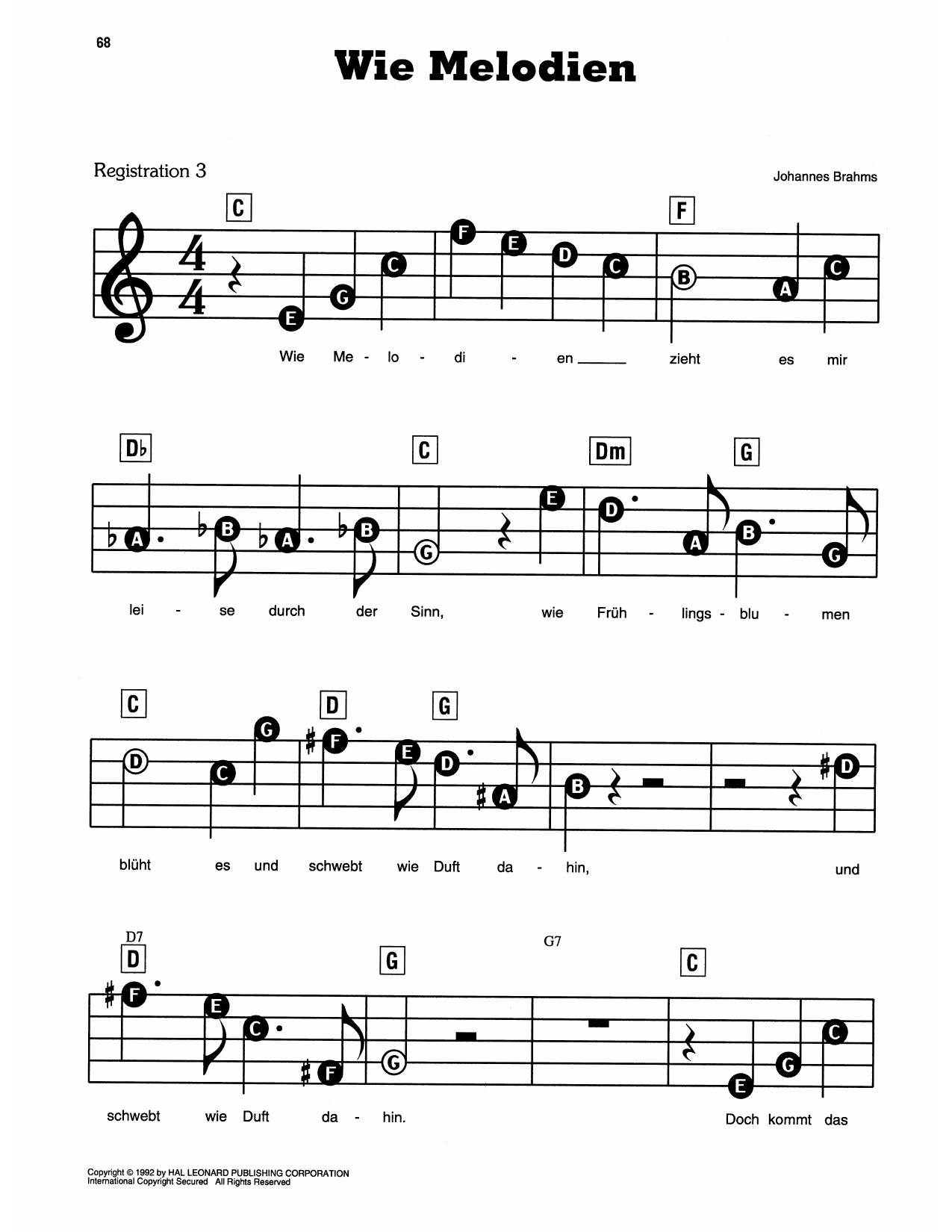
Wie Melodien: E-Z Play Today

By Johannes Brahms

Item: 35-DS01874727

Digital Download
$4.99
Description

Wie Melodien: E-Z Play Today isn't in MakeMusic Cloud just yet...but it could be. Let us know you'd like to see it, and you'll help shape what comes next. In the meantime, start a free trial and dive into thousands of interactive titles your students can play along with today.

Sample Audio
No sample audio found.
Sample Video
Additional Details
Publisher: Hal Leonard
Page Count: 3
SKU: 35-DS01874727

More about this title

About the Composer: Johannes Brahms

Johannes Brahms (1833–1897) stands as one of the Romantic era's most consequential composers, bridging the Classical tradition and the expressive possibilities of his own time. His mastery of form, orchestration, and harmonic language made him a transformative figure in music history, and his works remain cornerstones of the concert repertoire and essential study for musicians across all levels.

Why we love this

The E-Z Play Today arrangement makes one of Brahms' most lyrical vocal works accessible to pianists without the original's harmonic demands or interpretive complexity. Students encounter genuine Brahms material here, not a simplified facsimile; the legit melody and basic chord structure let players focus on phrasing and voice leading rather than wrestling with notation.

What to expect

Intimate and unhurried, the piece unfolds with the warmth of a confessional moment. The melody sits in a comfortable register, supported by straightforward harmonies that allow the emotional weight of Brahms' writing to emerge without distraction.

Who it's for

This suits intermediate students looking to expand their classical repertoire with repertoire that sounds elegant without requiring years of technical mastery. Teachers seeking a manageable Brahms entry point will find this a solid choice for students ready to work with genuine art song material.

How to get the most out of it

  • Shape the melody through subtle dynamic swells rather than obvious crescendos; Brahms' lyricism lives in restraint.
  • Let the accompaniment breathe by pulling back fractionally on eighth-note figures, allowing the top line to sing forward naturally.
  • Build into phrase endings gradually instead of arriving abruptly; think of the phrasing as a gentle arch, not a pointed gesture.

How to use it

Pair this with other Romantic-era art song transcriptions to build a short recital devoted to the nineteenth-century lied tradition. The three-page length makes it an ideal teaching piece for spring studio recitals or a gentle introduction to Brahms for younger intermediate students.

Skills your students will build

  • Sustaining long-lined melodic phrases without structural support
  • Balancing melody and accompaniment within a two-hand texture
  • Interpreting Classical and Romantic harmonic language at the keyboard
  • Developing sensitivity to rubato and expressive timing

You May Also Like