Wicked (Choral Highlights) (arr. Mark Brymer) Sheet Music Preview

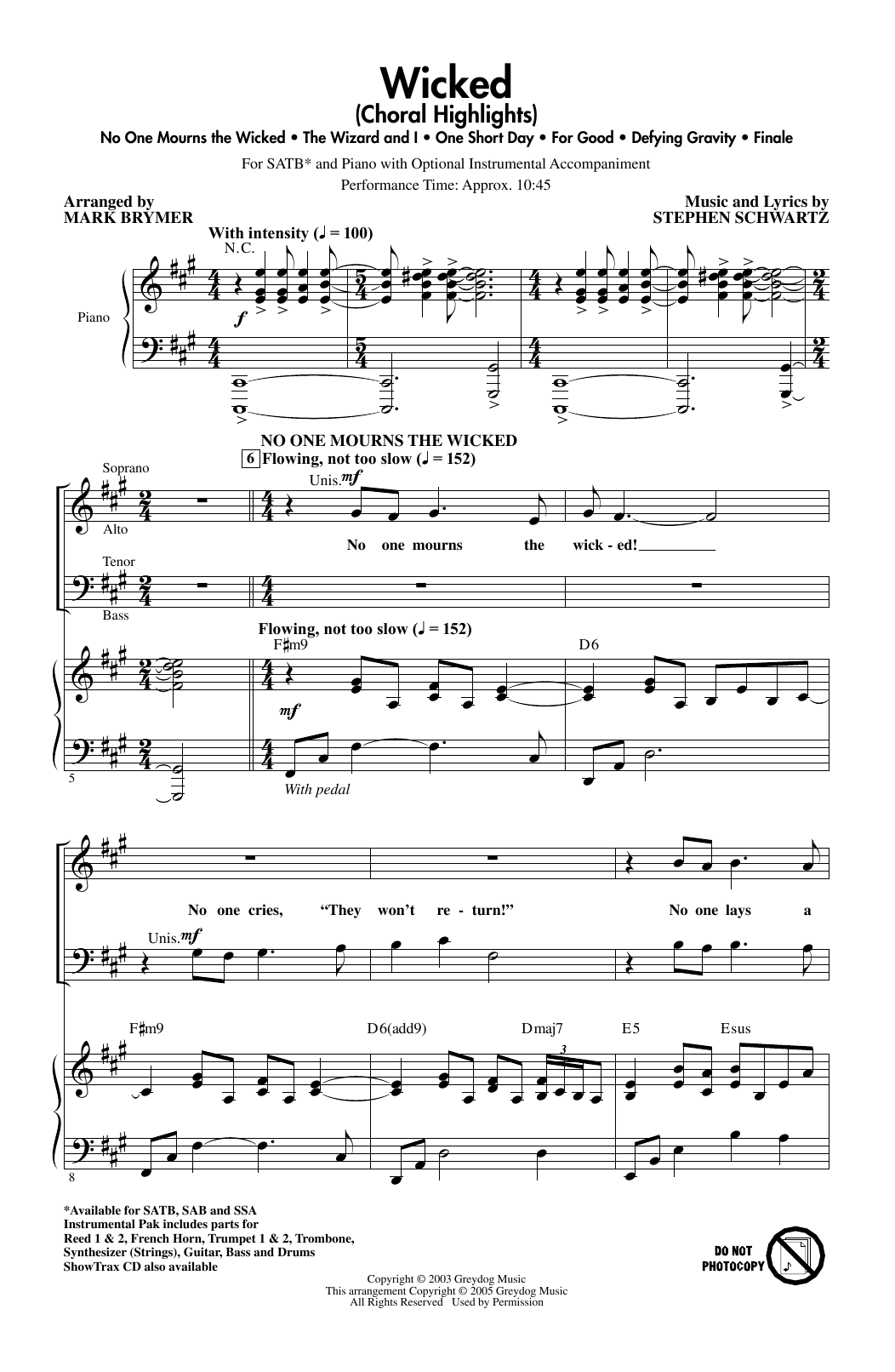
Wicked (Choral Highlights) (arr. Mark Brymer): SATB Choral Octavo

By Stephen Schwartz / Arranged by Mark Brymer

Item: 35-DS01554875

Digital Download
$4.35
Description

Wicked (Choral Highlights) (arr. Mark Brymer): SATB Choral Octavo isn't in MakeMusic Cloud just yet...but it could be. Let us know you'd like to see it, and you'll help shape what comes next. In the meantime, start a free trial and dive into thousands of interactive titles your students can play along with today.

Sample Audio
No sample audio found.
Sample Video
Additional Details
Publisher: Hal Leonard
Page Count: 38
SKU: 35-DS01554875

More about this title

About the Composer: Stephen Schwartz

Stephen Schwartz has shaped musical theater for nearly five decades, beginning with Godspell and Pippin in the 1970s before writing some of Broadway's most enduring scores. His work for Disney's animated films, particularly Pocahontas and Tangled, introduced his sophisticated harmonic language and character-driven songwriting to generations of students. Schwartz understands how to write for ensemble voices with clarity and emotional specificity, making his music accessible without sacrificing artistic depth.

In the classroom and on stage, his scores reward careful attention to lyrical content and musical understatement. Teachers value Schwartz's ability to create moments of genuine theatrical stakes while keeping the technical demands within reach of developing singers.

Why we love this

Mark Brymer's arrangement captures the theatrical scope of Wicked while respecting what SATB choirs can actually accomplish. Rather than oversimplifying, he preserves the songs' harmonic sophistication and arranges individual moments so each voice part feels purposeful. A 38-page selection lets you build a concert around these songs without committing to a full musical production.

What to expect

Wicked captures the defiant joy and heartbreak of the musical in miniature. The arrangements shift between introspective character moments and soaring ensemble passages, creating a performance that feels like stepping into the story rather than simply singing a medley. There's theatrical generosity throughout, moments that invite singers to commit fully to the emotion while trusting Brymer's smart writing to support them.

Who it's for

Intermediate to advanced high school choirs and community choirs looking for contemporary Broadway material with theatrical appeal and musical substance. Directors programming concert seasons that include musical theater will find these arrangements sophisticated enough to satisfy discerning audiences while remaining within reach of choirs with solid fundamentals.

How to get the most out of it

  • Pay attention to the lyrics and their dramatic arc. These songs tell a story across the medley, and singers who understand character motivation (especially Elphaba's) will find the emotional truthfulness the music requires.
  • Balance the alto line in 'Defying Gravity' carefully. It often sits below the sopranos and tenors, but it's harmonically essential and should never disappear.
  • Shape 'For Good' with restraint. The arrangement's power comes from clarity and ensemble blend rather than volume or excessive vibrato.
  • Lock in the rhythmic precision during 'The Wizard and I.' Schwartz's theater-song rhythms look simple but require exact counting and clear articulation to avoid dragging.

How to use it

Build a entire concert segment around Wicked without staging the full show, pairing it with other contemporary Broadway selections or using it as the centerpiece of a spring concert. Alternatively, extract individual songs for holiday programs or assembly performances where you need contemporary material with recognition factor and emotional depth. These arrangements also work well as a capstone project late in the year when choirs have developed the interpretive maturity Schwartz's music demands.

Skills your students will build

  • Dynamic control and ensemble balance across extended passage work
  • Lyrical interpretation and character understanding in dramatic singing
  • Harmonic awareness and voice independence within complex chord structures
  • Rhythmic precision in theater-song idioms with syncopation and irregular phrase lengths
  • Reading and sustaining musical lines through key changes and modulations

You May Also Like