
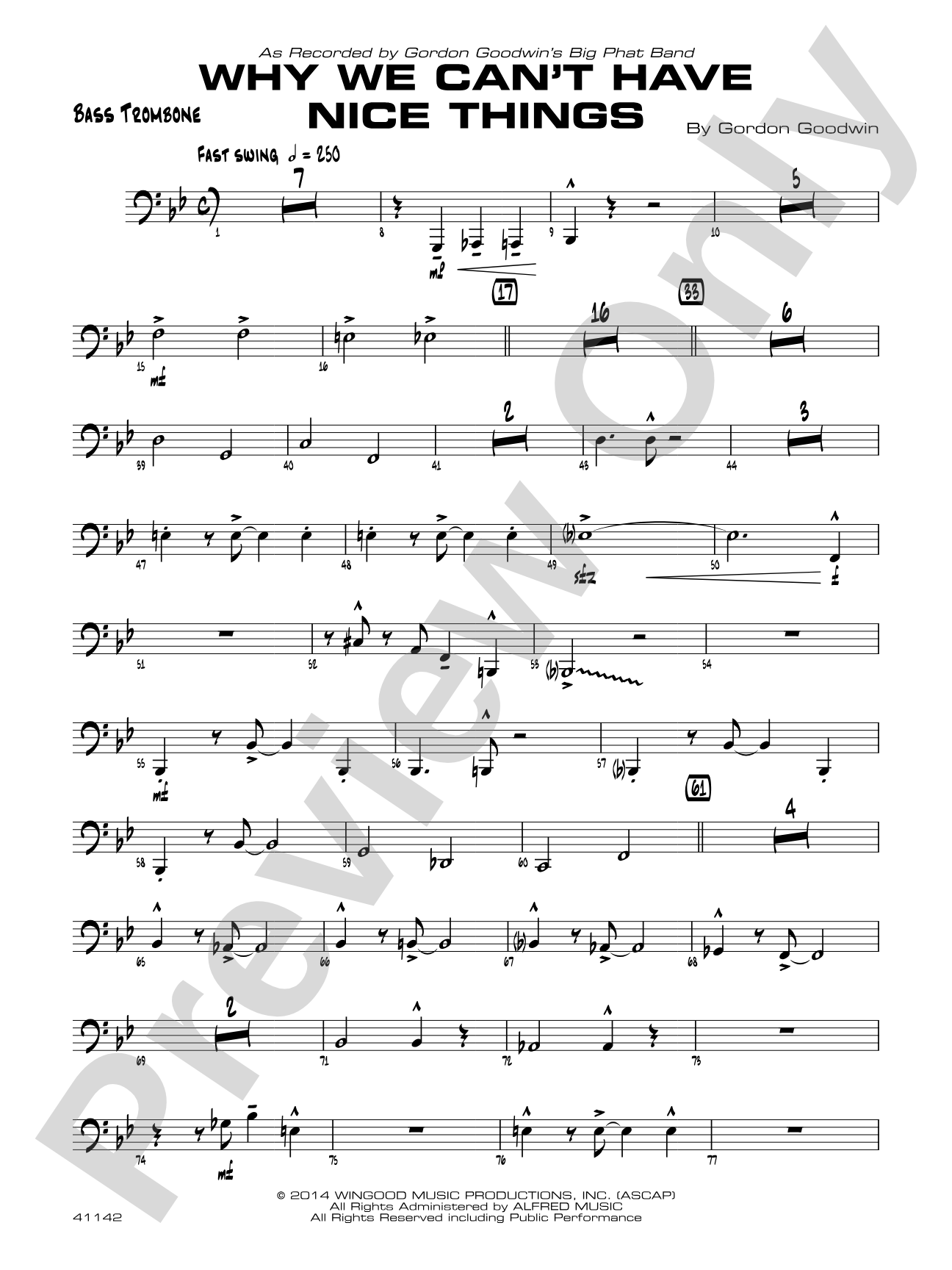

Why We Can't Have Nice Things: 4th Trombone
By Gordon Goodwin
Grade: 6 (Professional / Very Advanced)
Item: 00-PC-0016278_TN4
$3.00
Pickup currently not available
Description
As recorded by the Big Phat Band, you've got your basic flag-waving, barn-burning, straight-ahead swing chart here---and believe it or not, it's not all that hard to play! Sure, it's a challenge, but it's doable with a strong band. Solo space included for all saxes, trumpet 3, and trombone 1. Can you handle it? (2:06) This title is available in MakeMusic Cloud.


Don't just read it, hear it, play along with it, and watch your students grow with it. In MakeMusic Cloud, Why We Can't Have Nice Things: 4th Trombone comes alive with professional accompaniment, adjustable tempo, and built-in practice tools that turn solo practice into real progress.
Open in the Player
Jump straight in and assign it today.
Start Your Free Trial
Open this title and explore the full library in minutes.
Sample Audio
1
Audio File
--:--
0:00
0:00
Sample Video
No sample videos found.
Additional Details
Series:
Gordon Goodwin Series
Publisher:
Alfred Music
Page Count:
126
SKU:
00-PC-0016278_TN4
More about this title
About the Composer: Gordon Goodwin

Gordon Goodwin began composing full arrangements in his head at age five, a gift that led him to write his first big band chart, Hang Loose, at just thirteen years old. His early mastery caught the attention of film and television producers, earning him three Emmy Awards and multiple Grammy nominations for his work on major motion pictures including Bad Boys II, Con Air, and Remember the Titans. He has also written for and performed alongside some of jazz and popular music's most celebrated artists, from Quincy Jones to Christina Aguilera.
In 2000, Goodwin founded Gordon Goodwin's Big Phat Band, which has become one of Los Angeles' premier big band ensembles. The band's debut album, Swingin' for the Fences, made history as the first commercially available DVD audio release and garnered two Grammy nominations. His subsequent recordings, including the triple-nominated XXL, have solidified his reputation as one of today's most prolific and accomplished big band composers and arrangers.
Why we love this
Goodwin delivers a straight-ahead swing chart that sounds infinitely more complex than it actually plays. The writing sits well under the fingers and in the ranges of your section players, and the infectious energy of the Big Phat Band recording means your students will want to nail every phrase. Solo space for multiple voices (all saxes, trumpet 3, and trombone 1) gives your best improvisers real estate to shine without overwhelming the arrangement.
What to expect
Straight-ahead swinging energy with a contemporary big band voice. The tune bounces along with infectious groove, punctuated by moments of tighter ensemble writing that showcase the band's precision without sacrificing the relaxed, propulsive feel that makes jazz brass writing so satisfying to perform.
Who it's for
This chart works best for strong Grade 6 jazz ensembles with solid fundamentals and at least one improviser per solo chair who can confidently navigate swing phrasing. Directors programming a festival or contest set will find a crowd-pleaser that sounds polished without requiring months of rehearsal time to achieve professional results.
How to get the most out of it
- Establish the swing feel early in sectionals by locking the ride cymbal and hi-hat groove with the bass and piano before the full band enters; this foundation will anchor every section.
- Balance the sax section blend during the tight horn lines in the A section, especially when the lead and altos lock into unison figures with the trumpets.
- Let the solo passages breathe; resist over-conducting these moments and trust your players to tell their own story while the rhythm section provides support.
- Pay attention to the ensemble attacks and cutoffs, particularly on the flag-waving figures that define the style. Crispness here sells the barn-burning character.
How to use it
Program this as a festival or contest centerpiece; the 2:06 timing fits standard competition formats perfectly, and the soloists provide variety for judges while keeping the overall arc energetic and memorable. Alternatively, feature it on a spring concert alongside other Gordon Goodwin arrangements to highlight your band's advanced repertoire.
Skills your students will build
- Articulation and phrasing in swing contexts (legit vs. syncopated passages)
- Small group balancing within a large ensemble (section blend and solo support)
- Jazz improvisation over blues and swing changes
- Tight ensemble unison figures at faster tempos
- Reading jazz notation conventions (hit markings, rhythm feel cues, dynamics in the context of swing style)