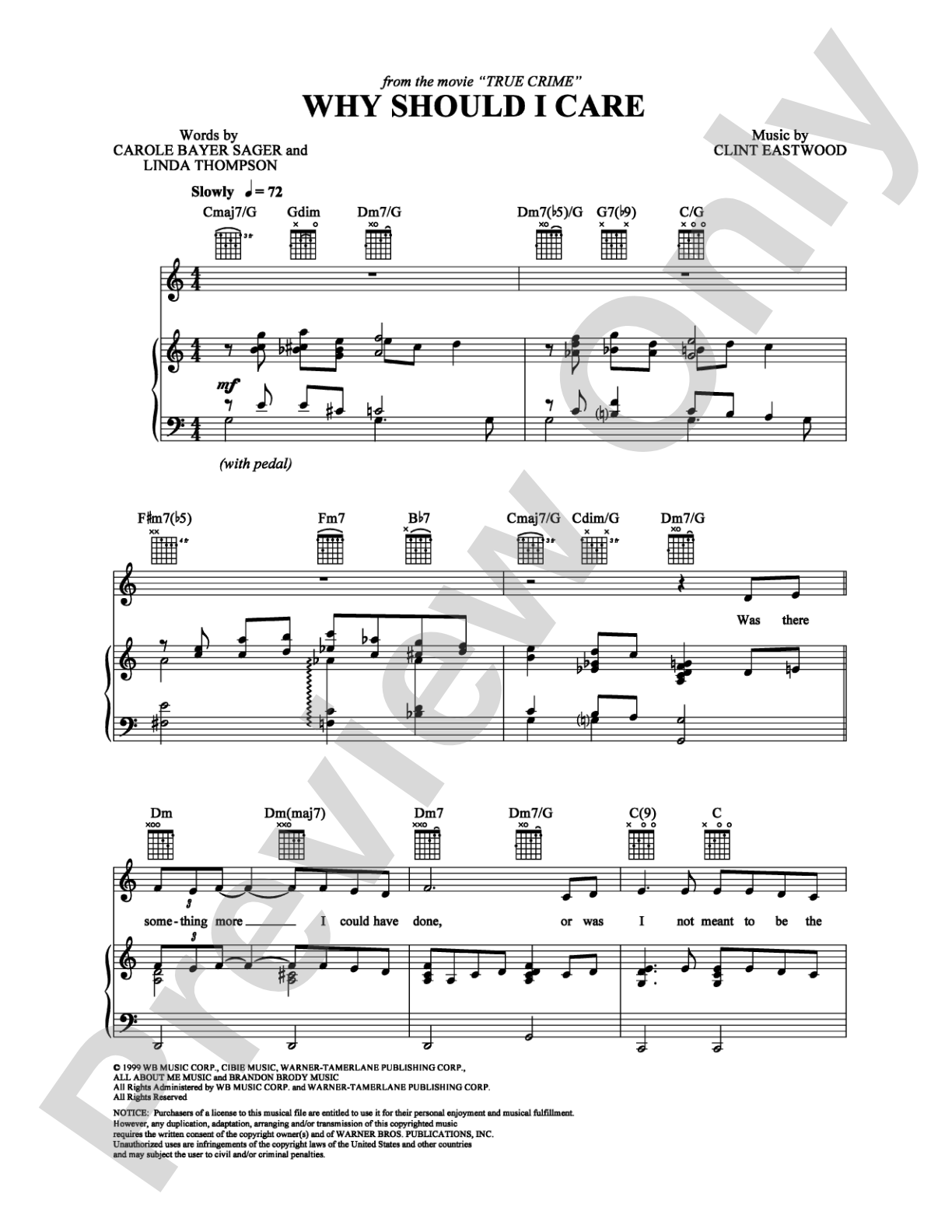
Why Should I Care: Piano/Vocal/Chords Digital Sheet Music

Why Should I Care: Piano/Vocal/Chords Digital Sheet Music

Clint Eastwood, Diana Krall

Item: 00-PS-0004903

Digital Download
$3.99
Description

Why Should I Care: Piano/Vocal/Chords Digital Sheet Music isn't in MakeMusic Cloud just yet...but it could be. Let us know you'd like to see it, and you'll help shape what comes next. In the meantime, start a free trial and dive into thousands of interactive titles your students can play along with today.

Sample Audio
No sample audio found.
Sample Video
Additional Details
SKU: 00-PS-0004903

More about this title

About the Artist: Diana Krall

Diana Krall is a Canadian jazz pianist and vocalist born in 1973 who has become one of the best-selling jazz artists of her generation. Her interpretations blend sophisticated harmonies with intimate vocal delivery, drawing from the Great American Songbook and contemporary compositions. Krall's work demonstrates how classical piano training combined with deep jazz knowledge creates compelling arrangements that appeal to both serious musicians and general listeners.

Why we love this

Krall's arrangements reveal the craft behind her sophisticated sound. This piece gives pianists and singers access to her harmonic sensibility and the kind of tasteful comping that makes jazz singing feel conversational rather than formal.

What to expect

Intimate and reflective, with understated elegance. The arrangement invites you into a quiet conversation rather than demanding attention, with the kind of harmonic depth that rewards listening closely to every chord change.

Who it's for

Jazz pianists who want to expand their repertoire with contemporary standards, vocalists studying how to interpret a song with harmonic sophistication, and pianists accompanying singers in jazz contexts or recitals.

How to get the most out of it

  • Study the voicings carefully before adding interpretation; Krall's chord choices drive the emotional arc, so clarity in the reharmonization matters before you add swing feel or rubato
  • Balance the vocal line against the piano texture by thinking of the accompaniment as conversation rather than backup; leave space for the lyric to breathe
  • Listen to Krall's recorded version to absorb the rhythmic placement and phrasing, especially how she sits behind and ahead of the beat in different sections

How to use it

Feature this in a jazz recital or cabaret setting where the focus is on song interpretation and chamber-like piano and vocal balance. It also works well as a teaching piece for pianists learning to comp for singers at an intermediate-advanced level.

Skills your students will build

  • Reading and interpreting jazz chord symbols and lead sheet notation
  • Piano voicings and reharmonization techniques common in contemporary jazz
  • Accompanying a vocalist with flexibility and musical responsiveness
  • Phrasing and rhythmic placement specific to conversational jazz interpretation

You May Also Like