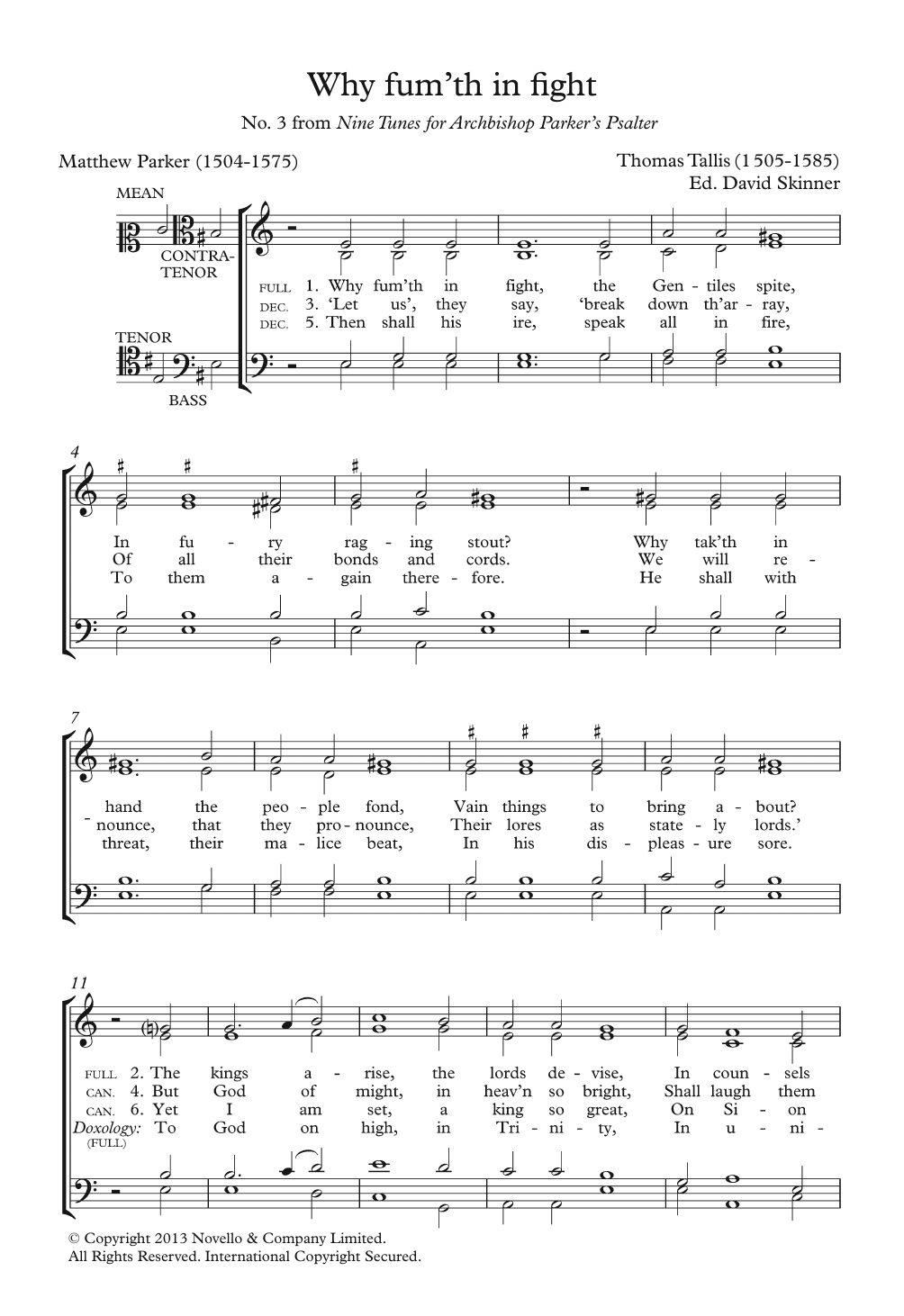
Why Fum'th In Fight (From Nine Tunes For Archbishop Parker's Psalter) Sheet Music Preview

Why Fum'th In Fight (From Nine Tunes For Archbishop Parker's Psalter): Choral Octavo

As performed by Thomas Tallis / Edited by David Skinner

Item: 35-DS00333776

Digital Download
$2.99
Description

Why Fum'th In Fight (From Nine Tunes For Archbishop Parker's Psalter): Choral Octavo isn't in MakeMusic Cloud just yet...but it could be. Let us know you'd like to see it, and you'll help shape what comes next. In the meantime, start a free trial and dive into thousands of interactive titles your students can play along with today.

Sample Audio
No sample audio found.
Sample Video
Additional Details
Publisher: Hal Leonard
Page Count: 2
SKU: 35-DS00333776

More about this title

About the Artist: Thomas Tallis

Thomas Tallis (c. 1505–1585) shaped English sacred music across one of the most turbulent centuries in the nation's religious history. He served as a gentleman of the Chapel Royal under Henry VIII, Edward VI, Mary I, and Elizabeth I, composing across Catholic and Protestant liturgical traditions without losing his distinctive voice. His ability to write idiomatically for English voices while maintaining continental sophistication made him indispensable to the development of Anglican choral music.

Tallis composed over 40 motets, around 30 Latin masses, and numerous English anthems and psalm settings. His technical mastery of counterpoint and his gift for expressive text painting influenced generations of English composers. Works like the 40-part motet "Spem in Deum" demonstrate his command of complex polyphonic writing, yet his smaller works show equal care in crafting singable, emotionally direct music.

Why we love this

Tallis's setting of this Parker Psalter tune captures the essence of English Renaissance choral writing: melodic clarity, restrained harmony, and text that sits naturally on the voice. The piece works as both a learning tool for period style and a genuine musical reward, never feeling like a textbook example. Programming it alongside later Anglican settings shows students how English composers built on this foundation.

What to expect

There's a quiet dignity to this setting, built from modal inflections and the careful architecture of four independent lines. The music unfolds with the patient clarity of a prayer spoken aloud, where each voice contributes to a whole greater than the sum of its parts. It feels both intimate and timeless.

Who it's for

Choirs with solid fundamentals in part-singing and a grasp of Renaissance polyphonic texture will find this accessible and rewarding. It suits high school advanced choirs, college choirs exploring historical repertoire, and community choirs seeking a bridge between modern and early music styles. The two-page length makes it ideal for directors building a concert set around English choral traditions.

How to get the most out of it

  • Balance the texture by ensuring inner voices aren't buried; Tallis's counterpoint only works when all four parts sing through with equal presence.
  • Observe the text underlay carefully, especially at phrase endings where word repetition often creates rhythmic variety; avoid rushing or flattening these moments.
  • Approach the harmonic language as speech rather than chords; let vertical sonorities emerge from the independent voice lines rather than doubling or homogenizing.
  • Shape the melodic line in the highest voice with forward motion, but allow the supporting voices to breathe at their own natural phrase points.

How to use it

Pair this with other Parker Psalter settings or Renaissance motets to create a concert section exploring English sacred music's evolution. It also fits naturally in a themed program about psalm settings across centuries, or as an opening piece that establishes early music context before moving into later repertoire. The modest length lets you build a full program without overwhelming rehearsal time.

Skills your students will build

  • Reading and singing authentic Renaissance part-writing
  • Balancing independent melodic lines while maintaining harmonic awareness
  • Shaping phrases in a non-metered or lightly metered style
  • Understanding modal harmony and how it differs from functional tonality
  • Accurate text declamation within polyphonic texture

You May Also Like