
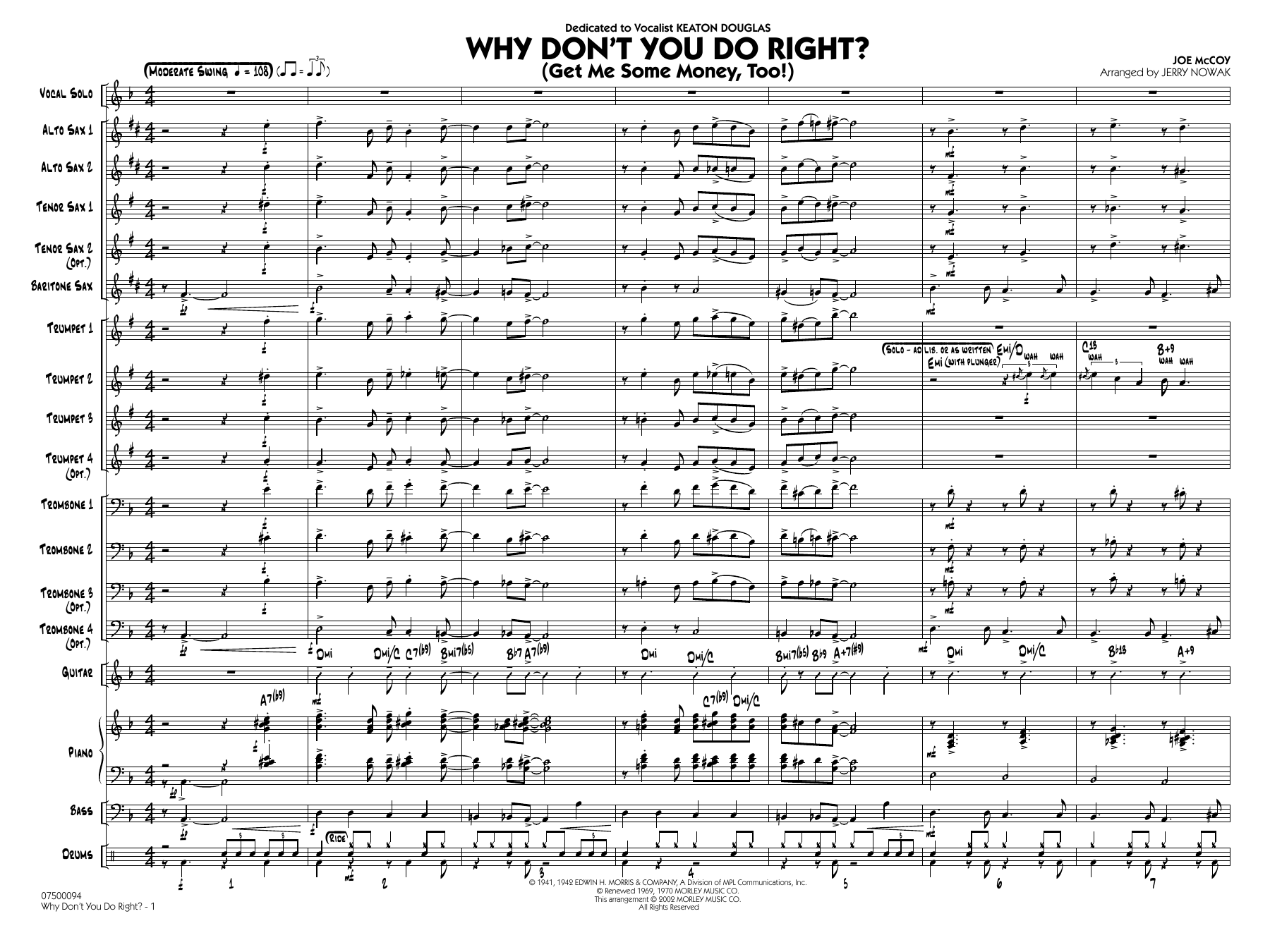

Why Don't You Do Right (arr. Jerry Nowak): Jazz Ensemble Conductor Score & Parts
As performed by Peggy Lee / Arranged by Jerry Nowak
Item: 35-PK01652099
$55.00
Pickup currently not available
Buy Extra Parts (Digital PDF Download)
Parts Added to Cart!
Description
One of Peggy Lee's first recorded hits with the Benny Goodman Orchestra was this bluesy swing tune. The vocal part is not that difficult and Jerry's accompaniment works great.


Why Don't You Do Right (arr. Jerry Nowak): Jazz Ensemble Conductor Score & Parts isn't in MakeMusic Cloud just yet...but it could be. Let us know you'd like to see it, and you'll help shape what comes next. In the meantime, start a free trial and dive into thousands of interactive titles your students can play along with today.
Request This Title
Tell us you want it.
Start Your Free Trial
Explore everything that's ready to play right now.
Sample Audio
No sample audio found.
Sample Video
No sample videos found.
Additional Details
Publisher:
Hal Leonard
SKU:
35-PK01652099
More about this title
About the Artist: Peggy Lee
Peggy Lee emerged as one of the most sophisticated jazz vocalists of the mid-20th century, bringing intelligence and emotional depth to every standard she touched. Her 1942 recording of "Why Don't You Do Right" with the Benny Goodman Orchestra became a signature vehicle for her sultry delivery and impeccable phrasing, establishing her as a force in both jazz and popular music.
Why we love this
Jerry Nowak's arrangement captures the swagger of the original recording without overwhelming a student vocalist. The rhythm section writing is idiomatic and playable; it breathes like real swing rather than sounding like someone transcribed a record and handed it to an ensemble.
What to expect
Smoky and knowing. There's a playful edge to the lyrics, delivered over a steady swing groove that feels both relaxed and sharp. The arrangement honors the original's sophistication while remaining accessible to student musicians.
Who it's for
Jazz ensembles with a vocalist who can handle bluesy phrasing and intonation. Works equally well for groups looking to add a classic swing number to their repertoire or as a teaching tool for understanding how to accompany a lead voice with restraint and style.
How to get the most out of it
- Balance the vocal line so it sits inside the ensemble texture rather than on top of it. This tune thrives when the band and singer move as one rhythmic unit.
- Have your rhythm section lock into a relaxed swing feel before adding the horns. The groove should feel inevitable, not pushed.
- Keep the blues vocabulary genuine. The band members should understand they're accompanying a jazz singer, not backing up a pop soloist; dynamics and phrasing adjust accordingly.
How to use it
This fits naturally into a jazz concert program alongside other swing-era standards, or as a bridge number between a purely instrumental set and vocalist-featuring pieces. It's also valuable in a classroom setting as a model for how good arranging serves the source material rather than overshadowing it.
Skills your students will build
- Swing feel and articulation (quarter-note pulse against eighth-note groove)
- Comping and accompaniment dynamics (supporting a melodic line without dominating)
- Blues vocabulary and harmonic language
- Call-and-response phrasing between sections
- Reading jazz chord changes and improvisation framework (if ensemble chooses to extend the tune)