Why Don't You Believe Me Sheet Music Preview

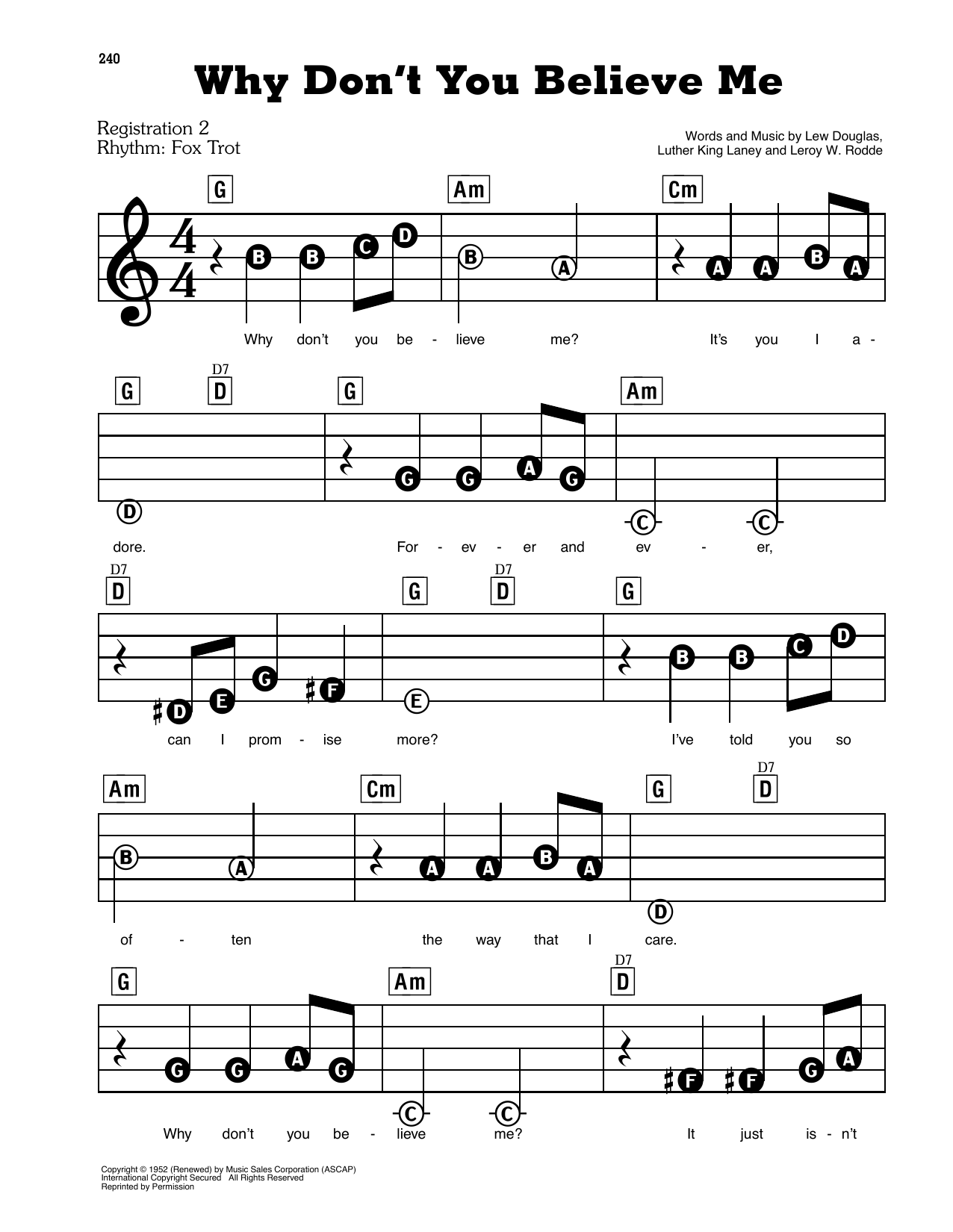
Why Don't You Believe Me: E-Z Play Today

As performed by Patti Page

Item: 35-DS00454185

Digital Download
$4.99
Description

Why Don't You Believe Me: E-Z Play Today isn't in MakeMusic Cloud just yet...but it could be. Let us know you'd like to see it, and you'll help shape what comes next. In the meantime, start a free trial and dive into thousands of interactive titles your students can play along with today.

Sample Audio
No sample audio found.
Sample Video
Additional Details
Publisher: Hal Leonard
Page Count: 2
SKU: 35-DS00454185

More about this title

About the Artist: Patti Page

Patti Page was one of the defining voices of 1950s pop music, known for her multi-tracked vocal recordings and her ability to bridge pop sensibility with jazz sophistication. Her recordings sold millions of copies and established her as a mainstream entertainer while maintaining genuine musicality and emotional depth in every performance.

Why we love this

This standard sits in that sweet spot where popular song writing meets genuine vocal artistry. The melody is singable but not simplistic, and it gives pianists room to shape the accompaniment in ways that reflect both the song's 1950s roots and contemporary interpretations.

What to expect

Warm and conversational, with the kind of earnest emotional directness that characterized 1950s pop at its best. The melody has a gentle arc that invites legit singing while the harmonic language keeps things accessible without feeling naive.

Who it's for

Pianists and vocalists looking to add a mid-century standard to their repertoire, whether for recital, teaching demonstration, or performance study. This works well for students exploring the songbook tradition and understanding how great melodies function across different arrangements.

How to get the most out of it

  • Pay attention to the phrasing in the vocal line; this song rewards singers who breathe naturally rather than mechanically following phrase marks.
  • Keep the piano accompaniment conversational rather than thick. The song benefits from space between the voice and the harmonic support.
  • Explore the dynamic curve across the entire form to avoid a static middle section; small dynamic shifts can refresh each repeated section without losing intimacy.

How to use it

Pair this with other mid-century standards in a recital exploring the American songbook, or use it as a teaching piece to show students how effective simplicity can be. It also works in mixed programs where you're bridging classical tradition and popular song.

Skills your students will build

  • Phrasing within a simple, singable melody
  • Building musical shape across a two-page form
  • Accompanying vocalists with restraint and sensitivity
  • Understanding the harmonic language of 1950s popular song

You May Also Like