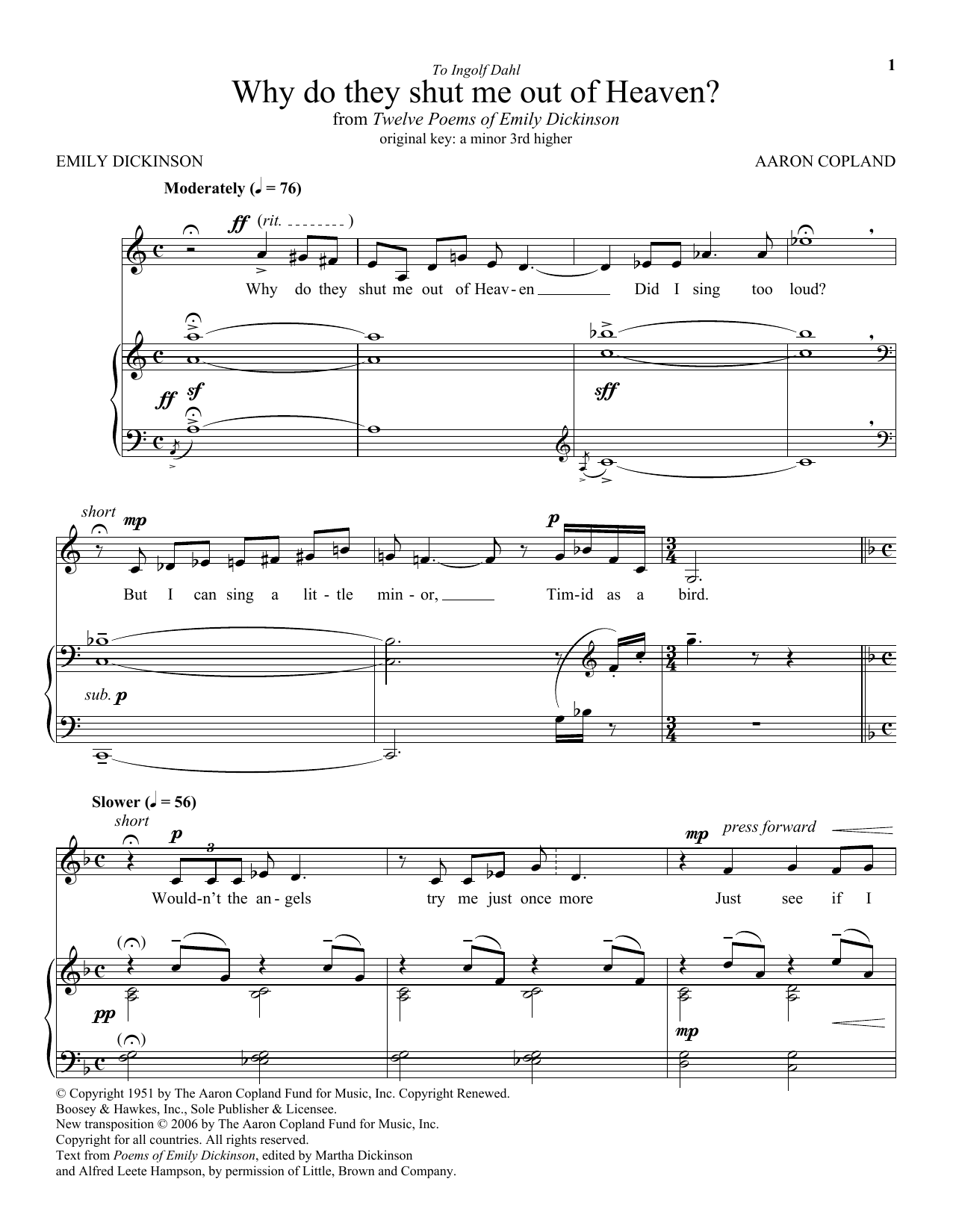
Why Do They Shut Me Out Of Heaven? Sheet Music Preview

Why Do They Shut Me Out Of Heaven?: Piano Vocal

As performed by Aaron Copland

Item: 35-DS00465365

Digital Download
$5.99

One moment…

One moment…

Description

Why Do They Shut Me Out Of Heaven?: Piano Vocal isn't in MakeMusic Cloud just yet...but it could be. Let us know you'd like to see it, and you'll help shape what comes next. In the meantime, start a free trial and dive into thousands of interactive titles your students can play along with today.

Sample Audio
No sample audio found.
Sample Video
Additional Details
Publisher: Hal Leonard
Page Count: 3
SKU: 35-DS00465365

More about this title

About the Artist: Aaron Copland

Aaron Copland (1900-1990) shaped American classical music by drawing directly from the country's musical vernacular. His gift lay in recognizing the expressive power of folk melodies, hymn tunes, and popular songs, then elevating them through sophisticated harmonic and orchestral treatment. Beyond his large-scale works, Copland wrote intimate vocal music that reveals his lyrical sensibility and his belief that serious composition could speak to ordinary listeners.

Copland's approach to song writing emphasizes clarity and emotional directness. His vocal works demand singers who understand how to sit comfortably in a melody without oversinging it, and pianists capable of creating rich harmonic contexts without overwhelming the voice. In the classroom and studio, his songs teach restraint, authenticity, and the power of simplicity.

Why we love this

Copland's setting of this Emily Dickinson poem combines a deceptively simple vocal line with piano writing that does most of the emotional heavy lifting. The accompaniment moves through chromatic shifts and unexpected harmonic turns that suggest the poem's spiritual questioning, while the voice remains tethered to a singable, almost folk-like melody. It's the kind of piece that rewards repeated listening and reveals new layers each time.

What to expect

There's a quality of loneliness here that never tips into sentimentality. Copland's harmonic language creates small moments of harmonic surprise that suggest spiritual doubt and searching. The piece sits in an intimate space between questioning and acceptance, with the piano's shifting colors mirroring an inner dialogue that the voice articulates.

Who it's for

This work suits low voice singers seeking repertoire that combines Copland's distinctly American voice with literary depth. Intermediate to advanced pianists will find the accompaniment rewarding, though the technical demands remain accessible. It serves well in art song recitals, classroom song study, or vocal competitions where authenticity and emotional clarity matter.

How to get the most out of it

  • Let the piano establish the harmonic landscape before entering vocally. The accompaniment isn't simply supporting the voice; it's creating the emotional framework the words inhabit.
  • Resist the urge to impose dramatic gestures on the lyric. Copland's setting benefits from singers who find intimacy through restraint rather than volume.
  • Pay attention to the arch of each phrase. The melody appears simple, but subtle shape and breath placement will determine whether it feels conversational or artificial.
  • Coordinate with the pianist on tempo stability. The harmonic motion sometimes obscures the pulse; locking the rhythm together prevents the piece from drifting.

How to use it

Pair this with other American art songs to build a recital set that explores how twentieth-century composers engaged with American poetry and identity. It also works beautifully in a vocal techniques class to study how composers approach setting philosophical or abstract texts. The modest page count makes it ideal for programming alongside a larger work.

Skills your students will build

  • Singing with emotional subtlety over complex harmonic movement
  • Interpreting text with musical restraint rather than dramatic exaggeration
  • Coordinating vocal and piano timing in passages where harmonic rhythm obscures the beat
  • Understanding how Copland's harmonic language reflects textual meaning

You May Also Like