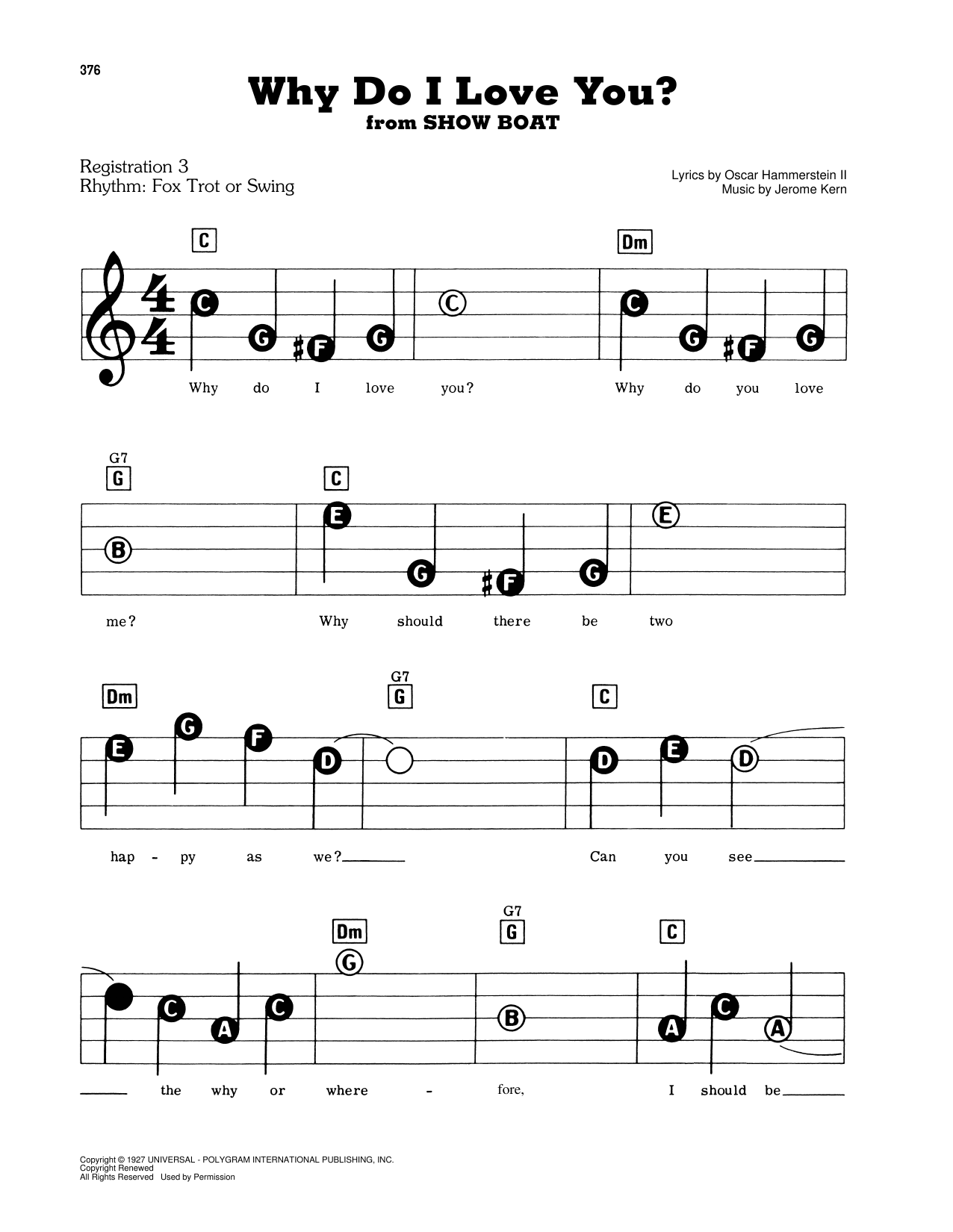
Why Do I Love You? (from Showboat) Sheet Music Preview

Why Do I Love You? (from Showboat): E-Z Play Today

Item: 35-DS00460071

Digital Download
$4.99
Description

Why Do I Love You? (from Showboat): E-Z Play Today isn't in MakeMusic Cloud just yet...but it could be. Let us know you'd like to see it, and you'll help shape what comes next. In the meantime, start a free trial and dive into thousands of interactive titles your students can play along with today.

Sample Audio
No sample audio found.
Sample Video
Additional Details
Publisher: Hal Leonard
Page Count: 2
SKU: 35-DS00460071

More about this title

About the Creator

Jerome Kern composed the music for Showboat in 1927, creating one of the first truly integrated musical theatre works. His gift for melody and harmonic sophistication elevated the Broadway musical from entertainment into a genuine art form, and "Why Do I Love You?" stands as one of his most enduring creations.

Kern's influence on American songwriting cannot be overstated. He wrote music that was singable yet sophisticated, accessible yet musically substantial. This piece exemplifies his ability to craft a tune that sticks in your ear while supporting it with elegant harmonic movement.

Why we love this

The E-Z Play Today version makes this Kern classic accessible without sacrificing its musical integrity. Students and adult learners can play a genuine jazz-age standard without struggling through dense arrangements, which means they spend their energy on phrasing and expression rather than decoding notation.

What to expect

Romantic and unhurried, with the gentle melancholy of early jazz harmonies. The melody unfolds like a confession of feelings; the chords underneath shimmer with that distinctive 1920s warmth.

Who it's for

Pianists working through the E-Z Play Today series who want to build repertoire in American standards and musical theatre. This also serves adult learners and students who perform in jazz or pop vocal contexts and need a simple but musically credible accompaniment.

How to get the most out of it

  • Shape the melody with rubato in the verse; let the accompaniment breathe under your vocal line or single-note melody
  • Emphasize the harmonic changes by softening slightly on unexpected chords, especially those 1920s jazz colorations that give the piece its period character
  • Keep the tempo singing but never rushed; this is a ballad that luxuriates in its sentiment

How to use it

Pair this with other Kern or Rodgers and Hammerstein standards to explore the Golden Age of musical theatre. It works equally well as a solo piano recital piece, a vocalist's accompaniment, or a teaching tool for learning about functional harmony in a familiar context.

Skills your students will build

  • Reading lead sheet notation with chord symbols
  • Interpreting jazz and popular music chord voicings
  • Accompanying a melody line with independence between hands
  • Understanding harmonic movement and voice leading in early 20th century popular music
  • Shaping a lyrical melodic line through dynamic and agogic phrasing

You May Also Like