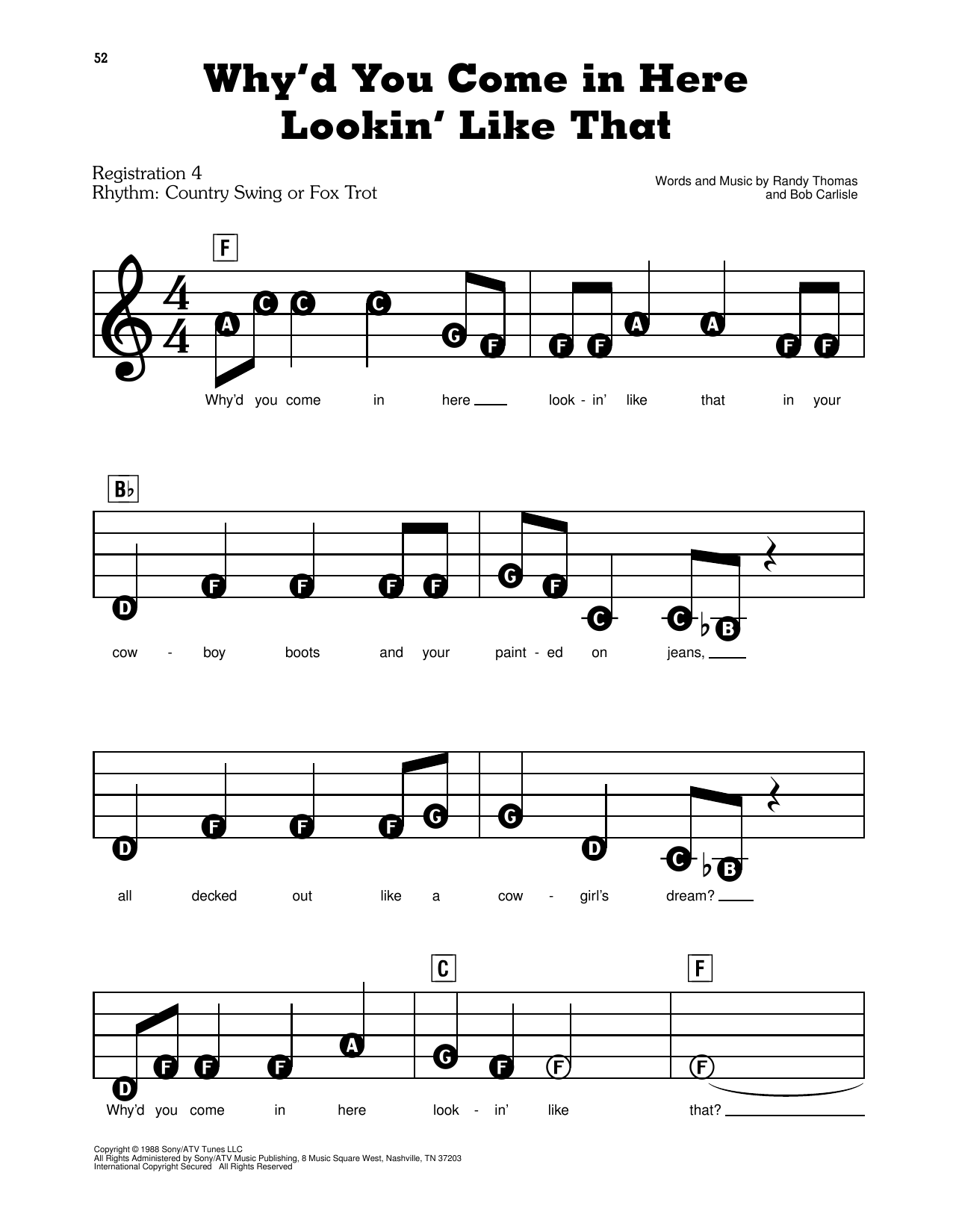
Why'd You Come In Here Lookin' Like That Sheet Music Preview

Why'd You Come In Here Lookin' Like That: E-Z Play Today

As performed by Dolly Parton

Item: 35-DS00586686

Digital Download
$4.99
Description

Why'd You Come In Here Lookin' Like That: E-Z Play Today isn't in MakeMusic Cloud just yet...but it could be. Let us know you'd like to see it, and you'll help shape what comes next. In the meantime, start a free trial and dive into thousands of interactive titles your students can play along with today.

Sample Audio
No sample audio found.
Sample Video
Additional Details
Publisher: Hal Leonard
Page Count: 4
SKU: 35-DS00586686

More about this title

About the Artist: Dolly Parton

Dolly Parton stands as one of country music's most prolific songwriters and performers, with a catalog spanning decades of hits that blend storytelling, emotional depth, and accessibility. Her compositions have become standards in music education precisely because they pair strong melodic hooks with relatable narratives and straightforward harmonic structures that don't sacrifice musical integrity.

Why we love this

This arrangement captures Parton's gift for writing memorable hooks without requiring advanced technical facility from students. The straightforward keyboard voicings in the E-Z Play series make a genuine country-pop crossover hit approachable for early intermediate pianists, yet the song's charming character and commercial polish keep rehearsals engaging.

What to expect

Warm and conversational, with the casual charm of a Parton classic that doesn't announce itself as clever but simply wins you over through infectious melody and genuine emotion. The arrangement breathes like a friendly chat set to music.

Who it's for

Early intermediate pianists ready to play recognizable pop and country standards with confidence. This works equally well for solo students building repertoire or as an ensemble piece in music classrooms exploring genre diversity.

How to get the most out of it

  • Keep the rhythm section tight and consistent; the groove is what carries this song, so lock into a steady tempo early and stick with it throughout.
  • Balance the melody line against the accompaniment so listeners hear the hook clearly without muddying the texture with overly heavy left-hand voicings.
  • Lean into the conversational phrasing of the lyric (if singing along) to shape the musical line naturally rather than mechanically.

How to use it

Pair this with other accessible country standards in a Americana or roots music concert segment, or use it as a bridge between classical and contemporary repertoire in a mixed ensemble setting. It also works beautifully as a standalone student recital piece that audiences recognize and enjoy immediately.

Skills your students will build

  • Playing steady groove-based accompaniment patterns
  • Balancing melody and harmony within a single staff system
  • Maintaining rhythmic consistency over repeated chord changes
  • Interpreting pop/country phrasing and expression

You May Also Like