
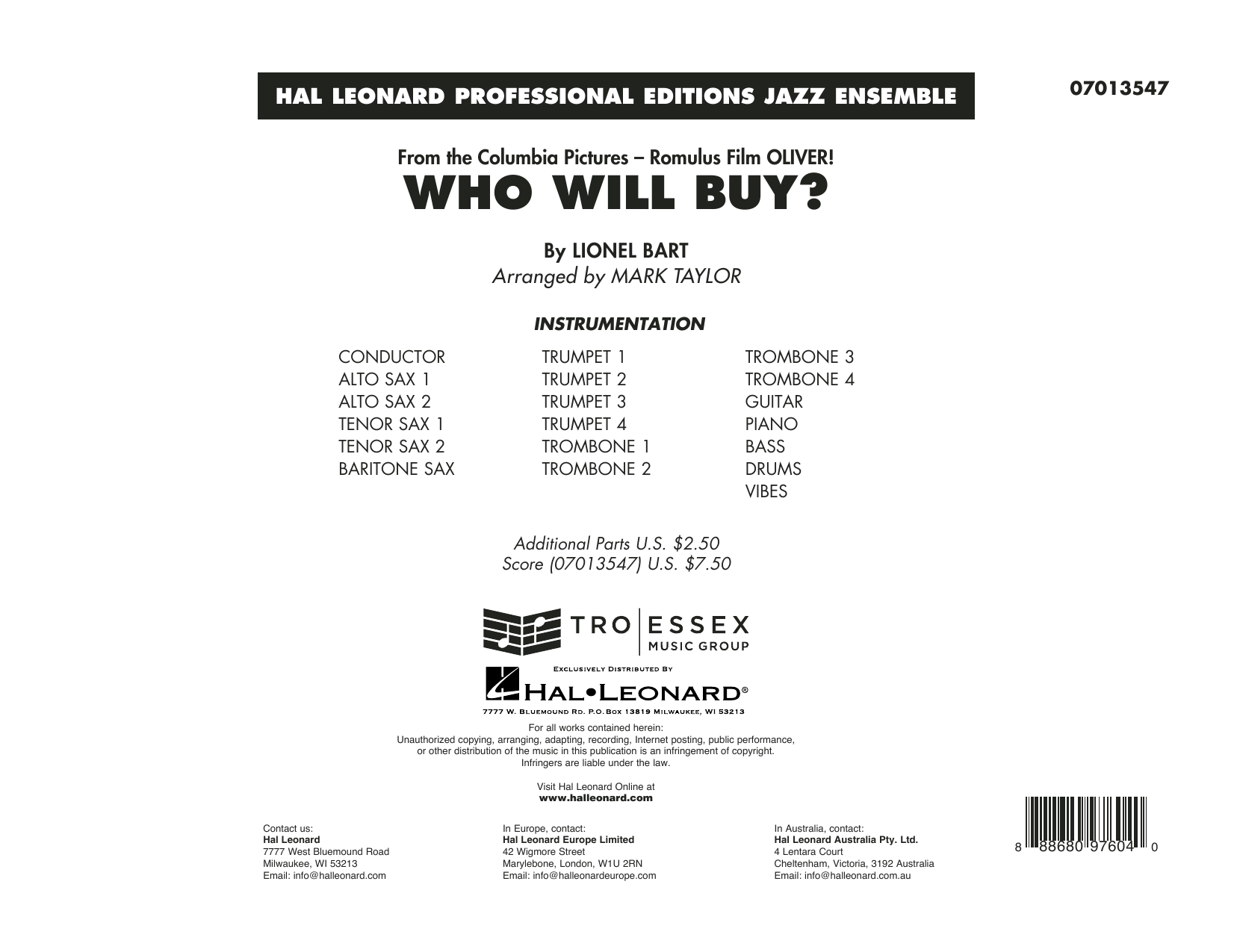

Who Will Buy? (from Oliver) (arr. Mark Taylor): Jazz Ensemble Conductor Score & Parts
As performed by Lionel Bart / Arranged by Mark Taylor
Grade: 5
Item: 35-PK00458978
$60.00
Pickup currently not available
Buy Extra Parts (Digital PDF Download)
Parts Added to Cart!
Description
One of the signature songs from the musical Oliver, this tune offers a wealth of opportunities for melodic and harmonic development. Adapted here as a samba, Mark Taylor's powerful arrangement opens with a duet for trumpet and alto, followed by features spots for saxes and solos for alto and trumpet. The nicely crafted full ensemble tutti starts soft and builds dramatically all the way to the end.


Who Will Buy? (from Oliver) (arr. Mark Taylor): Jazz Ensemble Conductor Score & Parts isn't in MakeMusic Cloud just yet...but it could be. Let us know you'd like to see it, and you'll help shape what comes next. In the meantime, start a free trial and dive into thousands of interactive titles your students can play along with today.
Request This Title
Tell us you want it.
Start Your Free Trial
Explore everything that's ready to play right now.
Sample Audio
No sample audio found.
Sample Video
No sample videos found.
Additional Details
Publisher:
Hal Leonard
SKU:
35-PK00458978
More about this title
About the Artist: Lionel Bart
Lionel Bart's gift was for crafting melodies that lodge immediately in the listener's ear while carrying genuine emotional weight. His work on Oliver, which premiered in 1960, established him as a major voice in musical theater, and the score's songs have become standards in performance and education settings worldwide. Bart understood how to write music that works equally well for professional productions and for students discovering musical theater for the first time.
Why we love this
Mark Taylor's samba reimagining transforms a beloved standard into something that feels fresh while keeping the melodic integrity of the original entirely intact. The arrangement gives multiple section leaders their moment (trumpet and alto duet, featured sax passage, individual solos) without losing the driving pulse that keeps an ensemble engaged. That final build from soft to powerful teaches dynamics and ensemble control in a context where students hear why those concepts matter musically.
What to expect
Bright and propulsive. The samba rhythm keeps things buoyant, while the lyrical melody gives players room to sing and phrase rather than purely displaying technique. There's joy in the arrangement, but not frivolity; students feel the warmth of the original song coming through the new setting.
Who it's for
Jazz ensembles at the Grade 5 level with soloists ready for responsibility but still building confidence. This works best for groups that can hold a steady groove and have at least one solid player on each featured voice (trumpet, alto, tenor/baritone).
How to get the most out of it
- Balance the opening trumpet and alto duet carefully; the melody needs to float above the rhythm section rather than compete with it. Mark the parts so players know when they're carrying the primary line versus supporting.
- Lock the samba pulse early in rehearsal by having the rhythm section play freely through several choruses before adding horns. This establishes the groove foundation that everything else depends on.
- Shape the full ensemble section with deliberate dynamic control. The written soft-to-loud arc only lands if the ensemble can execute graduated increments rather than jumping to forte.
- Feature players should hear the recorded accompaniment in their practice space multiple times before rehearsal so they arrive already oriented to the harmonic context and style.
How to use it
This works beautifully on a concert where you're mixing Broadway repertoire with jazz standards, or as a palate cleanser between heavier contemporary jazz pieces. The accessible melody and uptempo energy also make it a strong choice for spring concerts or end-of-year celebrations when student morale and audience engagement both matter.
Skills your students will build
- Playing with samba feel and Latin rhythmic subdivision
- Balancing solo voice with accompaniment
- Reading and executing dynamic shaping across ensemble sections
- Maintaining consistent groove while melody and soloists ornament over it
- Interpreting jazz articulation and phrasing on a familiar theatrical melody