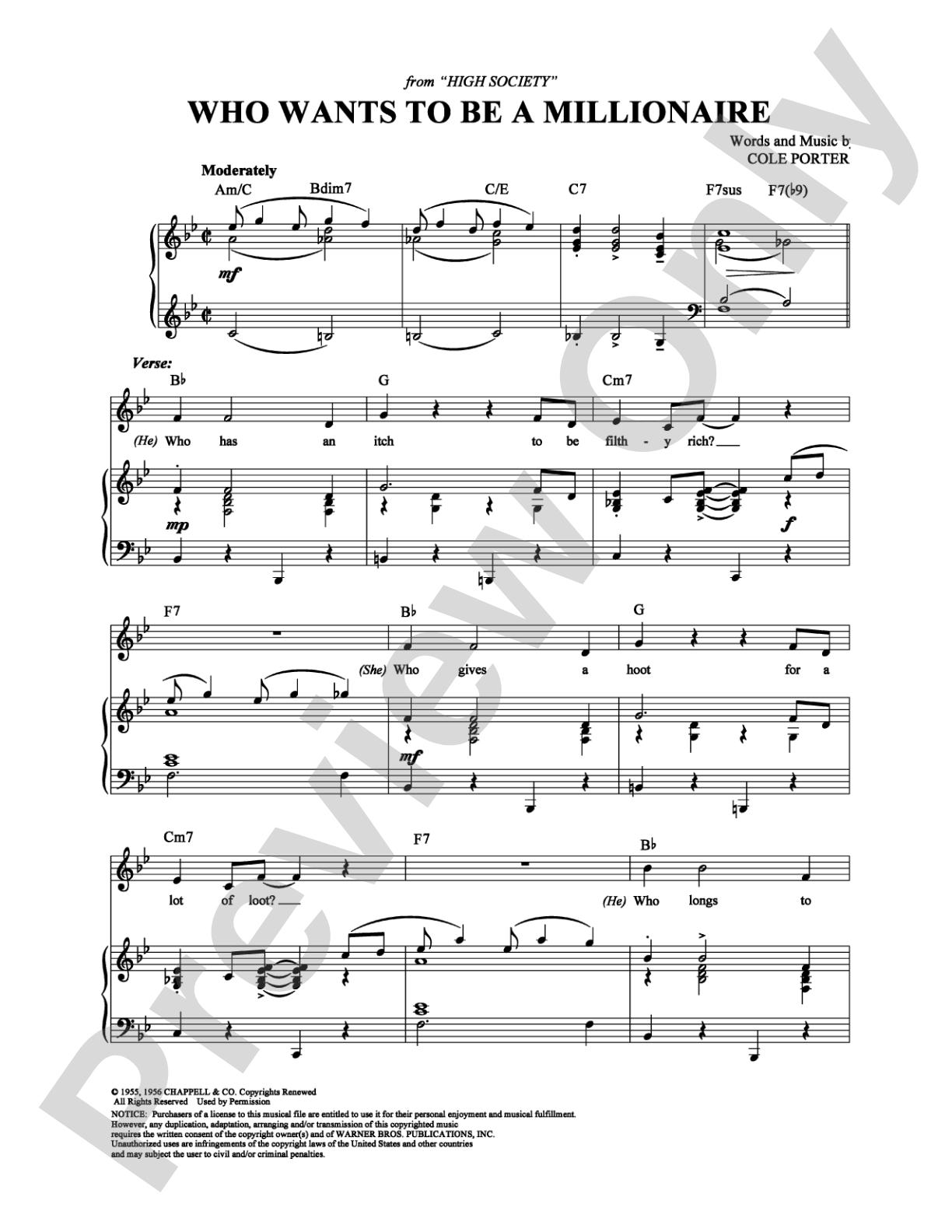
Who Wants to Be a Millionaire: Piano/Vocal/Chords Digital Sheet Music

Who Wants to Be a Millionaire: Piano/Vocal/Chords Digital Sheet Music

Cole Porter, Bing Crosby, Frank Sinatra

Item: 00-PS-0007910

Digital Download
$3.99
Description

Who Wants to Be a Millionaire: Piano/Vocal/Chords Digital Sheet Music isn't in MakeMusic Cloud just yet...but it could be. Let us know you'd like to see it, and you'll help shape what comes next. In the meantime, start a free trial and dive into thousands of interactive titles your students can play along with today.

Sample Audio
No sample audio found.
Sample Video
Additional Details
SKU: 00-PS-0007910

More about this title

About the Artist: Bing Crosby

Bing Crosby (1903-1977) was an American singer and actor whose smooth baritone and innovative phrasing shaped popular music for nearly five decades. His relaxed approach to rhythm and natural microphone technique influenced generations of vocalists and made him one of the most recorded artists of the twentieth century.

Why we love this

This standard belongs in any vocalist's jazz and popular music toolkit, and the piano/vocal/chord format makes it accessible whether you're coaching a student singer or working with an accompanist who reads lead sheets. The song's conversational lyric and conversational melodic contour reward singers who understand how to phrase naturally across bar lines rather than mechanically hitting each note.

What to expect

A witty, tongue-in-cheek number that sits comfortably in the middle register and invites playful delivery. The melody moves mostly stepwise with enough space for the lyrics to land, creating a song that feels conversational and deceptively simple until you try to make it swing.

Who it's for

Singers preparing jazz standards, pop singers exploring classic American songbook material, and vocal coaches working with students who want to develop authentic phrasing in the popular music idiom. Pianists and accompanists benefit from having the full chord changes laid out for both reading and improvisation.

How to get the most out of it

  • Treat the chord symbols as a guide rather than a limitation. Use them to understand the harmonic movement and find opportunities for subtle reharmonization if you're an experienced accompanist.
  • Let the lyric rhythm guide your phrasing. The song works best when you prioritize the natural speech patterns of the words over strict metric regularity.
  • Balance vocal projection with intimacy. This song works whether sung in a concert setting or an intimate jazz club, so adjust your approach to your venue without losing the tune's conversational charm.

How to use it

Program this alongside other standards from the American Songbook when building a popular music or jazz vocal recital. It pairs well with other Crosby-era songs and provides a lighter moment in a program of heavier ballads.

Skills your students will build

  • Phrasing across bar lines and prioritizing lyric rhythm over metric regularity
  • Reading chord symbols and understanding harmonic function
  • Interpreting rubato and swing feel in popular music contexts
  • Building authentic vocal delivery in the American popular song tradition

You May Also Like