
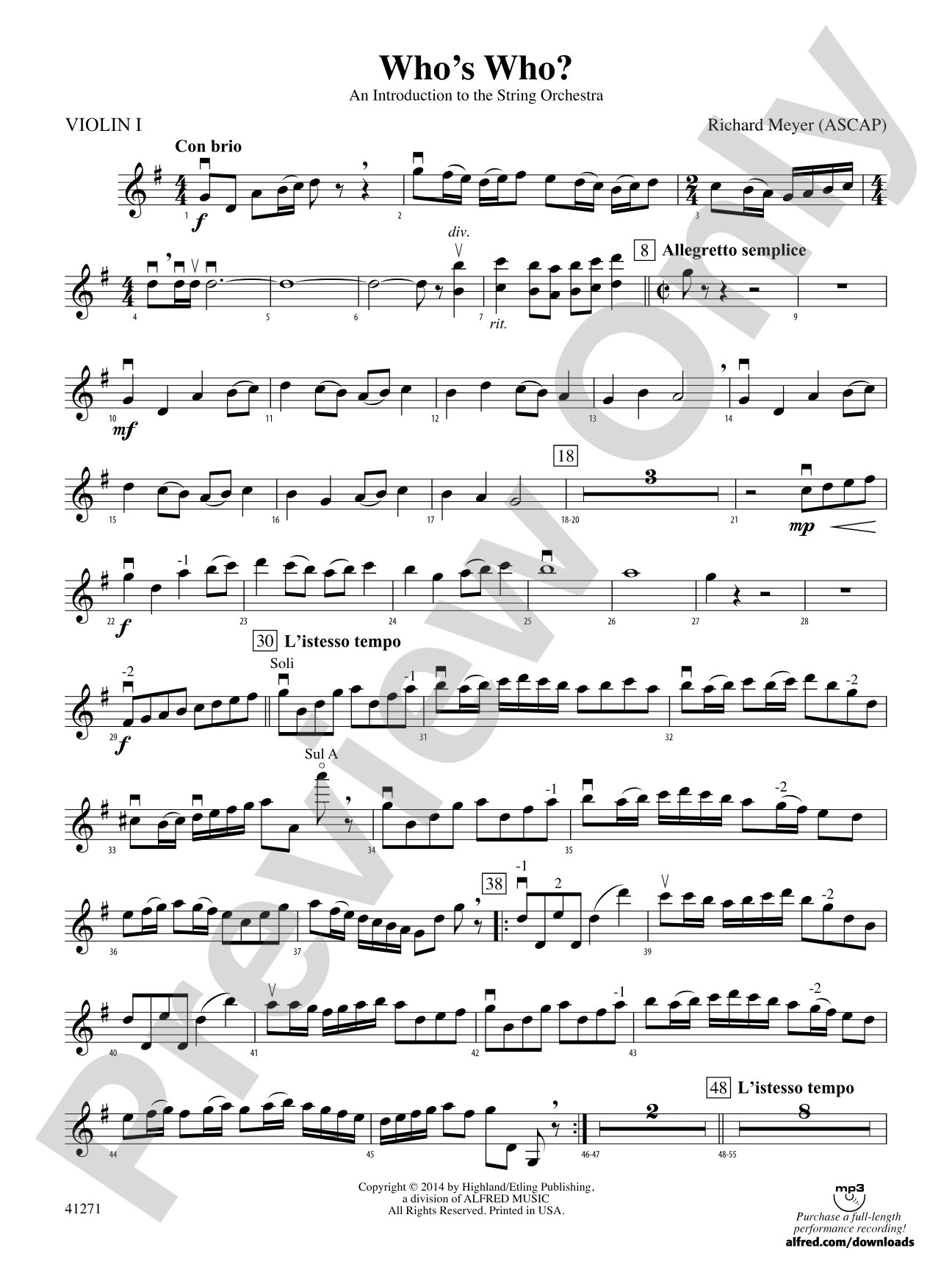

Who's Who?: 1st Violin
An Introduction to the String Orchestra
By Richard Meyer
Grade: 3
Item: 00-PC-0016388_VN1
$5.99
Pickup currently not available
Description
Think Benjamin Britten's Young Person's Guide but just for strings! Written to be used for outreach or recruiting concerts, this piece is a great way to educate audiences of all ages about the different instruments of the string orchestra. All of your students will love getting a chance in the spotlight as the simple main theme is followed by five variations, each featuring a different section (yes, Violins I and II get their own separate variation!). The piece concludes with a rousing 6/8 finale in which phrases of the theme are tossed from section to section, giving your audience a final review of what they have learned. Very playable and very enjoyable for all! (6:10) This title is available in MakeMusic Cloud.


Don't just read it, hear it, play along with it, and watch your students grow with it. In MakeMusic Cloud, Who's Who?: 1st Violin comes alive with professional accompaniment, adjustable tempo, and built-in practice tools that turn solo practice into real progress.
Open in the Player
Jump straight in and assign it today.
Start Your Free Trial
Open this title and explore the full library in minutes.
Sample Audio
1
Audio File
--:--
0:00
0:00
Sample Video
No sample videos found.
Additional Details
Series:
Highland/Etling String Orchestra
Publisher:
Alfred Music
Page Count:
124
SKU:
00-PC-0016388_VN1
More about this title
About the Composer: Richard Meyer
Richard Meyer spent 35 years teaching strings in public school settings, where he built the Oak Avenue Intermediate School orchestra from 29 students to 200 and oversaw the city's elementary string program in Temple City, California. During 22 of those years, he also directed the Pasadena Youth Symphony Orchestra for 16 years, taking the ensemble to performances across North America, Europe, and Australia. His "Giving Bach" program, launched in 2009, has become nationally recognized for its innovative use of interactive concerts to serve students with special needs and underserved communities throughout Southern California.
Beyond the podium, Meyer is a prolific composer with over 190 works published and has served as string editor for Alfred Publishing Company. He co-authored the String Explorer Series and Sight-read It for Strings, both widely adopted in school music programs. Meyer has been a featured clinician at the A.S.T.A. National Conference, the Texas Orchestra Directors' Association Conference, and regional string workshops, and has guest-conducted All-State and Honor Orchestras across multiple states.
Why we love this
Meyer crafted this piece with deep knowledge of string recruitment and audience education, so every section gets genuine spotlight moments that build pride and engagement. The structure itself mirrors a masterclass, making it perfect for open rehearsals, family concerts, or recruiting efforts where you need audiences to leave understanding and appreciating what each section contributes to the orchestra sound.
What to expect
The piece opens with an uncomplicated, memorable theme that invites the listener in immediately; then, as each variation unfolds, the character shifts subtly, highlighting what makes each section of the string orchestra distinctive. The final 6/8 section captures a celebratory energy, with the theme bouncing playfully between groups as if the orchestra is showing off everything the audience has just learned.
Who it's for
String orchestras at the intermediate and early high school levels will find this piece engaging and achievable, with enough technical simplicity to allow genuine focus on ensemble sound and section pride. Directors planning outreach, recruiting, or family concerts will discover a teaching tool that educates audiences while keeping student motivation high.
How to get the most out of it
- Balance the theme carefully across the five variations so that each new section sounds fresh and distinct rather than simply repeating the same melodic material; spotlight lighting or strategic seating can help emphasize the featured group.
- In the 6/8 finale, keep the phrase exchanges crisp and clear so the audience can follow which section has the theme; a unified approach to the rhythmic swing of 6/8 will tie the sections together even as they pass material back and forth.
- Record or videotape a rehearsal run-through and play it for your ensemble before the concert; seeing their own colleagues perform builds investment and helps younger players understand their role in the larger context.
- Work with your conductor to exaggerate character contrasts between variations so that even audience members unfamiliar with the orchestra can hear the personality differences between Violin I, Violin II, Violas, Cellos, and Basses.
How to use it
Open a concert with this piece to introduce your orchestra to families and community members, or use it as a centerpiece in a recruiting concert for elementary school students. The piece works equally well in a spring pops concert or as part of an educational outreach series, since the built-in teaching moment requires no narration once the audience grasps the concept.
Skills your students will build
- Ensemble balance and blend, particularly within individual string sections
- Ensemble entrances and releases as featured groups trade the main theme
- Awareness of individual section tone and character within the larger orchestra
- Rhythmic precision in 6/8 meter and syncopated phrase exchanges
- Listening and responding to other sections during section feature moments