Who's That Woman? (from Follies) Sheet Music Preview

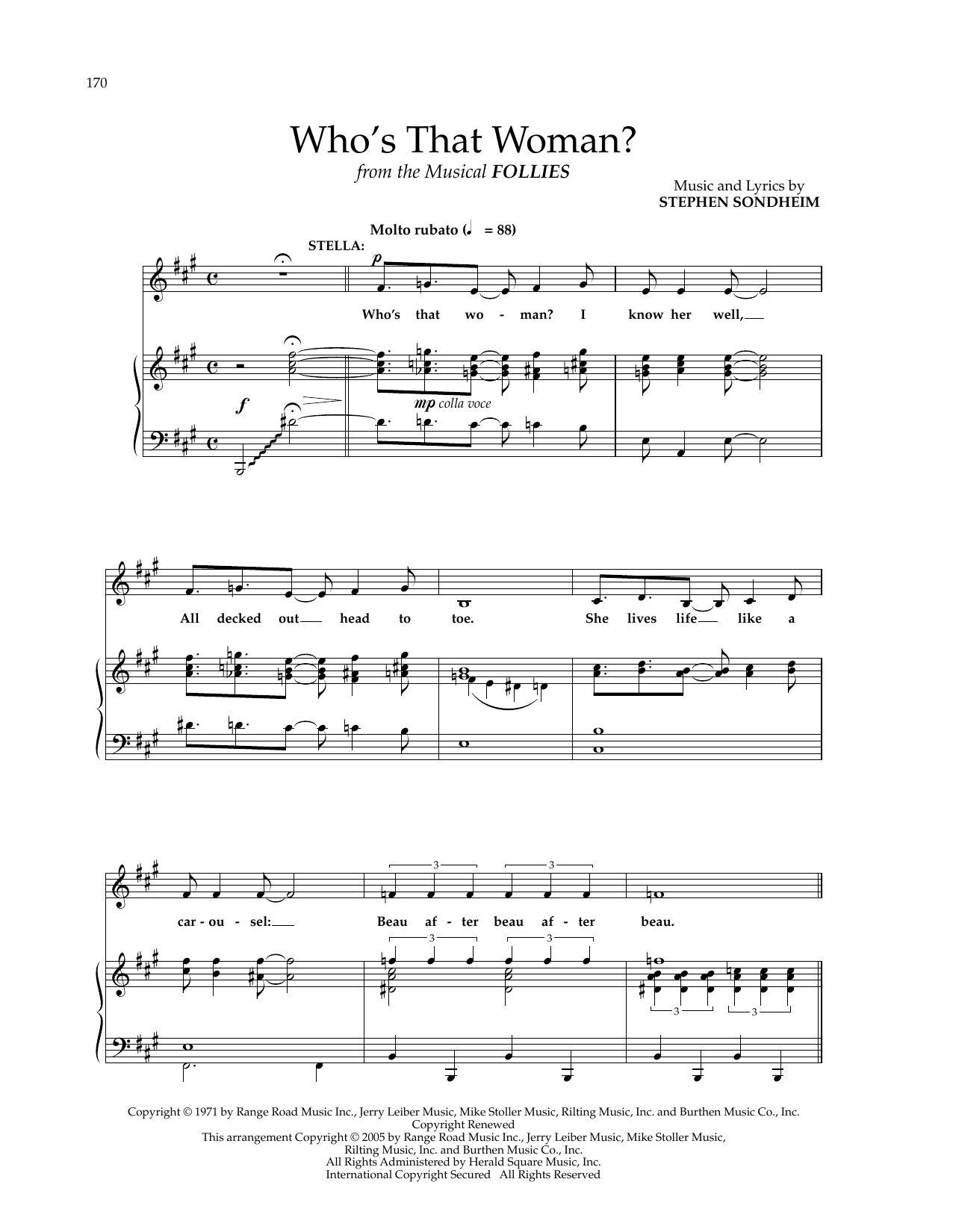
Who's That Woman? (from Follies): Piano Vocal

Item: 35-DS00552777

Digital Download
$5.99
Description

Who's That Woman? (from Follies): Piano Vocal isn't in MakeMusic Cloud just yet...but it could be. Let us know you'd like to see it, and you'll help shape what comes next. In the meantime, start a free trial and dive into thousands of interactive titles your students can play along with today.

Sample Audio
No sample audio found.
Sample Video
Additional Details
Publisher: Hal Leonard
Page Count: 10
SKU: 35-DS00552777

More about this title

About the Creator: Stephen Sondheim

Stephen Sondheim stands as one of the most sophisticated composers in American musical theater. His work fundamentally changed what the Broadway song could accomplish, moving beyond conventional pop structures into complex harmonies, intricate rhyme schemes, and psychological depth.

Follies, which premiered in 1971, represents Sondheim at his most ambitious. The show examines middle-aged regret and the ghosts of youth through a reunion of former showgirls and their husbands. "Who's That Woman?" emerges as one of the musical's most intricate numbers, layering past and present while showcasing Sondheim's gift for musical storytelling.

Why we love this

This number demands genuine artistry from singers and pianists in ways that most contemporary musical theater doesn't. The music requires precision, vulnerability, and the ability to shift tone and tempo mid-phrase, making it a rewarding challenge for serious students and a memorable audition piece.

What to expect

The song balances nostalgia with sharp observation, mixing moments of genuine warmth with undercurrents of melancholy. Musically, it shifts between delicate introspection and sudden theatrical flourishes, creating a sense that the past is breaking through the present moment in unpredictable ways.

Who it's for

This is material for singers with solid vocal technique and the musicality to handle sophisticated Sondheim writing. Pianists need comfort with contemporary harmonies and the rhythmic precision that keeps the piece together. It's equally at home in a voice lesson, a vocal performance class, or an advanced musical theater program.

How to get the most out of it

  • Shape the phrase architecture around the lyrical content rather than strict metric divisions; Sondheim's irregular phrasing mirrors the emotional architecture of the text.
  • Balance the piano part's rhythmic complexity with forward motion. The accompaniment shouldn't feel labored or metronomic, even when syncopation intensifies.
  • Approach dynamic shifts as psychological turning points. The number moves between introspection and performance energy; let your vocal production reflect these transitions.
  • Practice the vocal line independently from the piano to lock in the melodic contour, then layer in the accompanying textures to maintain clarity.

How to use it

Program this in a cabaret or concert setting focused on sophisticated musical theater repertoire. It works particularly well when paired with other introspective Sondheim material, or as a contrast to more conventionally upbeat numbers. Vocalists studying Sondheim's approach to character and storytelling should engage with this early.

Skills your students will build

  • Interpreting complex harmonic language and unconventional chord progressions
  • Singing irregular phrase lengths and adapting phrasing to lyrical meaning rather than predictable meter
  • Coordinating rhythmic complexity between voice and piano accompaniment
  • Exploring character development through musical gesture and dynamic nuance
  • Building confidence with contemporary musical theater composition beyond standard song forms

You May Also Like