

Who's That Knockin'?: SATB, a cappella Choral Octavo
Words and music by Greg Gilpin
Item: 00-PO-0003628
$1.90
Minimum order quantity: 20 copies
Pickup currently not available
Related Items
Who's That Knockin'?: SATB, a cappella Choral Octavo |
$1.90
|
View |
Description
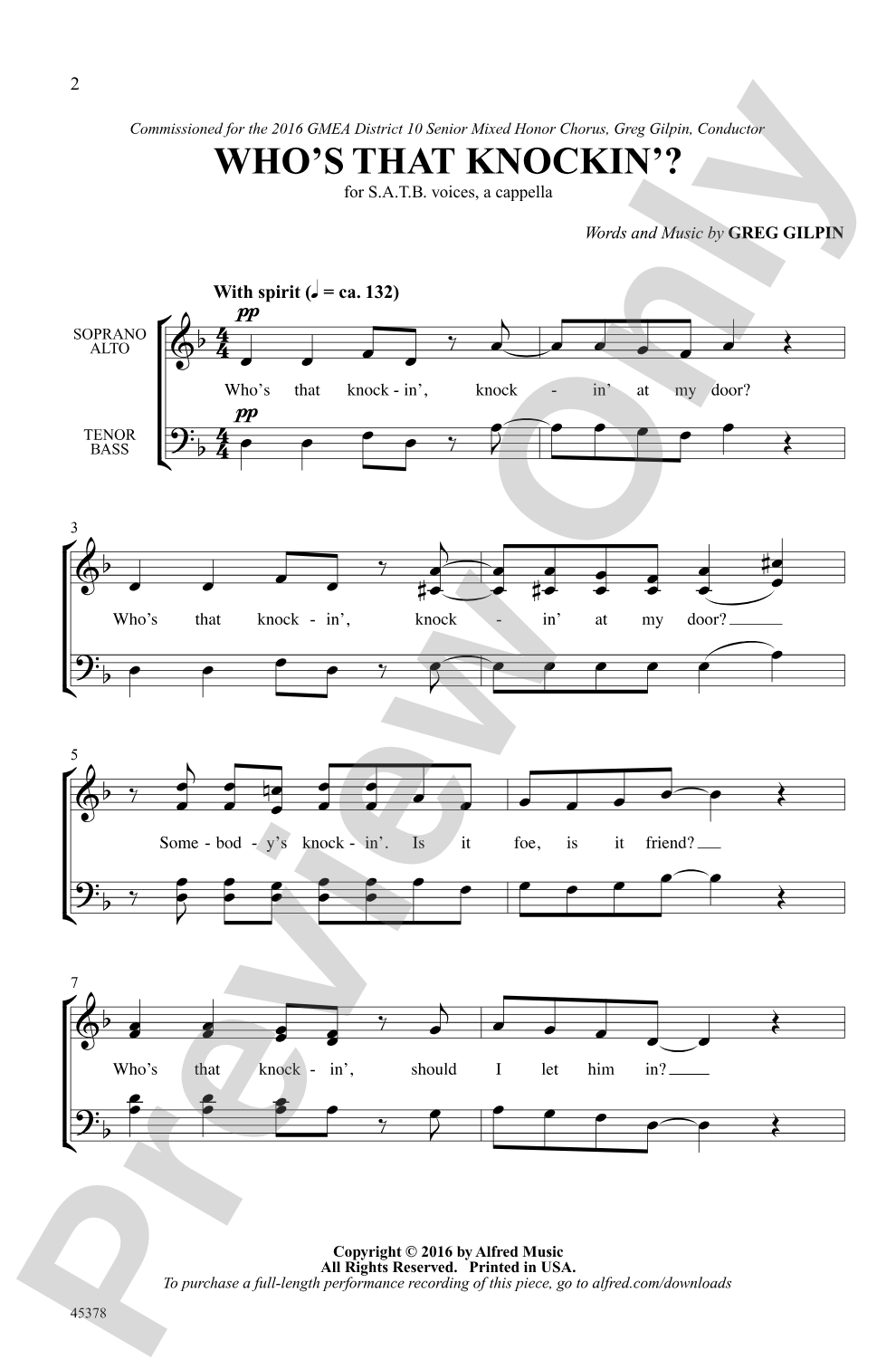
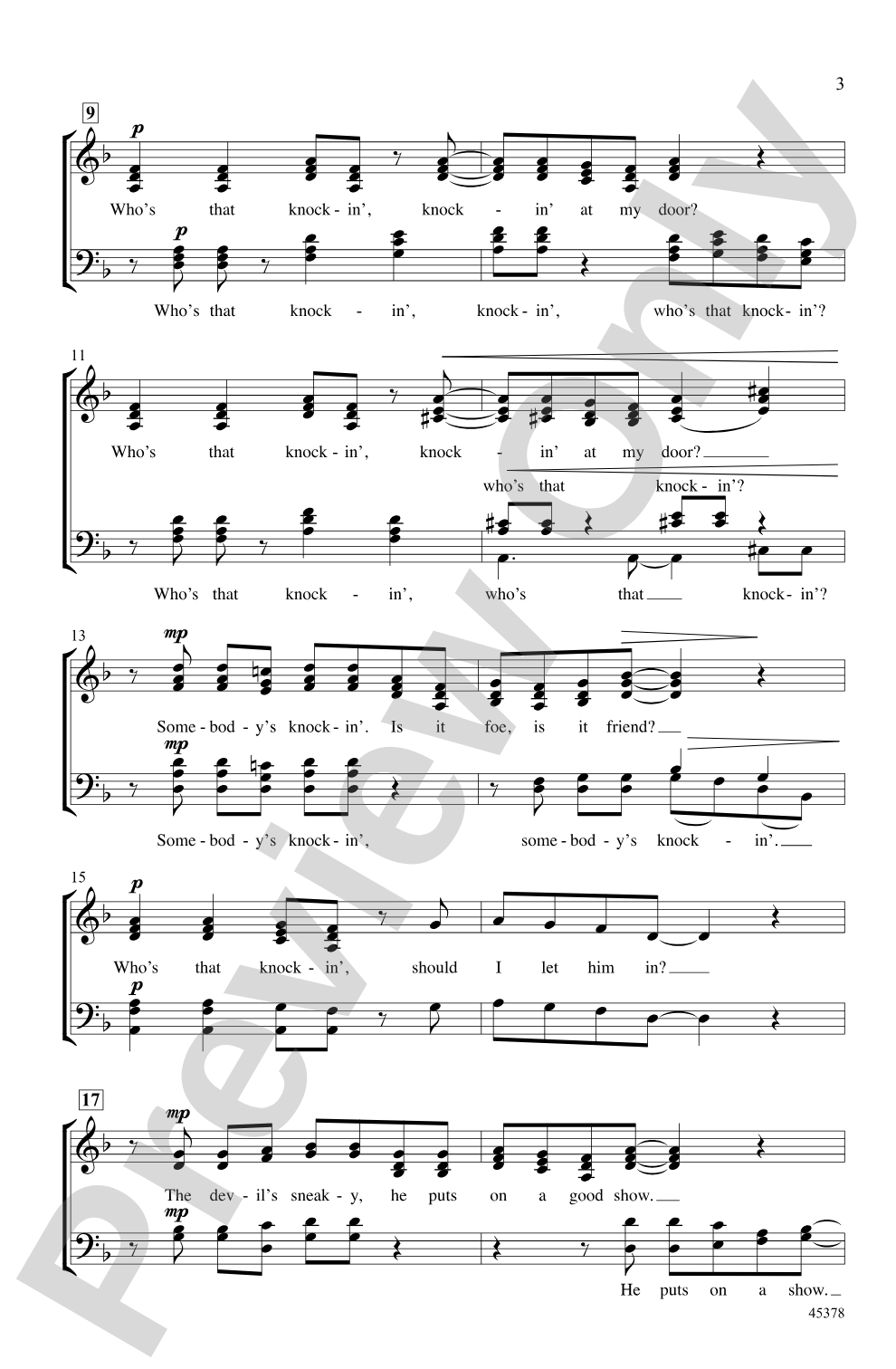
This fantastic original a cappella spiritual is not to be missed! An insistent melody opens the piece in unison, and then fully develops with rhythmic syncopations, varied choral textures, and dramatic dynamics. A challenging mixed meter section and a compelling descant build anticipation, leading to a satisfying musical payoff!


Who's That Knockin'?: SATB, a cappella Choral Octavo isn't in MakeMusic Cloud just yet...but it could be. Let us know you'd like to see it, and you'll help shape what comes next. In the meantime, start a free trial and dive into thousands of interactive titles your students can play along with today.
Request This Title
Tell us you want it.
Start Your Free Trial
Explore everything that's ready to play right now.
Sample Audio
1
Audio File
--:--
0:00
0:00
Sample Video
Additional Details
Series:
Alfred Choral Designs
Publisher:
Alfred Music
Page Count:
12
SKU:
00-PO-0003628
More about this title
About the Composer: Greg Gilpin

Greg Gilpin is an ASCAP award-winning composer and conductor whose choral works are performed across the United States and internationally. He has led performances at Carnegie Hall, Lincoln Center, the Ryman Auditorium, the Sydney Opera House, Royal Festival Hall, and Harpa Concert Hall, establishing himself as a significant voice in contemporary choral music. As Director of Educational Choral Publications for Shawnee Press, Gilpin shapes the landscape of choral repertoire available to singers at all levels.
Beyond his work in choral music, Gilpin has expanded into film scoring and produced the award-winning score for the short film "Rosie's Rescue" in 2021. He collaborated with soprano Angela Brown on a new arrangement of "What Child is This?" that premiered with the Indianapolis Symphonic Choir. An active member of ACDA, NAfME, and Phi Mu Alpha Sinfonia, Gilpin continues to compose, conduct, and teach while bringing his organizational expertise to additional professional ventures.
Why we love this
Gilpin writes with genuine understanding of what makes a cappella singing both exhilarating and achievable. The mix of unison opening, syncopated rhythmic textures, and strategic use of mixed meter creates genuine musical interest without sacrificing singability. Choirs will find themselves genuinely excited by the arc of this piece, from its insistent hook to the payoff of the descant section.
What to expect
This spiritual pulses with urgency and momentum. The insistent melody draws listeners in immediately, while the rhythmic energy and shifting textures keep the piece moving forward. By the time the descant enters, the full choir has built genuine anticipation, and the resolution lands with satisfying weight and presence.
Who it's for
Choirs with solid rhythmic and ensemble reading skills will thrive with this piece. The mixed meter section and syncopated passages demand singers who can handle independence while maintaining blend, making it ideal for high school choirs, college ensembles, and community choirs with rehearsal time to invest in detail work.
How to get the most out of it
- Establish the unison melody in rehearsal as the piece's identity. Once singers own that opening phrase, the rhythmic syncopations that follow will land with much greater precision.
- Treat the mixed meter section as a rhythmic ensemble challenge, not a hurdle. Slow it down initially and use subdivision and counting strategies to build confidence before tempo increases.
- Balance the descant carefully against the fuller voicing beneath it. The tension between these layers creates the dramatic payoff the piece aims for.
- Use dynamic contrast as your primary storytelling tool. The dramatic shifts referenced in the score should feel intentional and fully committed, not merely marked.
How to use it
This piece works beautifully as a concert anchor or contest selection where its dramatic arc and contemporary spiritual energy shine. Program it alongside other works that emphasize rhythmic vitality or spiritual depth to create a compelling narrative arc through your concert.
Skills your students will build
- Reading and maintaining pulse in mixed meter (3/4 and 4/4)
- Rhythmic syncopation and ensemble precision across multiple voice parts
- Balancing independence and blend in a cappella voicing
- Dynamic control and dramatic pacing in choral storytelling