Who's Sorry Now Sheet Music Preview

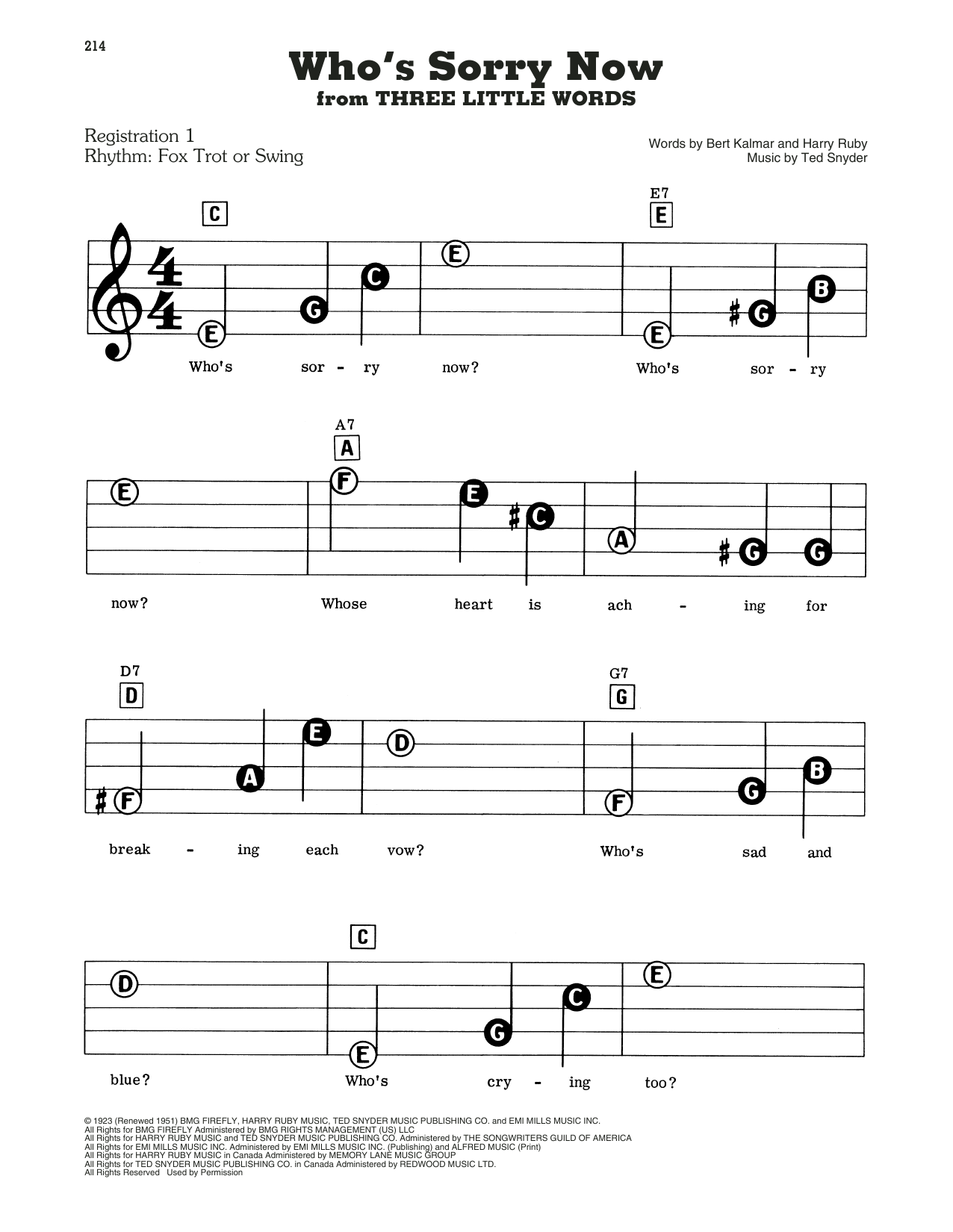
Who's Sorry Now: E-Z Play Today

As performed by Connie Francis

Item: 35-DS00609471

Digital Download
$4.99
Description

Who's Sorry Now: E-Z Play Today isn't in MakeMusic Cloud just yet...but it could be. Let us know you'd like to see it, and you'll help shape what comes next. In the meantime, start a free trial and dive into thousands of interactive titles your students can play along with today.

Sample Audio
No sample audio found.
Sample Video
Additional Details
Publisher: Hal Leonard
Page Count: 2
SKU: 35-DS00609471

More about this title

About the Artist: Connie Francis

Connie Francis emerged as one of the defining voices of 1950s pop and early 1960s popular music, bringing technical vocal control and emotional directness to standards and contemporary pop songs alike. Her recording of 'Who's Sorry Now' became a signature piece, showcasing her ability to navigate the intersection of jazz phrasing and accessible pop melody with equal facility.

Why we love this

This E-Z Play arrangement opens up a classic of American popular song to pianists who are building fluency with jazz voicings and swing idioms. The simplified notation lets students focus on the style and feel of the tune rather than wrestling with complex notation, making it ideal for developing swing comping skills and understanding how standards sit within the pop and jazz repertoire.

What to expect

A swinging, conversational tune that sits somewhere between a torch ballad and a jazz number. There's a nostalgia and warmth to the melody, supported by chords that give enough harmonic color to keep things interesting without becoming dense or overly complex.

Who it's for

Pianists in the intermediate-beginner range who want to build comfort with standards and jazz-pop repertoire without the notational demands of a full score. This also works well for students preparing to play as accompanists for singers working on classic American songbook material.

How to get the most out of it

  • Listen closely to the original recording to absorb the swing feel and phrasing; the rhythm section should sit back and breathe with the melody rather than push it forward.
  • Shape the melody by subtly relaxing the time on the lyrical phrases, then locking in the groove on the more rhythmic sections.
  • Balance the left hand accompaniment so it supports without overwhelming; this tune lives in the interplay between vocalist and rhythm section.

How to use it

Pair this with other standards from the American songbook as part of a jazz appreciation unit or a pops concert that celebrates classic singers. It also works well as a solo piece for a student pianist exploring the jazz and popular music traditions that shaped twentieth-century American music.

Skills your students will build

  • Swing feel and rhythmic phrasing in the context of popular song
  • Jazz voicings and chord colors in a simple, accessible context
  • Accompanying skills that balance support with restraint
  • Understanding the standards repertoire and its role in jazz and popular music

You May Also Like