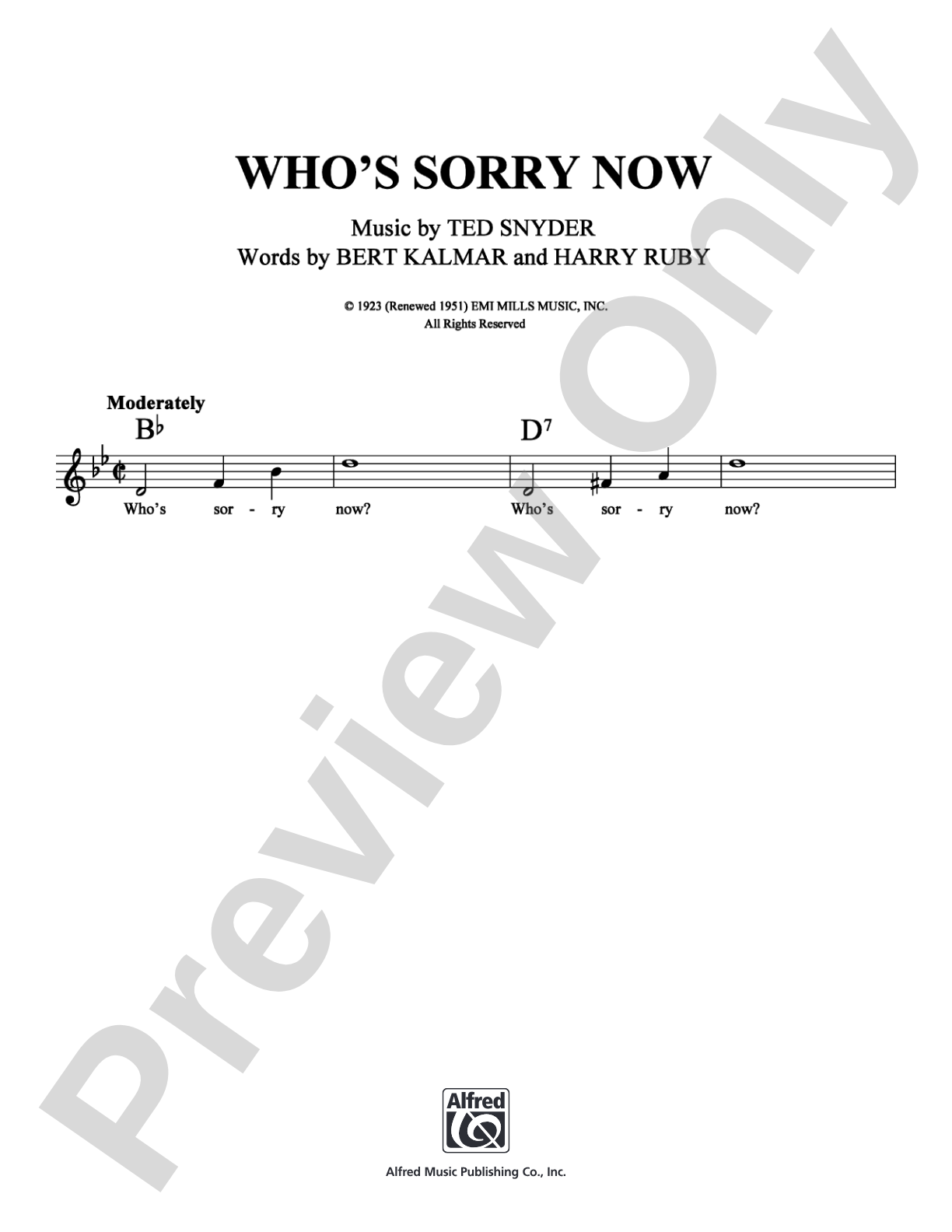
Who's Sorry Now: Lead Sheet Digital Sheet Music

Who's Sorry Now: Lead Sheet Digital Sheet Music

Ted Snyder, Connie Francis, Gloria De Haven

Item: 00-PS-0009025

Digital Download
$1.99
Description

Who's Sorry Now: Lead Sheet Digital Sheet Music isn't in MakeMusic Cloud just yet...but it could be. Let us know you'd like to see it, and you'll help shape what comes next. In the meantime, start a free trial and dive into thousands of interactive titles your students can play along with today.

Sample Audio
No sample audio found.
Sample Video
Additional Details
SKU: 00-PS-0009025

More about this title

About the Artist: Connie Francis

Connie Francis emerged as one of the most successful recording artists of the 1950s and 1960s, with a career spanning multiple decades and numerous chart-topping hits. Her versatility across pop, rock, and standards repertoire made her a household name, and her recordings remain widely performed and studied in music education contexts.

Why we love this

This lead sheet captures a classic standard with enduring melodic appeal and straightforward harmonic movement, making it accessible for singers and instrumentalists working on jazz and popular music repertoire. The tune's familiar structure supports both performance and improvisation, giving students room to interpret and develop their own musical ideas.

What to expect

The tune carries a conversational, almost intimate quality, with enough melodic charm to stick with listeners long after the performance ends. There's a gentle nostalgia to the piece, paired with honest emotional directness that feels neither sentimental nor overly polished.

Who it's for

This lead sheet works for singers exploring classic American popular standards, musicians learning jazz and pop harmony, and instrumentalists seeking repertoire that bridges classical technique with contemporary styles. It's equally valuable for music theory classes studying harmonic structures in mid-twentieth-century popular music.

How to get the most out of it

  • Study the original recording to understand the phrasing and vocal nuance, then experiment with how your own interpretation differs from Connie Francis's approach.
  • Pay attention to the lyrical content as you shape each phrase; the emotional arc of the song should inform your tempo choices and dynamic contour.
  • If performing with accompaniment, ensure your rhythm section locks into a groove that honors the song's pop-rock feel while leaving space for your melodic line to breathe.

How to use it

Include this in a jazz or standards showcase where singers and musicians can explore American popular song traditions. It also pairs well in educational settings where students are learning to read and interpret lead sheets, as the melody is memorable enough to encourage focus on harmonic accompaniment and rhythmic nuance.

Skills your students will build

  • Reading lead sheet notation and chord symbols
  • Interpreting and performing from melody and harmony without a full score
  • Phrasing and interpretation in popular song idiom
  • Chord-tone soloing and comping techniques

You May Also Like