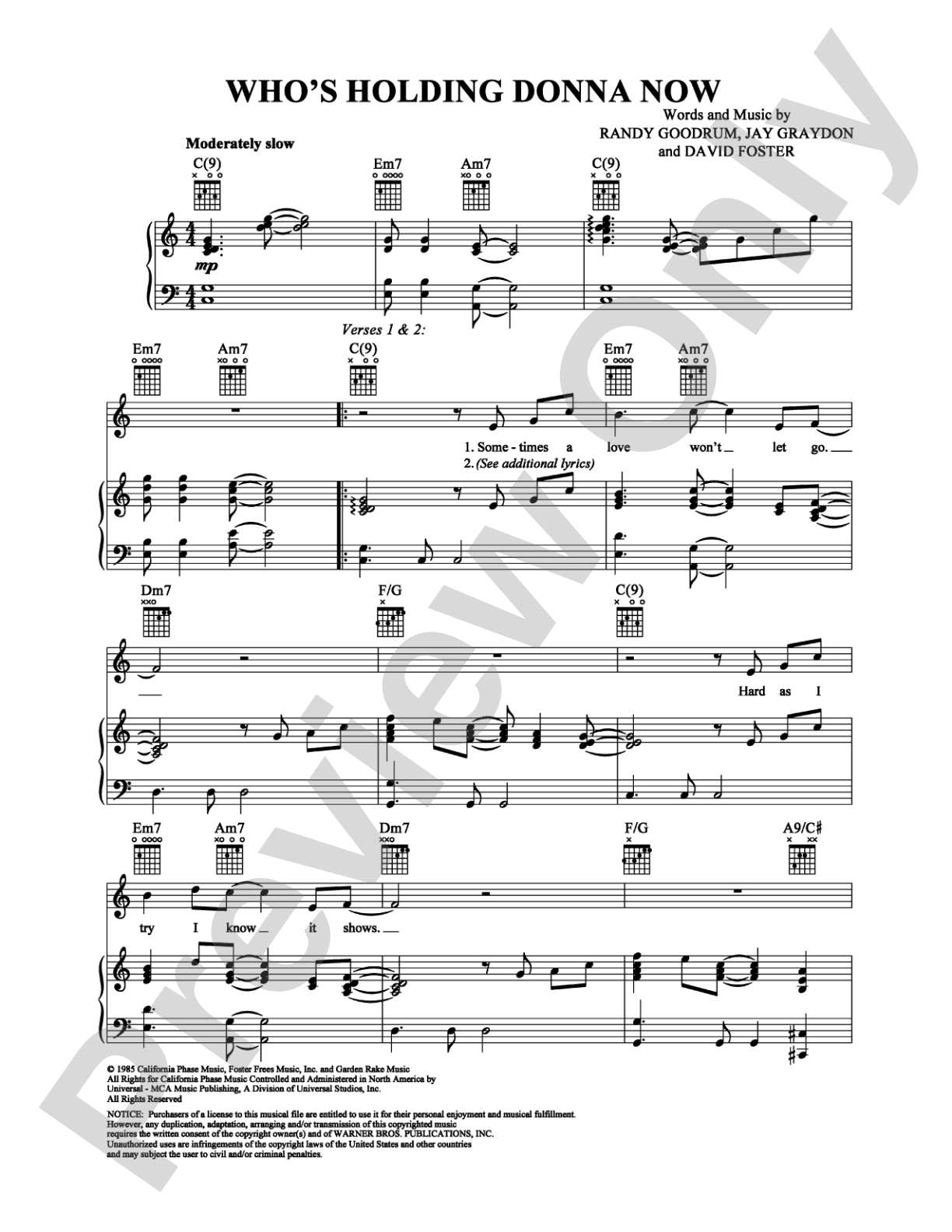
Who's Holding Donna Now: Piano/Vocal/Chords Digital Sheet Music

Who's Holding Donna Now: Piano/Vocal/Chords Digital Sheet Music

David Foster, Randy Goodrum, DeBarge, Jay Graydon

Item: 00-PS-0002622

Digital Download
$2.95
Description

Who's Holding Donna Now: Piano/Vocal/Chords Digital Sheet Music isn't in MakeMusic Cloud just yet...but it could be. Let us know you'd like to see it, and you'll help shape what comes next. In the meantime, start a free trial and dive into thousands of interactive titles your students can play along with today.

Sample Audio
No sample audio found.
Sample Video
Additional Details
SKU: 00-PS-0002622

More about this title

About the Artist: DeBarge

DeBarge emerged from the family-led R&B and pop movement of the early 1980s, blending smooth vocal harmonies with contemporary production that defined the decade's sound. The group's sophisticated arrangements and crossover appeal made them influential in both pop and R&B contexts, offering educators rich material for studying vocal layering, groove-based phrasing, and the intersection of commercial and artistic songwriting.

Why we love this

This chart captures the groove and vocal sophistication that made DeBarge an enduring reference point for singers learning to navigate R&B-inflected pop phrasing. The chord voicings and rhythmic layout reward careful attention to both melody and harmonic movement, making it a smart choice for pianists and singers working on stylistic authenticity and dynamic range control.

What to expect

Smooth and grooved, with the warm, intimate quality of 1980s R&B; the song breathes rather than drives, creating space for expressive phrasing and vocal nuance. The harmonic palette and rhythmic feel encourage singers to connect emotionally with the lyric while maintaining the song's sophisticated, laid-back character.

Who it's for

Singers and pianists working on contemporary pop and R&B repertoire who need a solid reference recording and chart. Voice students developing interpretive control and stylistic awareness will find this accessible yet musically substantial.

How to get the most out of it

  • Pay attention to the chord symbols as guides for comping texture; the left hand doesn't need to spell out every voicing literally, but should reflect the harmonic color suggested by the symbols.
  • Shape the vocal line with legit phrasing, not straight time; allow breath and emphasis to follow the lyrical content rather than strict metric placement.
  • Balance the accompaniment so the vocal line reads clearly; this style relies on the relationship between voice and piano to create its groove, not on volume.
  • Use the chord chart to explore different rhythmic figures in the left hand that complement the vocal rhythm without doubling it directly.

How to use it

Include this in a recital exploring popular music of the 1980s, or use it as a studio learning tool for singers working on groove-based phrasing and dynamic control. It pairs well with other R&B and pop-soul standards in a mixed repertoire context.

Skills your students will build

  • Reading chord symbols and understanding voicing choices in pop/R&B contexts
  • Phrasing control and breath management in legit vocal style
  • Rhythmic flexibility and syncopation relative to a steady harmonic pulse
  • Dynamic balance between voice and accompaniment in small ensemble settings

You May Also Like