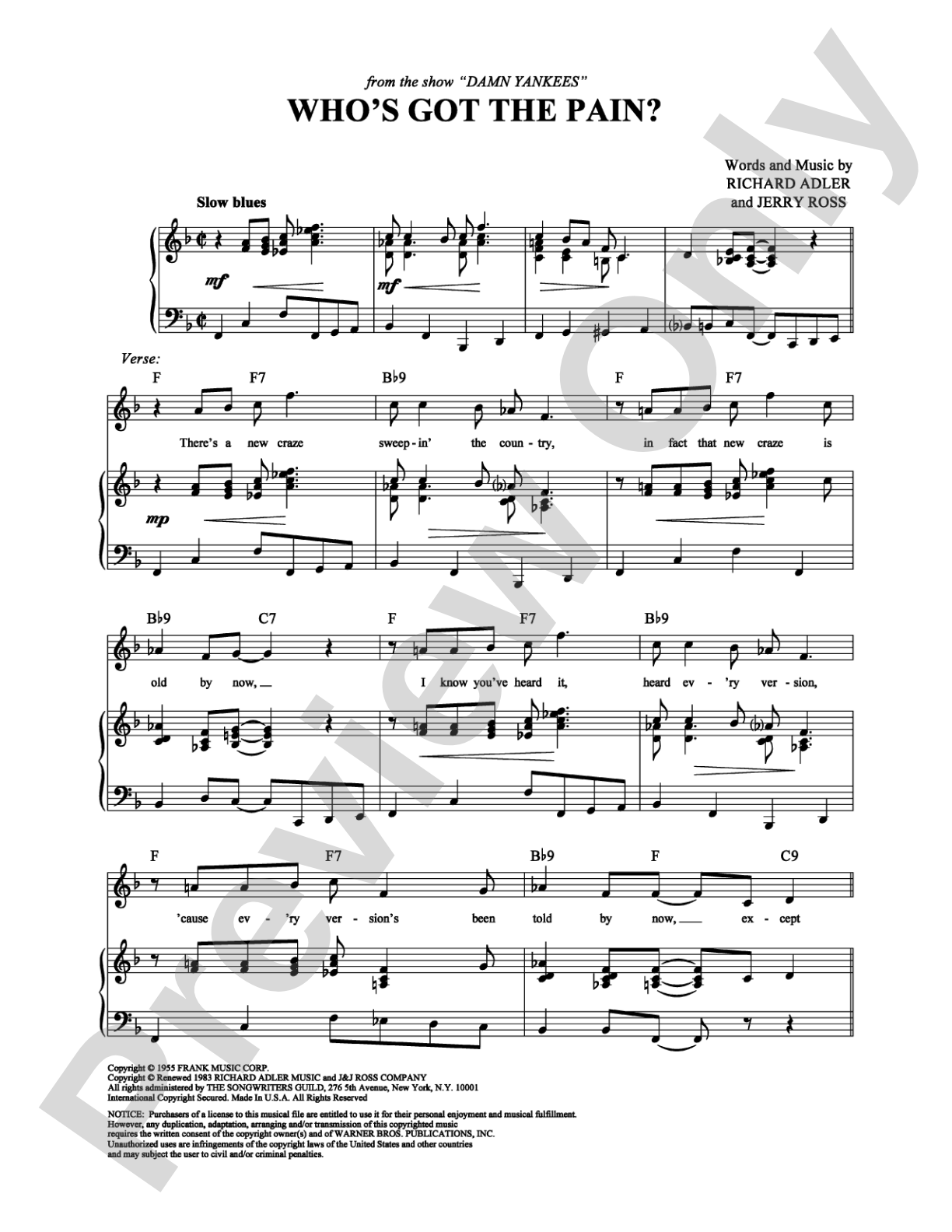
Who's Got the Pain?: Piano/Vocal/Chords Digital Sheet Music

Who's Got the Pain?: Piano/Vocal/Chords Digital Sheet Music

Richard Adler, Jerry Ross

Item: 00-PS-0003479

Digital Download
$3.99
Description

Who's Got the Pain?: Piano/Vocal/Chords Digital Sheet Music isn't in MakeMusic Cloud just yet...but it could be. Let us know you'd like to see it, and you'll help shape what comes next. In the meantime, start a free trial and dive into thousands of interactive titles your students can play along with today.

Sample Audio
No sample audio found.
Sample Video
Additional Details
SKU: 00-PS-0003479

More about this title

Why we love this

This is a vocalist's vehicle for dramatic storytelling, with piano writing that supports rather than overshadows the vocal line. The chord chart makes it accessible for pianists at varying levels, whether you're accompanying in rehearsal or performing in a recital setting.

What to expect

A song built on vulnerability and emotional directness. The piano/vocal arrangement creates an intimate space where the voice and accompaniment can converse, with the writing supporting honest, expressive storytelling.

Who it's for

Singers preparing repertoire for lessons, recitals, or auditions will find a complete vocal score with chord symbols for flexible accompaniment. Pianists accompanying vocalists benefit from both the detailed notation and the chord chart, which allows for stylistic interpretation and adaptation.

How to get the most out of it

  • Balance the vocal line prominently over the piano part; the accompaniment should frame the singer's interpretation rather than compete with it.
  • Work through the chord changes slowly with your accompanist before running the full piece at tempo, ensuring transitions feel natural and unhurried.
  • Explore the emotional arc of the lyric and let that shape your phrasing; the piano/vocal format invites intimate, character-driven choices.

How to use it

Feature this as a solo vocal recital piece or use it in a mixed repertoire program where you want a moment of close, personal connection with your audience. The accessible accompaniment also makes it suitable for student recitals and performance classes.

Skills your students will build

  • Interpreting a vocal melody with lyrical awareness and emotional specificity
  • Reading and performing from a lead sheet with chord symbols
  • Collaborating with an accompanist to shape tempo, phrasing, and expression
  • Balancing projection and intimacy in a small-ensemble setting

You May Also Like