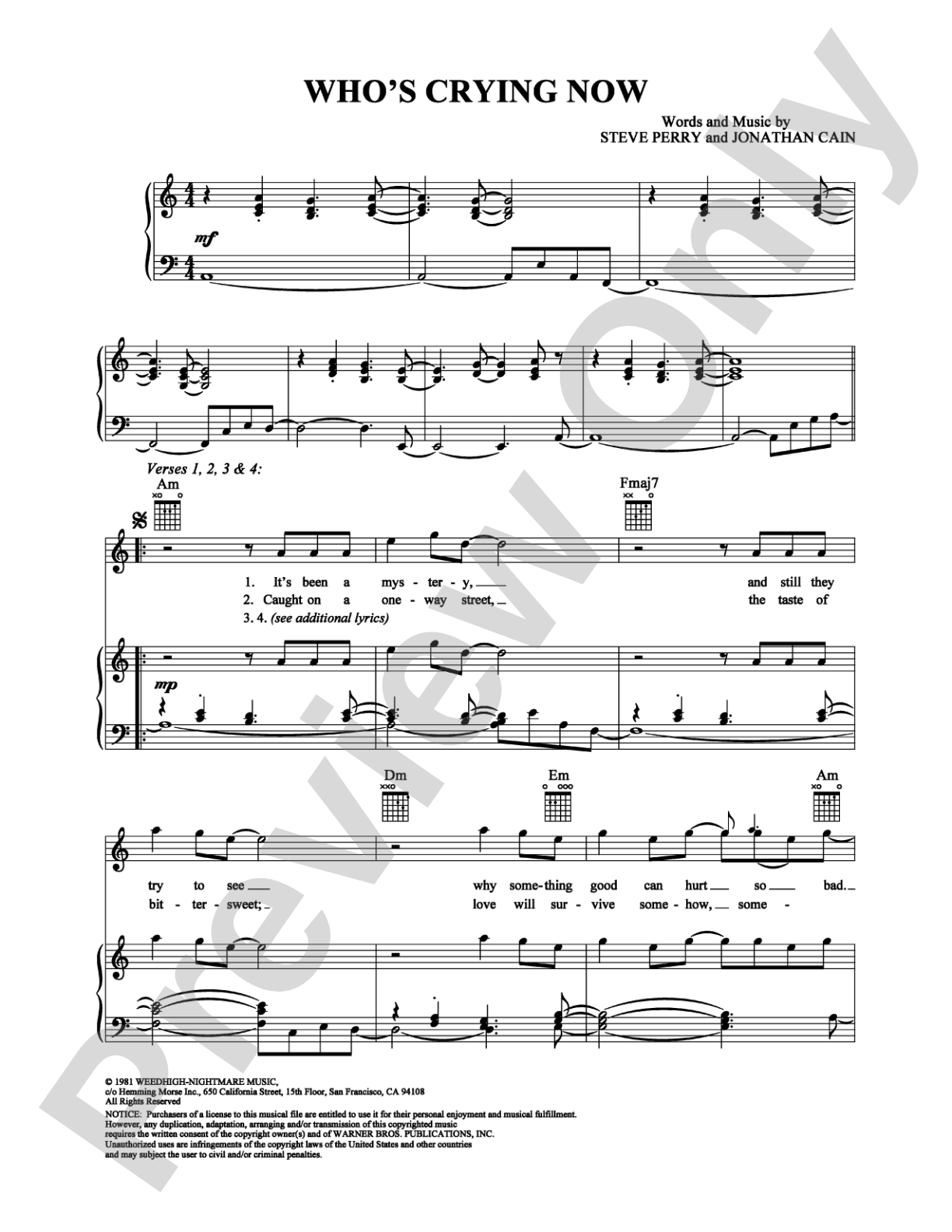
Who's Crying Now: Piano/Vocal/Chords Digital Sheet Music

Who's Crying Now: Piano/Vocal/Chords Digital Sheet Music

Jonathan Cain, Steve Perry, Journey

Item: 00-PS-0009081

Digital Download
$2.95
Description

Who's Crying Now: Piano/Vocal/Chords Digital Sheet Music isn't in MakeMusic Cloud just yet...but it could be. Let us know you'd like to see it, and you'll help shape what comes next. In the meantime, start a free trial and dive into thousands of interactive titles your students can play along with today.

Sample Audio
No sample audio found.
Sample Video
Additional Details
SKU: 00-PS-0009081

More about this title

About the Artist: Journey

Journey emerged from San Francisco in 1973 as one of rock music's most enduring acts, built on the foundation of a classically trained keyboardist (Jonathan Cain), a soaring vocalist (Steve Perry), and a rhythm section that locked into stadium-sized grooves. The band's signature sound combines progressive rock instrumentation with pop sensibility, producing some of the 1980s' most recognizable anthems. Their ability to craft emotionally direct songs without sacrificing musicianship made them essential listening for generations of musicians learning the craft of contemporary songwriting.

Why we love this

This track sits at the intersection of vocal accessibility and sophisticated pop-rock arranging, making it rewarding for singers who want to explore contemporary material with real harmonic substance. The piano part carries both accompaniment and melodic interest, giving your accompanist plenty to work with beyond block chords. It's a piece that sings naturally without oversimplification.

What to expect

Earnest and immediate. The song lives in emotional honesty without melodrama, with a melody that feels inevitable once you hear it. There's a sense of vulnerability underneath the rock energy, letting singers explore genuine expression within a accessible vocal range.

Who it's for

Singers looking for contemporary pop-rock material that doesn't require operatic technique, and pianists who want to accompany vocal students or perform in a pop-rock context. High school choirs and amateur vocal ensembles can also use this for a group arrangement.

How to get the most out of it

  • Balance the vocal line clearly over the piano texture; the melody should always emerge, especially in the verse sections where the accompaniment sits higher in the register.
  • Pay attention to the chord progression and use the harmonic movement to inform phrasing. Journey's changes often suggest where to breathe and where to push through.
  • Lock the piano's rhythmic feel with the vocal phrasing rather than treating them as separate elements. This is pop-rock, so groove matters as much as melody.
  • Let the recorded accompaniment (if using one) establish the overall energy, then find your vocal placement within that sound rather than competing with it.

How to use it

Feature this in a pop-rock or contemporary music showcase, where it pairs well with other Journey hits or similar 1980s mainstream rock. It also works as a recital piece for a vocalist building confidence with self-contained, well-known material that audiences recognize and enjoy.

Skills your students will build

  • Singing pop-rock melody with natural phrasing rather than classical technique
  • Reading piano/vocal/chords format and interpreting lead sheet notation
  • Coordinating vocal and accompaniment parts in popular music context
  • Interpreting chord symbols and understanding harmonic function in contemporary songwriting

You May Also Like