
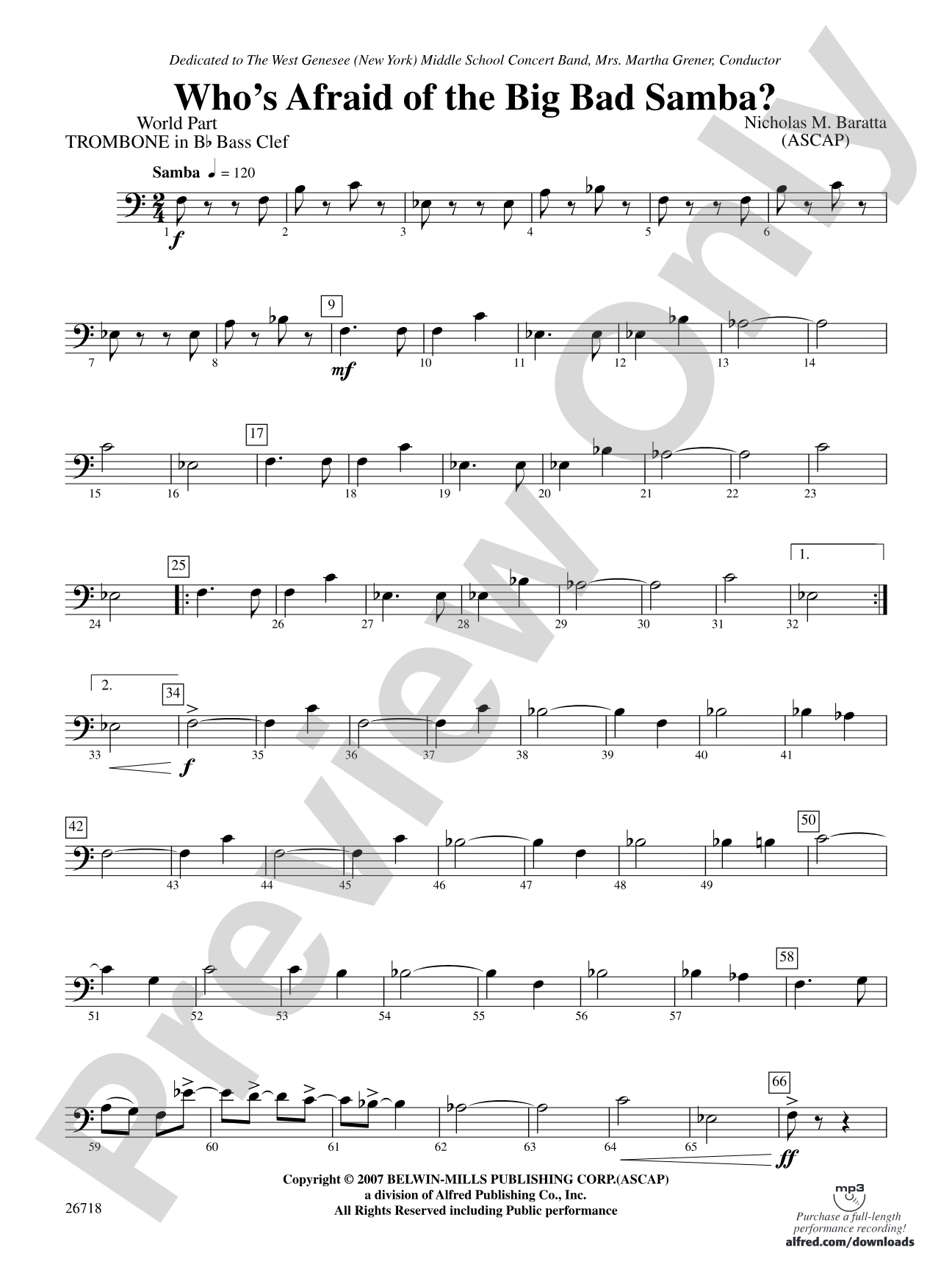
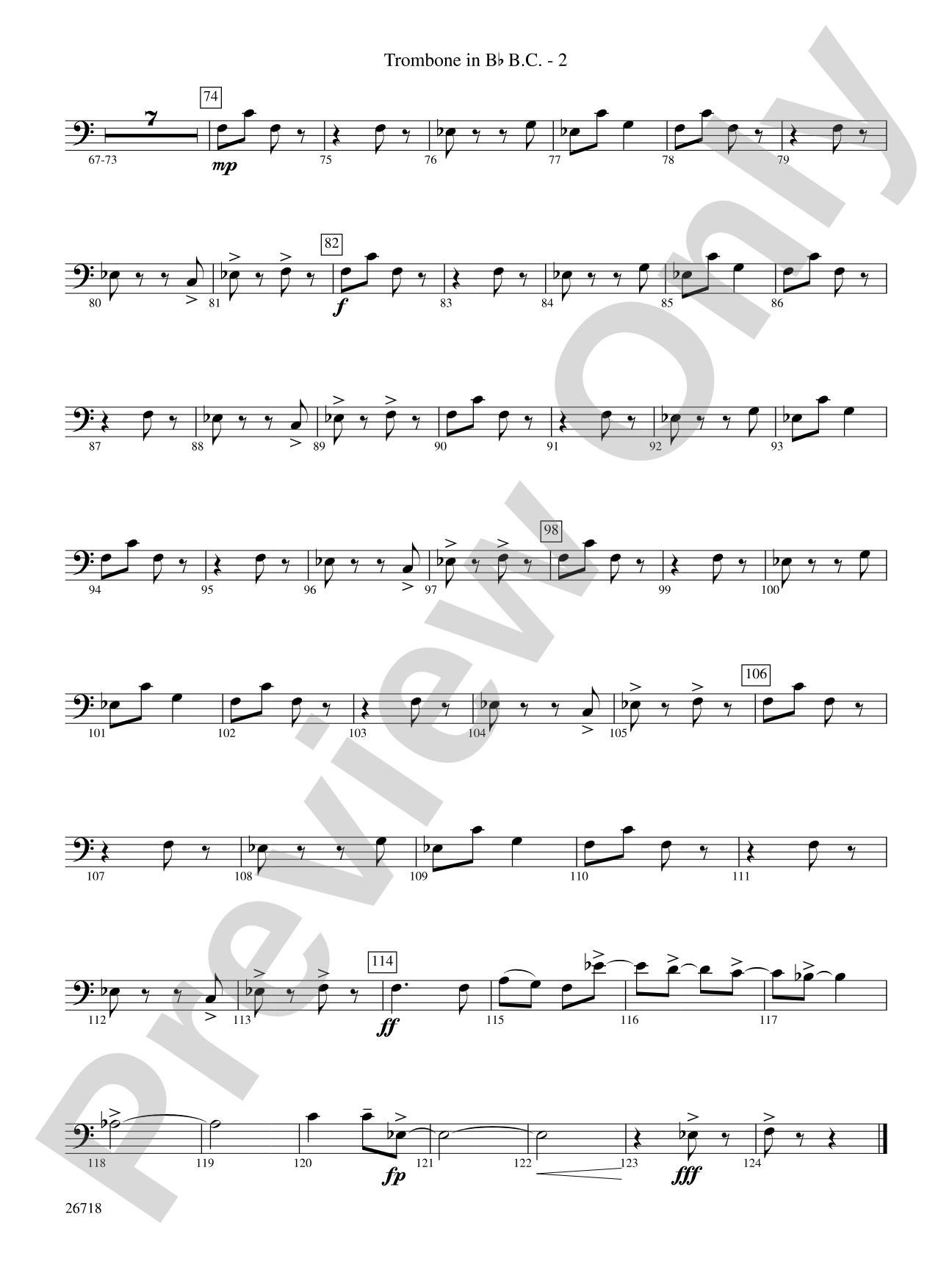

Who's Afraid of the Big Bad Samba?: (wp) 1st B-flat Trombone B.C.
Percussion Section Feature
By Nicholas Baratta
Grade: 2 (Easy)
Item: 00-PC-0001191_wpTN1BC
$3.00
Pickup currently not available
Description
A fun-filled original work that features your percussion section and serves as an excellent introduction to the samba style. Nicholas Baratta treats your young band to an exploration of the tritone in his upbeat work. Building on the percussion-section groove, the rich jazz-based harmonies make this a joy to rehearse and perform! This title is available in MakeMusic Cloud.


Don't just read it, hear it, play along with it, and watch your students grow with it. In MakeMusic Cloud, Who's Afraid of the Big Bad Samba?: (wp) 1st B-flat Trombone B.C. comes alive with professional accompaniment, adjustable tempo, and built-in practice tools that turn solo practice into real progress.
Open in the Player
Jump straight in and assign it today.
Start Your Free Trial
Open this title and explore the full library in minutes.
Sample Audio
1
Audio File
--:--
0:00
0:00
Sample Video
No sample videos found.
Additional Details
Series:
Belwin Young Band
Publisher:
Alfred Music
Page Count:
130
SKU:
00-PC-0001191_wpTN1BC
More about this title
About the Composer: Nick Baratta

Nick Baratta holds a BM in Music Education and Applied Percussion from The New England Conservatory, where he studied under BSO percussionist Frank Epstein and Vic Firth. For twenty years he served as director of bands and percussion instructor at West Genesee Central Schools in New York, building the program into a nationally competitive force; he has continued as Creative Director and arranger for the West Genesee Marching Band since 1978, guiding the ensemble to 30 New York State Championships and three Festival of States national titles.
Baratta's compositions and arrangements have been performed at the Midwest Band and Orchestra Clinic, Music Educators National Conference, Bands of America National Concert Festival, and the Percussive Arts Society National Convention. His percussion ensemble works have been programmed by ensembles at Eastman, the University of Utah, and Kent State University. He has maintained a private percussion studio since 1980 and served as an All-State selector for the New York School Music Association. Published by Alfred/Belwin since 1987, Baratta continues to consult with high school programs on competitive marching band development.
Why we love this
Baratta's percussion background shines through in every measure; the rhythmic writing is idiomatic and genuinely fun to play, and the samba groove is infectious without being simplistic. Young musicians hear immediately what makes this style swing, and the tritone exploration adds harmonic color that keeps ensemble awareness sharp while staying within Grade 2 reach.
What to expect
Bright, energetic, and surprisingly sophisticated. The samba pulse carries infectious joy while the jazz harmonies add color and sophistication that feels modern and alive. Your young musicians will feel like they're playing something real, not a simplified version of something else.
Who it's for
Young concert bands ready to explore beyond standard march and hymn-tune repertoire. This is an ideal entry point for Grade 2 ensembles curious about Latin and jazz styles, where solid fundamentals are in place but confidence in contemporary idioms may be building.
How to get the most out of it
- Let the percussion section drive the samba feel from the ground up. Lock the clave and kick drum patterns first, then have the band phrase around that rhythmic foundation rather than imposing tempo from above.
- The tritone intervals deserve ear training in sectionals. Have players isolate these harmonies to understand how they create the modern jazz flavor without obscuring the Latin style underneath.
- Balance the horn voices carefully; the rich jazz harmonies can muddy if the upper woodwinds and brass don't maintain clarity. Full-section balance checks work better here than individual part rehearsal.
- Encourage the band to listen for the percussion section during performance. Soloists and supporting players both need to feel the groove rather than simply count it.
How to use it
Program this as a crowd-pleaser alongside more traditional concert fare to showcase your ensemble's range and style flexibility. It works especially well mid-concert to shift energy and give the audience a fresh sound, or as a confident closer that leaves listeners smiling.
Skills your students will build
- Recognizing and executing samba rhythmic patterns, particularly the clave
- Understanding tritone intervals and their harmonic function in contemporary styles
- Responding to percussion-driven ensemble textures and groove-based phrasing
- Reading and playing jazz-influenced harmonies at Grade 2 level
- Balancing multiple rhythmic layers within a single ensemble sound