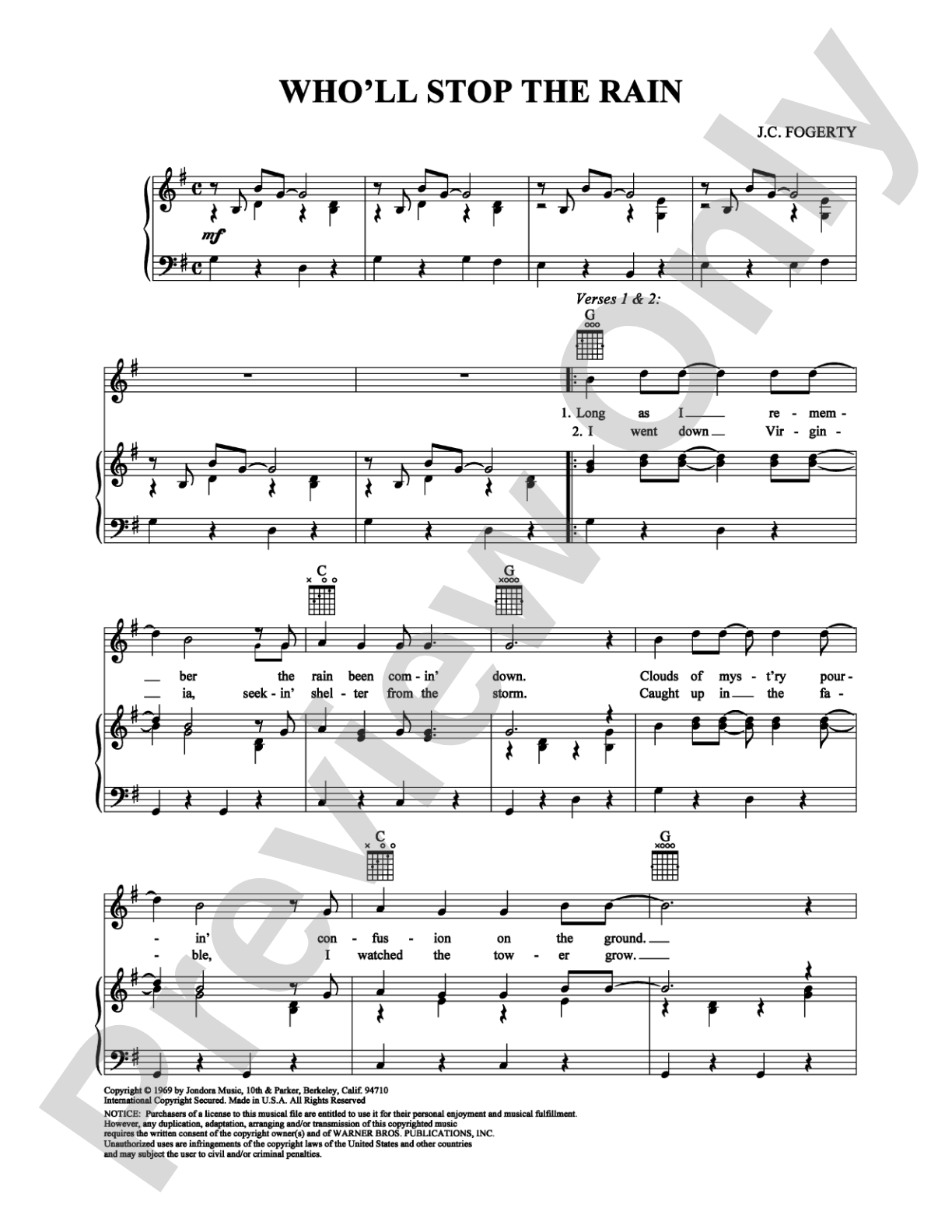
Who'll Stop the Rain?: Piano/Vocal/Chords Digital Sheet Music

Who'll Stop the Rain?: Piano/Vocal/Chords Digital Sheet Music

Creedence Clearwater Revival, John Fogerty

Item: 00-PS-0007481

Digital Download
$2.95
Description

Who'll Stop the Rain?: Piano/Vocal/Chords Digital Sheet Music isn't in MakeMusic Cloud just yet...but it could be. Let us know you'd like to see it, and you'll help shape what comes next. In the meantime, start a free trial and dive into thousands of interactive titles your students can play along with today.

Sample Audio
No sample audio found.
Sample Video
Additional Details
SKU: 00-PS-0007481

More about this title

About the Artist: Creedence Clearwater Revival

Creedence Clearwater Revival emerged from El Sobrante, California, in the late 1960s as one of rock music's most distinctive and prolific bands. Led by John Fogerty's distinctive vocals and songwriting, the group combined swamp rock, blues, and folk influences into a sound that felt both timeless and urgent. Their catalog spans just five years of studio recording but includes some of the most recognizable rock songs ever written, songs that remain staples in popular music education and performance.

The band's influence on American rock is immeasurable. Their ability to craft memorable melodies, socially aware lyrics, and tight instrumental arrangements made their music accessible to classrooms and concert stages alike. Songs like "Who'll Stop the Rain" showcase their gift for writing pieces that work equally well as rock performances and as vehicles for musicianship study, making them enduringly valuable in music education settings.

Why we love this

This song sits in that rare space where rock authenticity meets genuine musicality. The harmonic language and vocal melody are sophisticated enough to hold a serious musician's attention, yet the groove and production remain immediately graspable for students encountering rock repertoire. It's the kind of piece that proves rock songwriting deserves a seat at the table alongside traditional repertoire.

What to expect

There's an undercurrent of anxiety running beneath the driving rhythm, a sense of things spinning slightly out of control. The vocal melody has a questioning quality, almost conversational, while the accompaniment keeps steady pressure underneath. It's music that feels both grounded and unsettled.

Who it's for

Pianists and vocalists comfortable with contemporary rock idioms will find this accessible and rewarding. It works well for singers developing their ability to interpret popular music with musicality and for pianists building fluency with jazz-inflected voicings in a rock context.

How to get the most out of it

  • Let the rhythm section lock in the groove before layering vocals and harmonies; this song's power comes from a tight pocket, not from rushing the tempo.
  • Pay attention to the dynamics in the vocal line. The verses sit lower and more introspective than the chorus, which should open up and expand.
  • Balance the accompaniment so the vocal melody cuts through cleanly. Piano voicings in rock arrangements often sit in a dense middle register where they can mask the singer.
  • Capture the slight urgency and restraint of the original without overdoing it. This song is about tension, not excess.

How to use it

Consider this for a contemporary music showcase or a program exploring rock as a serious compositional tradition. It pairs well with singer-songwriter material and works as a standalone piece in a recital setting or as part of a rock-focused student concert.

Skills your students will build

  • Interpreting vocal melody over jazz-influenced chord voicings
  • Maintaining steady groove while singing expressively
  • Reading and performing slash chord symbols in a popular music context
  • Balancing vocal projection with accompaniment density

You May Also Like