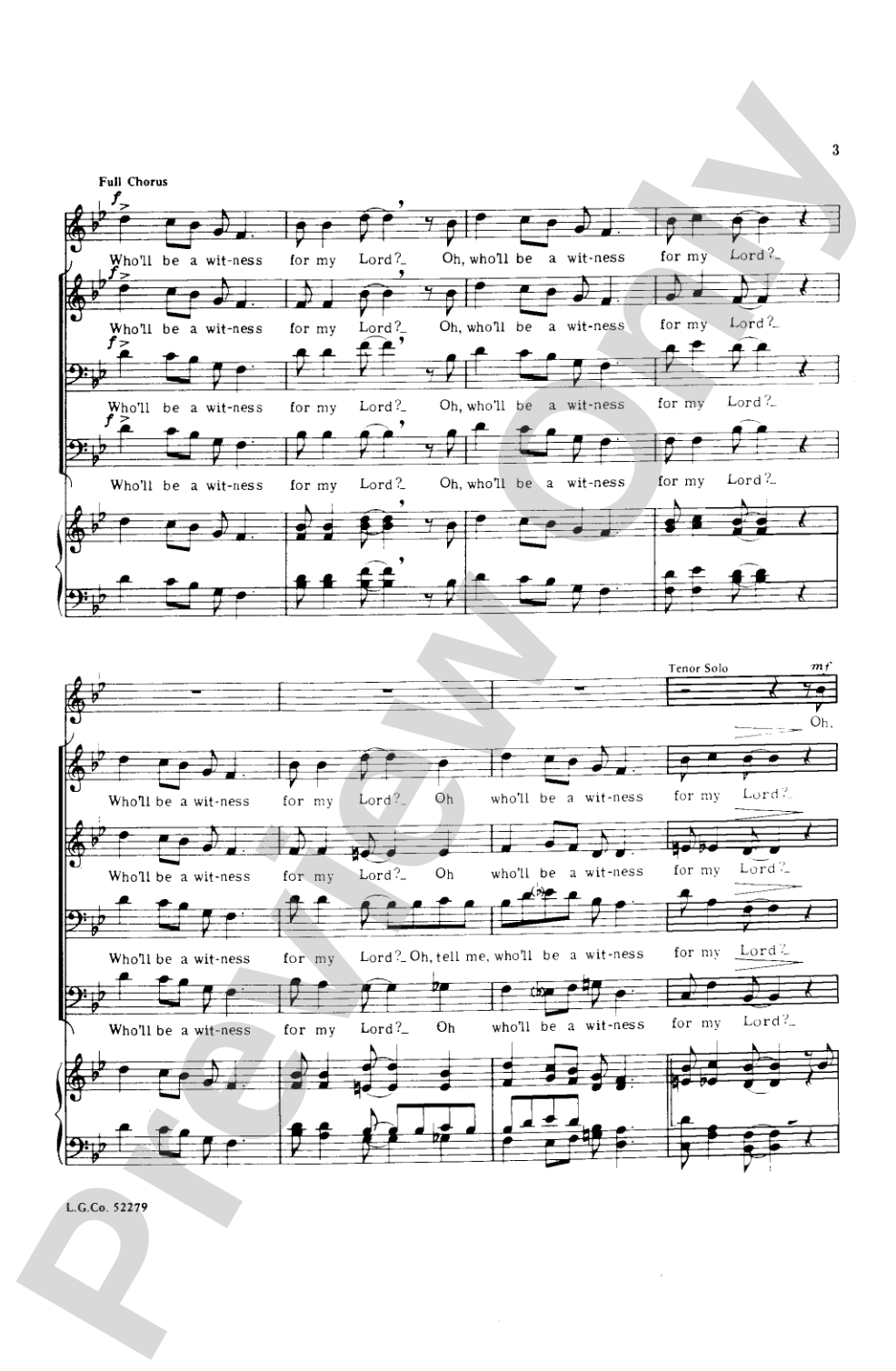
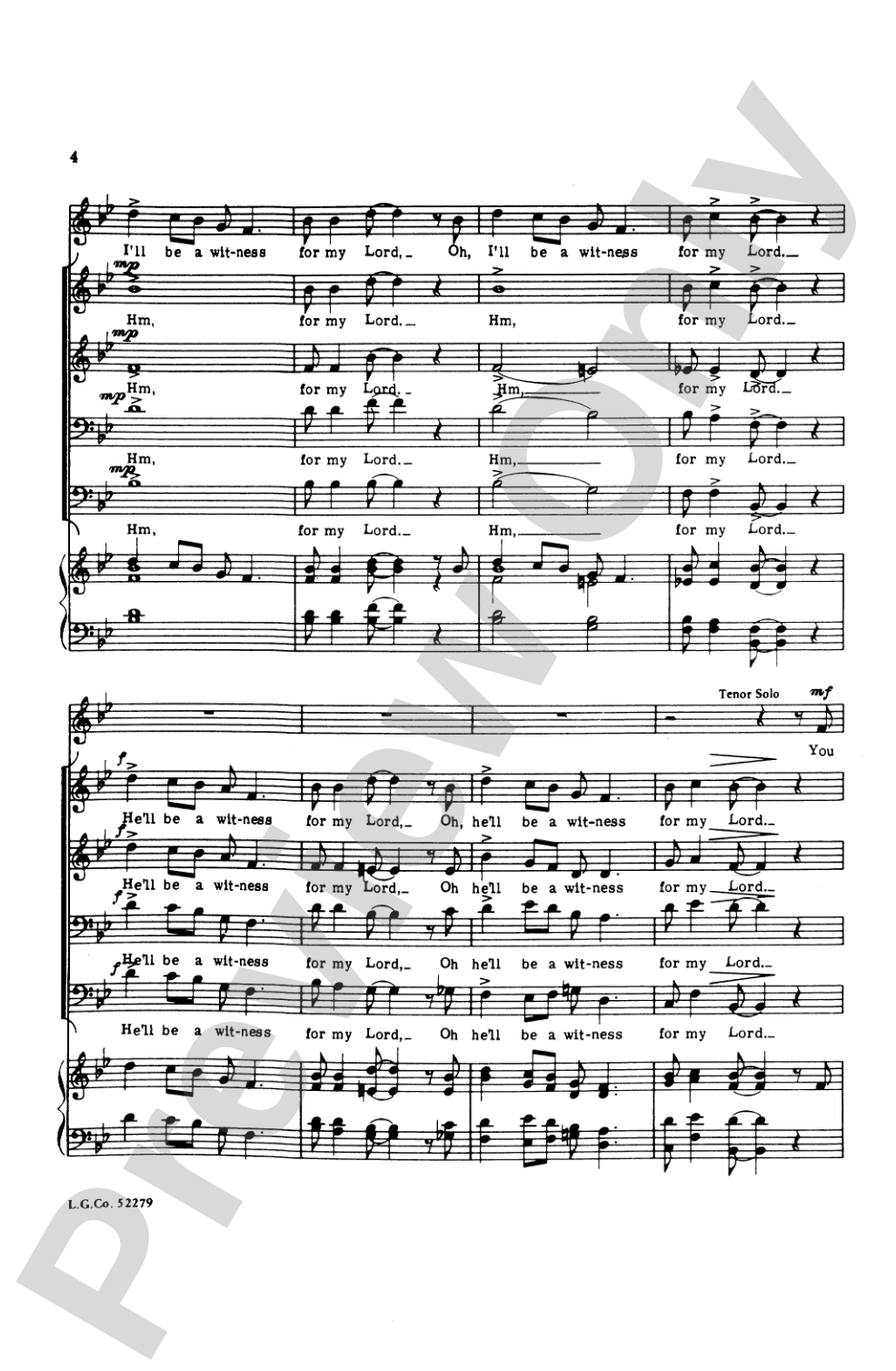
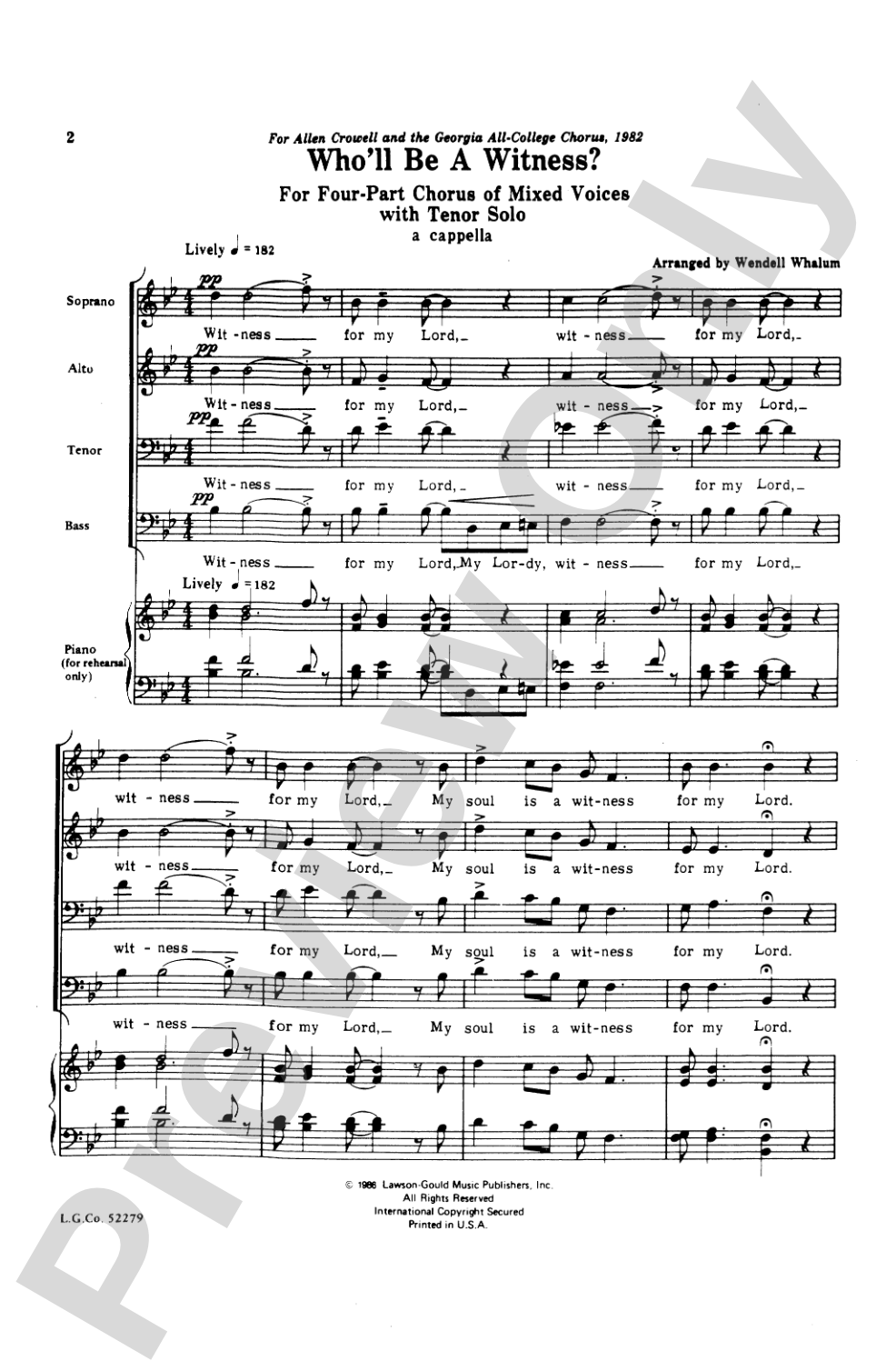
Who'll Be a Witness Sheet Music Preview

Who'll Be a Witness: SATB Choral Octavo

Arr. Wendell Whalum

Item: 00-PO-0005051

Digital Download
$2.95

Minimum order quantity: 20 copies

Description

Who'll Be a Witness: SATB Choral Octavo isn't in MakeMusic Cloud just yet...but it could be. Let us know you'd like to see it, and you'll help shape what comes next. In the meantime, start a free trial and dive into thousands of interactive titles your students can play along with today.

Sample Audio
No sample audio found.
Sample Video
Additional Details
Series: Alfred Archive Edition: Lawson-Gould Music Publishers
Publisher: Alfred Music
Page Count: 16
SKU: 00-PO-0005051

More about this title

About the Arranger: Wendell Whalum

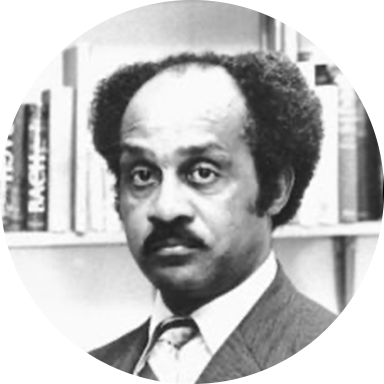
Wendell Whalum

Wendell P. Whalum brought together deep musicological training and a lifetime commitment to the spiritual traditions of African American music. A graduate of Morehouse College and the University of Iowa, he held positions as organist, conductor, and educator while earning recognition across multiple disciplines—he served on the faculty of Morehouse College as Director of the Glee Club beginning in 1953, authored scholarly work, and lectured internationally on music and culture. His memberships in Phi Beta Kappa, the American Guild of Organists, and the Music Educators National Conference reflected the breadth of his influence in both academic and performance circles.

Whalum's work as an arranger drew on intimate knowledge of the spiritual and choral traditions he championed. The University of Haiti honored him with a Doctor Honoris Causa in 1968, recognizing contributions that extended far beyond the classroom. Throughout his career, he worked to preserve and interpret the African American choral legacy for new generations of singers and audiences.

Why we love this

Whalum's hand as an arranger is evident in the authenticity and musicality of this spiritual. The a cappella setting demands ensemble cohesion and genuine musical communication from your singers—no accompaniment to hide behind—while the arrangement itself respects the integrity of the tradition. Directors consistently find this piece rewarding because it challenges singers to listen carefully to each other and delivers profound results in both concert and festival contexts.

What to expect

Intimate and powerful. Without the buffer of accompaniment, the human voices emerge in their fullest expression, and the spiritual's emotional weight lands directly. There's a directness to a cappella work that asks singers to stand fully in the music.

Who it's for

Any SATB choir ready to commit to the specific demands of unaccompanied singing. This is equally at home in a concert setting, a festival competition, or a worship context. High school and college choirs will find the musical maturity of Whalum's writing accessible yet rewarding.

How to get the most out of it

  • Balance the vocal lines by listening for the spiritual's melodic line regardless of which voice part carries it; this shifts throughout the piece, so stay flexible with your voice blend.
  • Approach the rhythmic figures with the natural speech inflection of the text rather than metronomic precision; spirituals live in the space between strict time and conversational phrasing.
  • Build dynamic contrast not through sudden changes but through the gradual layering of voices; let the arrangement's own logic guide your shaping.
  • Record sectional rehearsals and have singers listen back; without instrumental support, intonation and blend issues become immediately audible and urgent to fix.

How to use it

Program this as the centerpiece of a concert exploring African American choral traditions, or use it to cap a set of spirituals where it can serve as both climax and benediction. It also performs well as a contest piece where its a cappella requirement distinguishes it from typical accompanied fare and where its musicality speaks plainly to adjudicators.

Skills your students will build

  • Singing a cappella with secure intonation and without instrumental reference
  • Balancing multiple independent melodic lines in close harmony
  • Shaping musical phrases through text interpretation and breath placement rather than external accompaniment
  • Listening across voice parts to maintain blend and ensemble unity

You May Also Like