
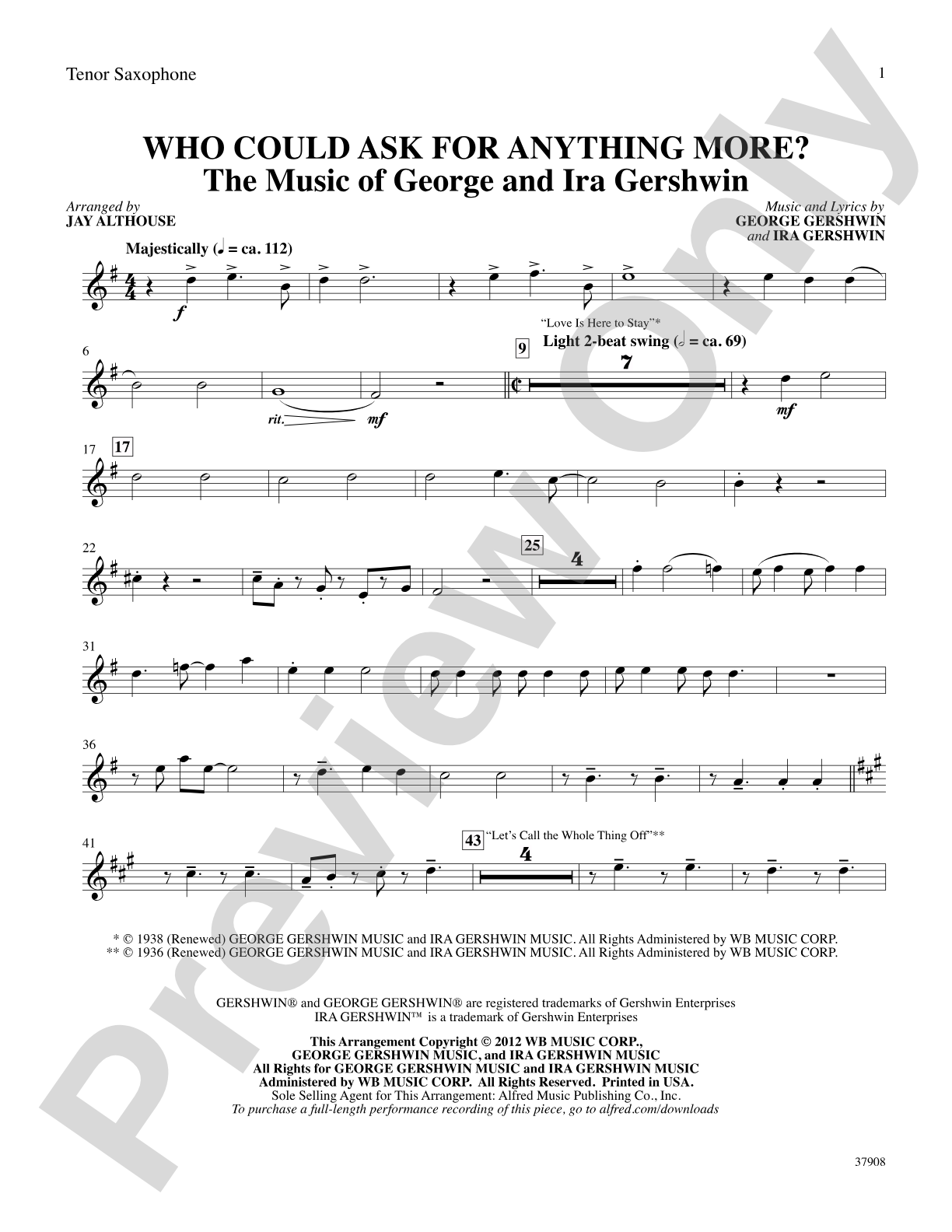

Who Could Ask for Anything More?: B-flat Tenor Saxophone: Choral SoundPax
Featuring: Love Is Here to Stay / Let's Call the Whole Thing Off / Someone to Watch Over Me / 'S Wonderful / Nice Work If You Can Get It / Embraceable You / I Got Rhythm
Music by George and Ira Gershwin / arr. Jay Althouse
Item: 00-PC-0015788_TX1
$6.00
Pickup currently not available
Description
Pay tribute to one of America's all-time greatest songwriting teams! These seven memorable compositions of George and Ira Gershwin celebrate life, love, and music. Enjoy this 8 1/2-minute medley of some of their best-known songs, arranged with flair and style.


Don't just read it, hear it, play along with it, and watch your students grow with it. In MakeMusic Cloud, Who Could Ask for Anything More?: B-flat Tenor Saxophone: Choral SoundPax comes alive with professional accompaniment, adjustable tempo, and built-in practice tools that turn solo practice into real progress.
Open in the Player
Jump straight in and assign it today.
Start Your Free Trial
Open this title and explore the full library in minutes.
Sample Audio
1
Audio File
--:--
0:00
0:00
Sample Video
No sample videos found.
Additional Details
Publisher:
Alfred Music
Page Count:
36
SKU:
00-PC-0015788_TX1
Instrumentation:
SoundPax
More about this title
About the Composer: George Gershwin
George Gershwin (1898-1937) bridged classical and popular music in ways that few composers have managed. His ability to write instantly memorable melodies, sophisticated harmonies, and music that felt both accessible and artistically ambitious made him one of the most influential American composers of the twentieth century. Working closely with his lyricist brother Ira, George created songs that defined the Jazz Age and remain central to the American songbook.
Why we love this
Jay Althouse's arrangement captures the joy and sophistication of Gershwin's original compositions while making them work beautifully for choir. The medley format lets you program genuine masterworks without requiring extended rehearsal time, and the variety across these seven songs keeps both singers and audiences engaged. This is choral repertoire that feels substantial and celebratory at the same time.
What to expect
Effervescent, witty, and warm. These songs carry the optimism and sophistication of early twentieth-century popular music, yet they never feel dated. Singing them reminds you why Gershwin's melodies have endured for a century: they're simply beautiful to sing and to hear, and they make you want to smile.
Who it's for
This arrangement suits choirs with intermediate to advanced musicianship who want to perform recognizable, beloved repertoire with substance. It works equally well for high school choirs, community and college ensembles, and professional groups looking for a strong closer or a concert highlight that audiences will immediately connect with.
How to get the most out of it
- Balance the ensemble sound carefully during the transitions between songs; each new section has its own character, and clarity matters more than volume when moving through seven distinct melodies.
- Work through the accompaniment arrangement alongside the vocal parts during early rehearsals. The SoundPax format pairs voices with piano or orchestral backing, so your singers need to hear how their lines sit within the full texture.
- Pay attention to the lyrical and rhythmic differences across these songs. Some will feel jazzy and syncopated; others more lyrical. Let those stylistic shifts come through rather than treating the medley as one continuous piece.
- Record yourselves partway through preparation. Hearing the medley in progress helps singers understand pacing and identify balance issues that might not be obvious in the rehearsal room.
How to use it
This medley works beautifully as a concert closer, especially in a program that mixes styles or honors American songwriting. At just over eight minutes, it occupies a substantial spot without dominating a concert, and it serves as an excellent vehicle for showing off your choir's ability to balance ensemble singing with stylistic nuance. It also pairs well with other American standards or jazz-influenced choral works.
Skills your students will build
- Singing through harmonic complexity and unexpected chord progressions
- Maintaining clarity and independence within a medley format
- Interpreting jazz-influenced rhythms and phrasing within a choral context
- Balancing lyrical singing with rhythmic precision across contrasting musical styles
- Blending with a recorded accompaniment and responding to its tempo and texture