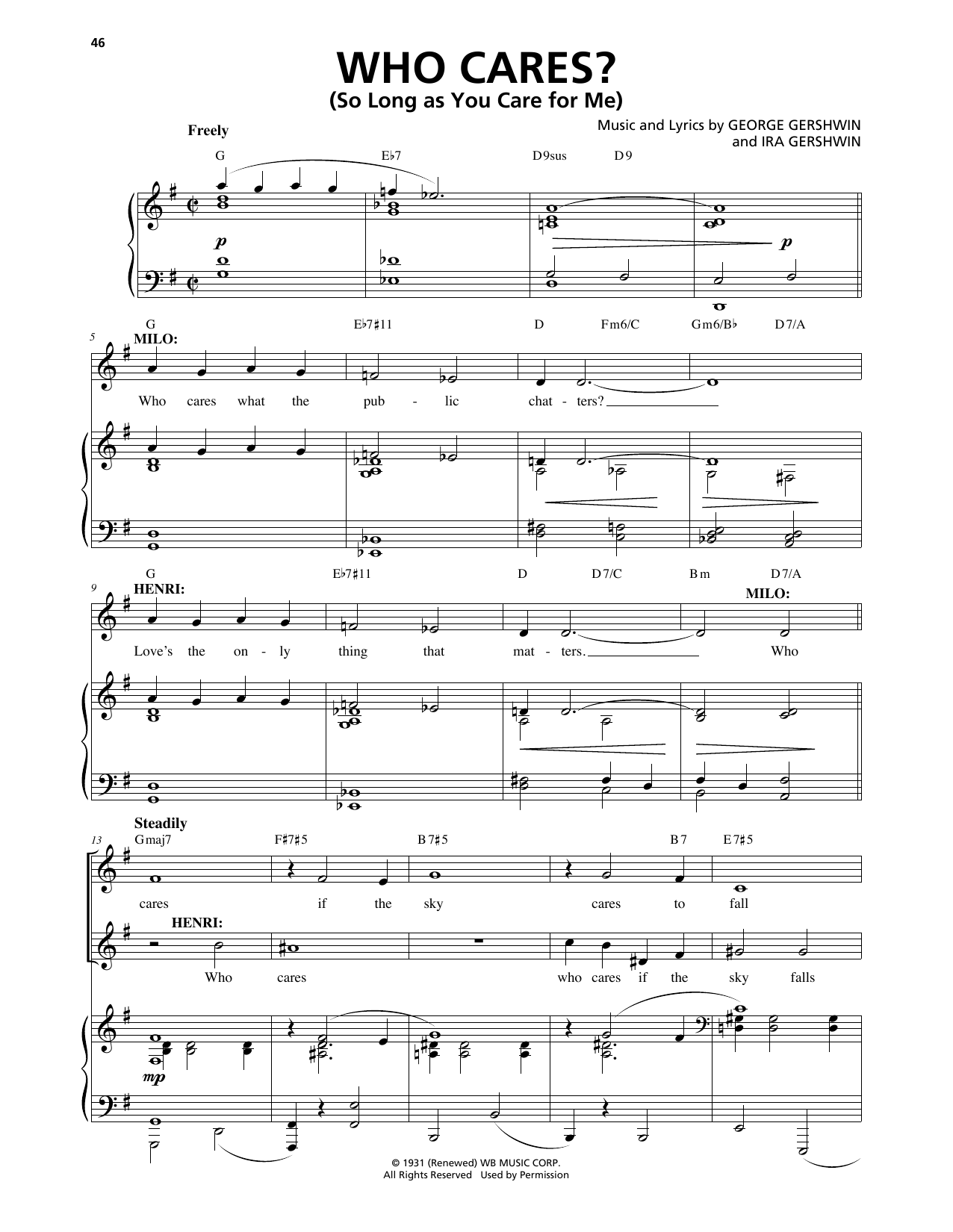
Who Cares? (So Long As You Care For Me) (from An American In Paris) Sheet Music Preview

Who Cares? (So Long As You Care For Me) (from An American In Paris): Piano Vocal

Item: 35-DS00458593

Digital Download
$5.99

One moment…

Description

Who Cares? (So Long As You Care For Me) (from An American In Paris): Piano Vocal isn't in MakeMusic Cloud just yet...but it could be. Let us know you'd like to see it, and you'll help shape what comes next. In the meantime, start a free trial and dive into thousands of interactive titles your students can play along with today.

Sample Audio
No sample audio found.
Sample Video
Additional Details
Publisher: Hal Leonard
Page Count: 3
SKU: 35-DS00458593

More about this title

About the Creator: George Gershwin

George Gershwin composed An American in Paris in 1928, a rhapsodic orchestral work that captures the vibrant energy and romantic optimism of Jazz Age Paris. The show later adapted into a 1951 film musical featuring this standard, which Gershwin wrote with his brother Ira supplying the lyrics.

Why we love this

This song sits at the intersection of jazz sophistication and Broadway accessibility, making it ideal for singers who need to navigate rubato and syncopation without drowning in complex harmonic territory. The three-page piano part provides enough detail to support a vocalist's phrasing while remaining playable for pianists at an intermediate level.

What to expect

Effortless charm wrapped around a gentle emotional core. The melody dances with a lightness that belies the sincerity of the lyrics, creating that distinctly Gershwin blend of wit and warmth.

Who it's for

Singers developing jazz phrasing and interpretation skills will find this standard manageable yet musically rewarding. Accompanists working toward fluency with jazz chord voicings and lighter touch will benefit from the clearly notated piano part.

How to get the most out of it

  • Shape the vocal line through the bridge with slight tempo elasticity; Gershwin's harmonic movement there rewards a relaxed approach rather than metronomic precision.
  • Balance the jazz voicings in the piano part so the vocal melody remains the clear focus. Accompany, don't compete.
  • Lean into the rhythmic swagger of the verse. The syncopation in both voice and piano works best when it feels conversational, not stiff.
  • Take advantage of the romantic quality in the A section by allowing space for the singer to breathe and let the lyrics land.

How to use it

Feature this in a jazz or American songbook recital where it can anchor a set of standards without overshadowing lighter pieces. It works equally well as a solo showcase or paired with other Gershwin songs to create thematic coherence.

Skills your students will build

  • Jazz phrasing and rubato in a tonal context
  • Reading and interpreting syncopated rhythms across voice and piano
  • Handling swing-style articulation and chord-tone awareness
  • Balancing vocal melody with accompaniment texture

You May Also Like