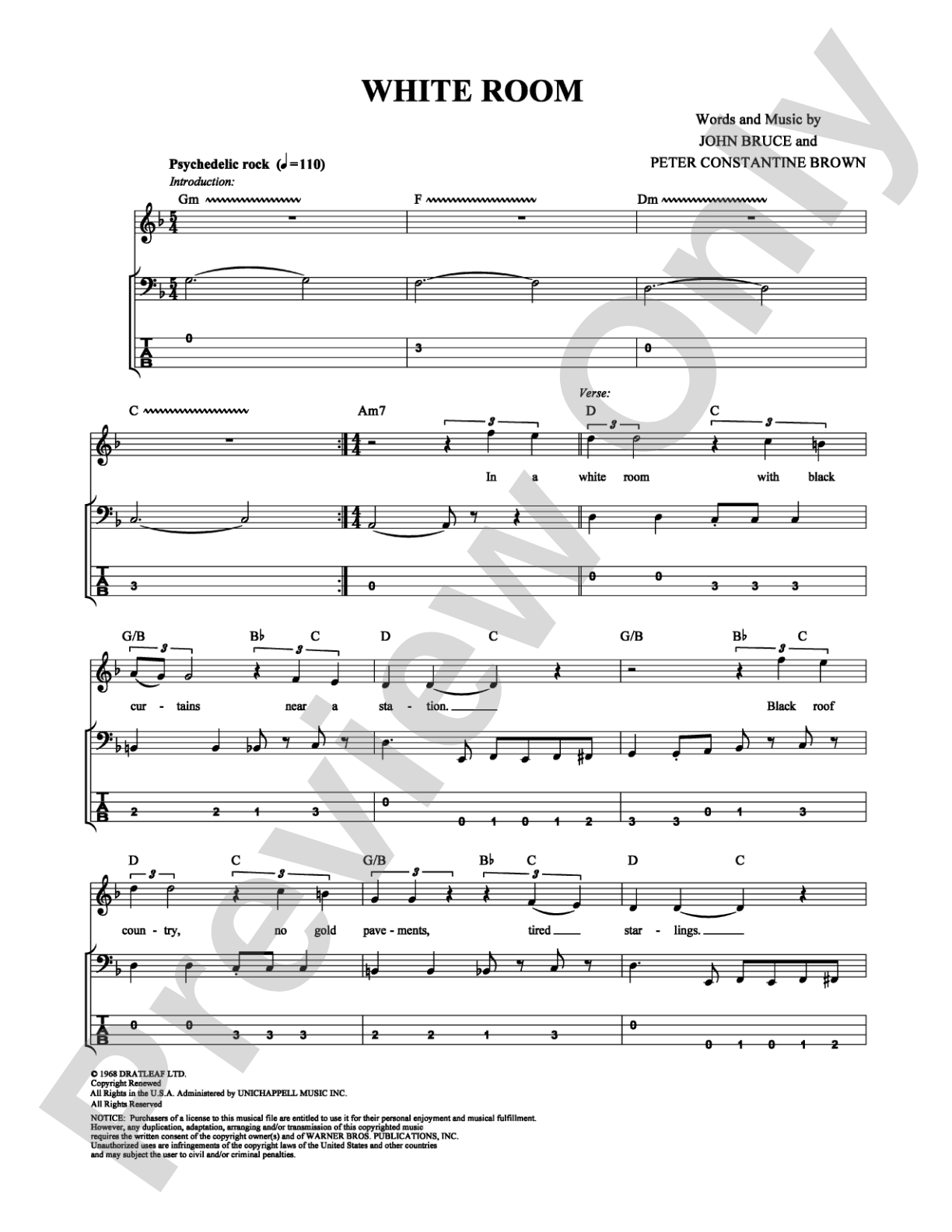
White Room: Bass TAB Digital Sheet Music

White Room: Bass TAB Digital Sheet Music

Cream, John Bruce, Peter Constantine Brown

Item: 00-PS-0003477

Digital Download
$2.99
Description

White Room: Bass TAB Digital Sheet Music isn't in MakeMusic Cloud just yet...but it could be. Let us know you'd like to see it, and you'll help shape what comes next. In the meantime, start a free trial and dive into thousands of interactive titles your students can play along with today.

Sample Audio
No sample audio found.
Sample Video
Additional Details
SKU: 00-PS-0003477

More about this title

About the Artist: Cream

Cream formed in 1966 as a British power trio featuring Jack Bruce on bass and vocals, Ginger Baker on drums, and Eric Clapton on guitar. The band pioneered the heavy blues-rock sound that would define late-1960s rock music, drawing from American blues while layering distortion and psychedelic effects into their arrangements. Their innovative approach to song structure and instrumental interplay made them one of the most influential rock groups of their era, disbanding in 1968 at the height of their popularity.

For music educators, Cream's catalog represents a crucial bridge between blues tradition and modern rock. Their songs remain teaching tools for understanding how electric instruments expanded the expressive range of traditional song forms, and how bass could function as a lead voice rather than a purely rhythmic anchor.

Why we love this

"White Room" showcases Jack Bruce's bass work at its most inventive. The bass line drives the entire track with melodic authority, making this an excellent choice for students ready to explore how bass can become a lead instrument in rock contexts. The TAB format makes it accessible without requiring a deep reading of standard notation.

What to expect

"White Room" pulses with controlled intensity. The bass line weaves around sparse instrumentation with a hypnotic, almost serpentine quality, building tension while maintaining forward momentum. You'll feel the weight of the groove without ever settling into a predictable rhythm.

Who it's for

Bass players at the intermediate to advanced level who are ready to move beyond root-position accompaniment. Students studying classic rock bass work or preparing concert programs that feature 1960s rock repertoire will find this material directly applicable.

How to get the most out of it

  • Lock into the opening bass figure early in your rehearsal process. This signature riff anchors the entire arrangement, so precision with your timing will make everything else fall into place.
  • Pay attention to the dynamic shifts between verse and chorus. The bass needs to push harder in some sections while laying back in others; the TAB should indicate these changes clearly.
  • Use the recorded track as a reference for tone and attack. Bruce's bass sound is distinct and integral to the track's character, not an afterthought.
  • Work through the bass line in sections rather than trying to nail it all at once. Break it into 4- or 8-bar phrases and master each before connecting them.

How to use it

Include this as a featured bass solo in a rock history concert or a tribute program celebrating 1960s rock innovation. It pairs well alongside other Cream selections if you're programming a band or ensemble arrangement, or it stands alone as a powerful statement of what bass can accomplish in a rock context.

Skills your students will build

  • Reading TAB notation with confidence
  • Playing melodic bass lines that function as primary voices
  • Matching tone and attack to a recorded reference
  • Navigating dynamic changes within a single song form
  • Understanding the blues-rock bass vocabulary

You May Also Like