
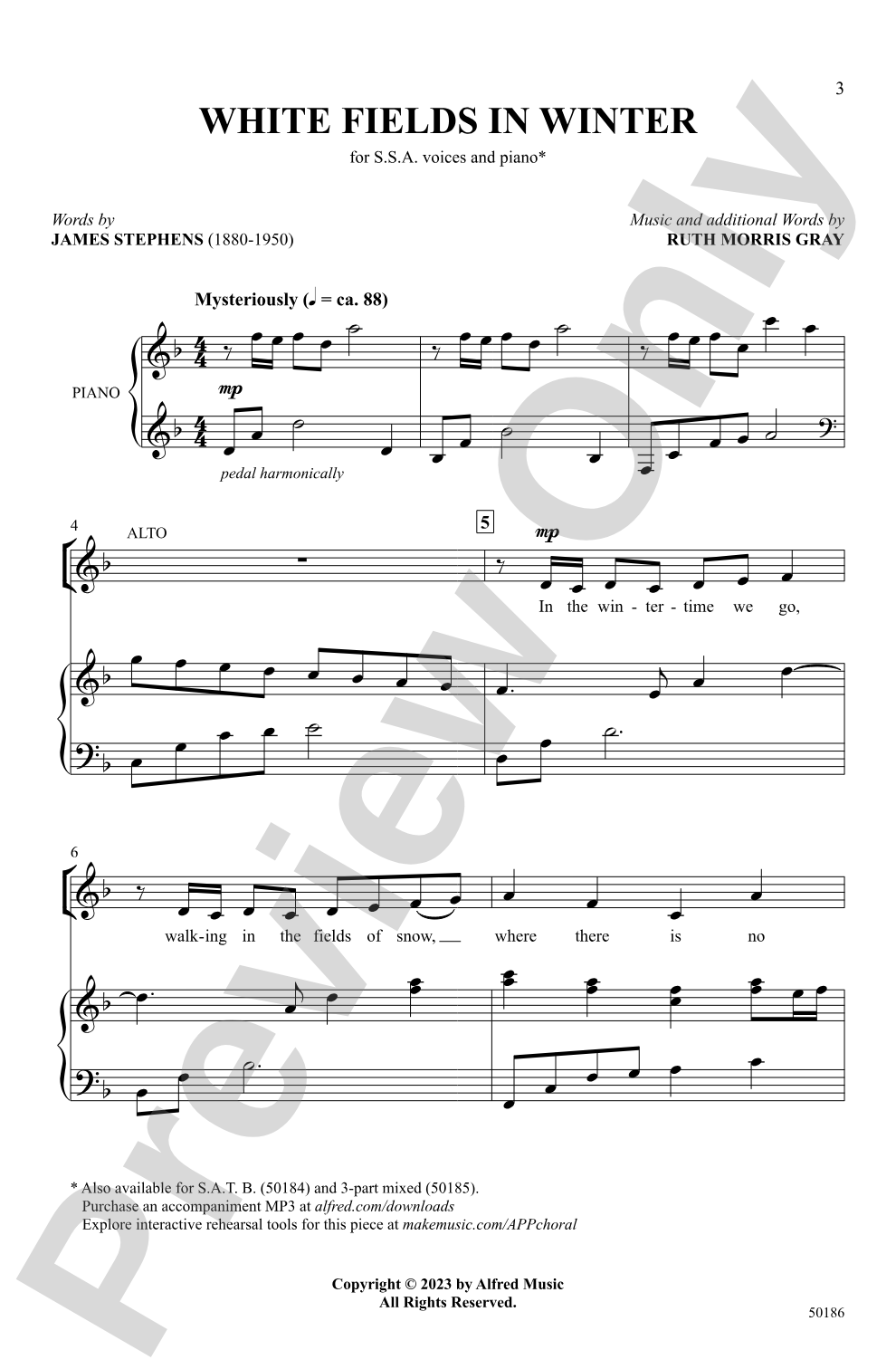

White Fields in Winter
Words by James Stephens, music by Ruth Morris Gray
Item: 00-PO-0007135
$2.05
Minimum order quantity: 20 copies
Pickup currently not available
Description
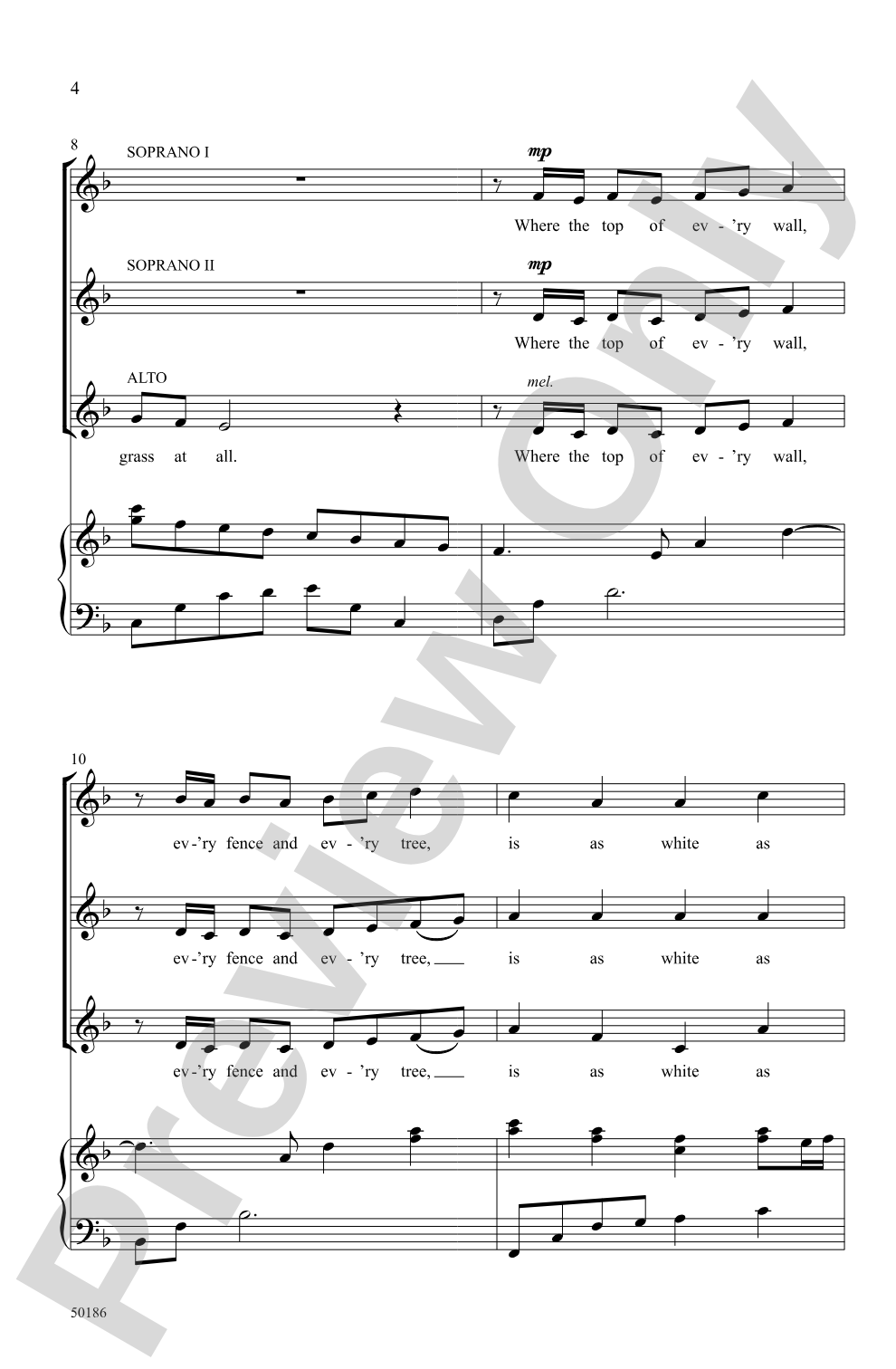
This delightful winter poem imagines footprints in the snow as "prints of silver filigree." Ruth Morris Gray's captivating musical setting seamlessly alternates between major and minor keys. Enunciate clearly on the lightly lilting verses, sing lyrically on the legato refrain, and then enjoy the surprise when the two distinct motives come together near the end.
The PerformancePlus+ series is an innovative addition to the ever-expanding MakeMusic Cloud interactive library. These engaging selections are presented with educational resources designed to enrich the rehearsal process and create outstanding performances. Including:


The PerformancePlus+ series is an innovative addition to the ever-expanding MakeMusic Cloud interactive library. These engaging selections are presented with educational resources designed to enrich the rehearsal process and create outstanding performances. Including:
- Assignment, recording, and assessment tools within MakeMusic Cloud
- Part-predominant and accompaniment tracks
- Printable sheet music (with a standard MakeMusic Cloud subscription)
- Correlated rehearsal guides and performance notes
- Rights to perform in a live or virtual setting
White Fields in Winter isn't in MakeMusic Cloud just yet...but it could be. Let us know you'd like to see it, and you'll help shape what comes next. In the meantime, start a free trial and dive into thousands of interactive titles your students can play along with today.
Request This Title
Tell us you want it.
Start Your Free Trial
Explore everything that's ready to play right now.
Sample Audio
1
Audio File
--:--
2
Audio File
--:--
Audio File
0:00
0:00
Sample Video
Additional Details
Series:
PerformancePlus+
Page Count:
12
SKU:
00-PO-0007135
More about this title
About the Composer: Ruth Morris Gray

Ruth Morris Gray holds the position of Director of Choirs at Rosemead High School in California, where she has shaped the choral program since 2004. She brings both keyboard and vocal expertise to her work, having earned a Bachelor of Music in Piano Performance and Composition from Biola University and a Master of Arts in Music Composition from UC Santa Barbara. With over 100 published choral compositions to her name, Gray has established herself as a prolific voice in contemporary choral music while maintaining her commitment to classroom teaching and performance.
Beyond the rehearsal room, Gray pursues an active life that includes travel, swimming, reading, and cycling adventures with her husband Douglas. Her diverse interests inform the lyrical sensibility and poetic sensibility evident in her compositions, many of which pair carefully chosen texts with accessible yet sophisticated musical settings.
Why we love this
Gray's alternation between major and minor tonalities creates a sophisticated harmonic landscape that feels both modern and emotionally resonant. The structural design rewards clear choral technique: distinct motives in the verses and refrain give singers distinct expressive territory to inhabit, and the final convergence of both ideas arrives as a genuinely satisfying payoff rather than a predictable conclusion. This is the kind of piece that demonstrates what contemporary choral writing can accomplish when it combines poetic sensitivity with direct musical purpose.
What to expect
The opening verses float lightly, inviting listeners into a quiet winter landscape rendered in delicate detail. As the refrain arrives, the music deepens into a more lyrical, sustained quality that feels like stepping into shelter. Gray's interplay of major and minor modes creates subtle emotional shifts that mirror the poem's own movement from observation to reflection, culminating in a moment where the two musical strands finally embrace.
Who it's for
This piece suits women's choirs across secondary and adult ensemble levels. The text and moderate range make it accessible to developing singers, while the tonal sophistication and form reward more advanced groups seeking rewarding contemporary literature.
How to get the most out of it
- Focus on textual clarity during the verses by treating each syllable with intentional articulation. Gray's rhythmic setting aligns with natural speech patterns, so avoid over-legato phrasing in these sections.
- Reserve your fullest legato singing for the refrain, where the harmonic movement and text demand sustained tonal beauty. The contrast will make the return to lighter verse material feel refreshed.
- Listen carefully to how the two motives interact as they approach the final section. Balance each voice part so that the moment they converge reads as a unified whole rather than layered fragments.
- Use the recorded accompaniment to locate the harmonic shifts between major and minor. These tonal changes are central to the piece's emotional arc and should inform your phrasing choices even when singing unaccompanied passages.
How to use it
Pair this with other contemporary pieces that draw from literary sources to create a cohesive concert segment on poetry and music. Its moderate length and accessible subject matter also make it ideal for a mid-winter concert alongside both traditional and modern seasonal repertoire. The literary sophistication elevates a holiday or winter-themed concert beyond typical seasonal fare.
Skills your students will build
- Singing major and minor tonalities with secure intonation in each mode
- Distinguishing and executing contrasting articulation styles within a single piece (lighter verses versus legato refrain)
- Following harmonic movement through tonal shifts to inform phrasing and dynamic shape
- Balancing multiple melodic motives when they combine, maintaining textural clarity