
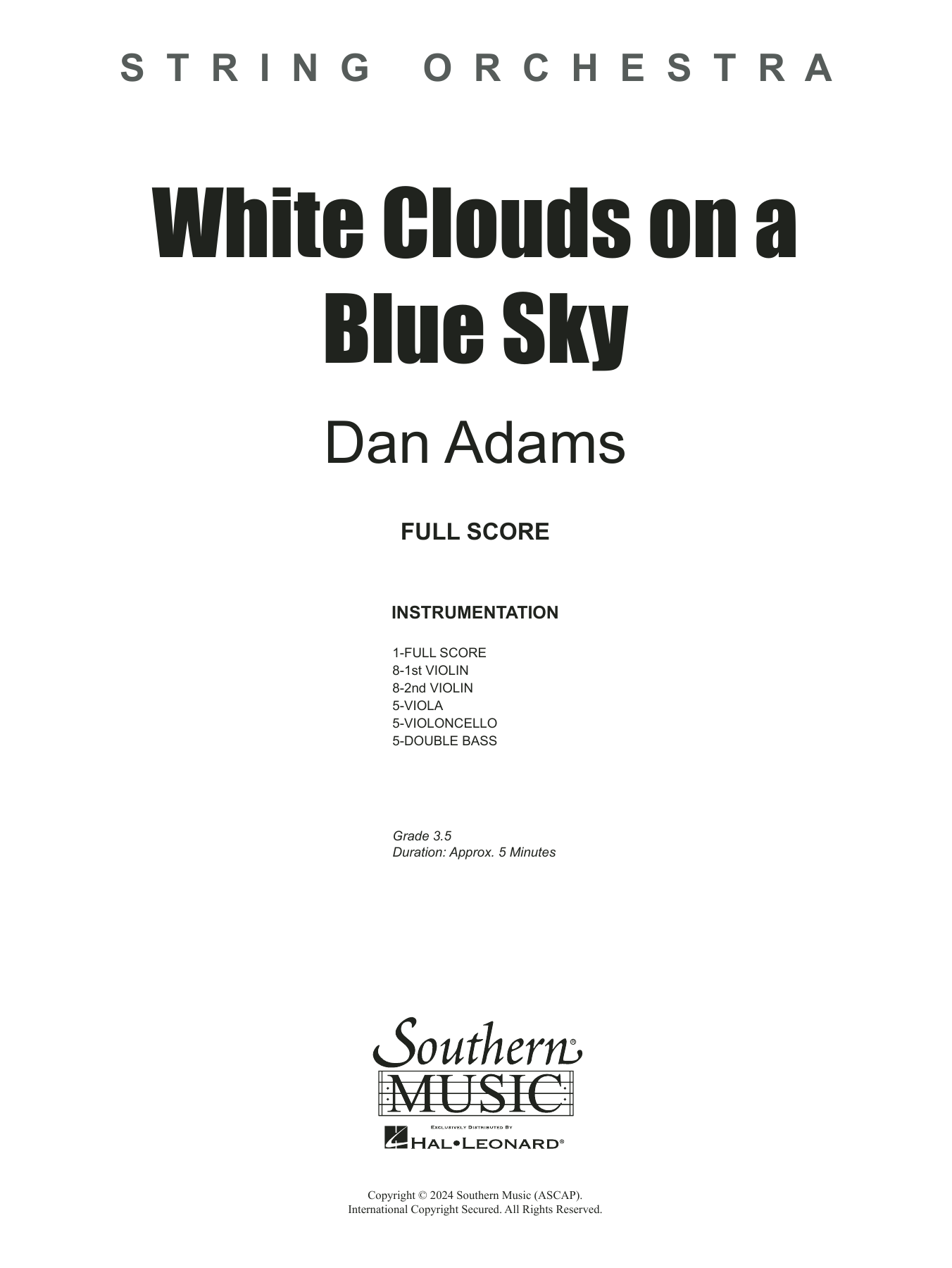

White Clouds On A Blue Sky: String Orchestra Conductor Score & Parts
By Dan Adams
Grade: 3.5
Item: 35-PK01512412
$55.00
Pickup currently not available
Buy Extra Parts (Digital PDF Download)
| Product | Price | Quantity |
|---|---|---|
| White Clouds On A Blue Sky - Full Score | $6.00 | |
| White Clouds On A Blue Sky - Violin 1 | $2.50 | |
| White Clouds On A Blue Sky - Violin 2 | $2.50 | |
| White Clouds On A Blue Sky - Viola | $2.50 | |
| White Clouds On A Blue Sky - Violoncello | $2.50 | |
| White Clouds On A Blue Sky - Double Bass | $2.50 |
Parts Added to Cart!
Description
There is nothing like the beauty of a clear blue sky on a spring or summer day. Lying on a blanket as you look up, whether in soft grass or on a sandy beach, its a time to take a deep breath and appreciate how small you are in comparison to everything above you. One might say, however, that a parade of fluffy white clouds floating by is far more interesting and peaceful. Clouds at a higher altitude barely seem to move at all, while clouds nearer to the ground sail past more quickly, all the time changing their relationship to one another as they move. Its hard not to imagine characters and shapes in the formations. A bear? A dog? A boat? The imagination is sparked... there are WHITE CLOUDS ON A BLUE SKY.


White Clouds On A Blue Sky: String Orchestra Conductor Score & Parts isn't in MakeMusic Cloud just yet...but it could be. Let us know you'd like to see it, and you'll help shape what comes next. In the meantime, start a free trial and dive into thousands of interactive titles your students can play along with today.
Request This Title
Tell us you want it.
Start Your Free Trial
Explore everything that's ready to play right now.
Sample Audio
No sample audio found.
Sample Video
No sample videos found.
Additional Details
Publisher:
Hal Leonard
SKU:
35-PK01512412
More about this title
About the Composer: Dan Adams

Dan Adams spent nearly thirty years leading instrumental programs in the Wooster City Schools, where he shaped generations of young musicians as both band and orchestra director. His credentials include a Bachelor of Music Education from The Ohio State University and a Master of Music in Conducting from Northwestern University, where he studied under the renowned John Paynter.
Throughout his career, Adams has remained active as an adjudicator, conductor, and brass performer. His compositions have earned substantial recognition, appearing at prestigious festivals like The Midwest Band Clinic and the Western International Band Clinic, and securing multiple J.W. Pepper Editors' Choice honors and Bandworld Top 100 placements.
Why we love this
Adams captures something genuinely cinematic here without resorting to bombast or overly literal tone painting. The piece trusts young string players to find character in floating, interconnected lines rather than hitting predetermined emotional beats. It's the kind of writing that makes orchestras sound more mature and musicians more thoughtful about phrasing and ensemble listening.
What to expect
The score unfolds with gentle motion and open space, letting instrumental lines drift and intersect like clouds themselves changing shape. There's contemplative beauty throughout, inviting musicians and listeners alike into that suspended moment of lying on grass and watching the sky evolve.
Who it's for
This works beautifully for school orchestras working at the Grade 3.5 level who want to explore sustained, lyrical writing. Directors looking for a concert piece that's accessible but musically legitimate will find real substance here.
How to get the most out of it
- Shape phrases across the bar lines rather than in isolated measures; the clouds move continuously, never stopping or resetting.
- Balance upper strings carefully so that thematic material emerges naturally without forced prominence.
- Experiment with subtle tempo flexibility to mirror how clouds seem to drift at different rates depending on altitude.
- Encourage violins and violas to listen across sections; entrances should feel like clouds drifting into view, not announcements.
How to use it
Pair this with something more rhythmically driven or structurally distinct to create a well-rounded concert arc. It sits naturally as a contrasting middle piece that gives both audience and orchestra a chance to breathe before returning to more active repertoire.
Skills your students will build
- Sustaining long phrases across multiple measures
- Listening for balance within chorale-like textures
- Creating dynamic shaping without obvious climactic moments
- Ensemble intonation in slower tempos