
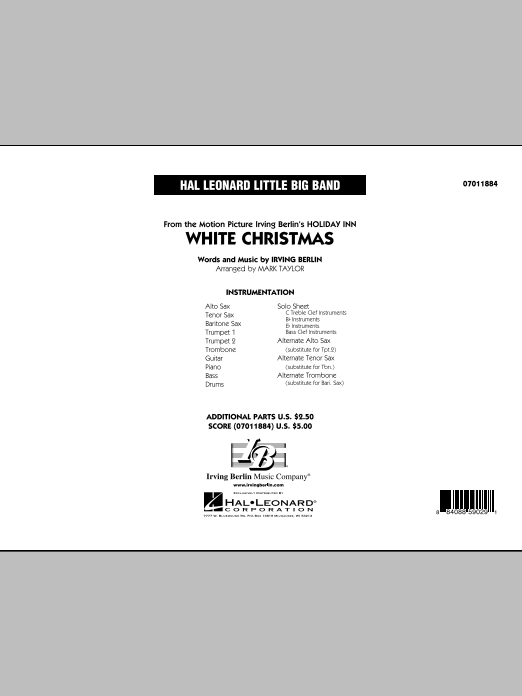

White Christmas: Jazz Ensemble Conductor Score & Parts
By Irving Berlin / Arranged by Mark Taylor
Grade: 3-4
Item: 35-PK00185299
$50.00
Pickup currently not available
Buy Extra Parts (Digital PDF Download)
| Product | Price | Quantity |
|---|---|---|
| White Christmas - Full Score | $6.00 | |
| White Christmas - Alto Sax | $6.00 | |
| White Christmas - Tenor Sax | $6.00 | |
| White Christmas - Baritone Sax | $6.00 | |
| White Christmas - Trumpet 1 | $6.00 | |
| White Christmas - Trumpet 2 | $6.00 | |
| White Christmas - Trombone | $6.00 | |
| White Christmas - Guitar | $6.00 | |
| White Christmas - Piano | $6.00 | |
| White Christmas - Bass | $6.00 | |
| White Christmas - Drums | $6.00 | |
| White Christmas - C Solo Sheet | $6.00 | |
| White Christmas - Bb Solo Sheet | $6.00 | |
| White Christmas - Eb Solo Sheet | $6.00 | |
| White Christmas - Bass Clef Solo Sheet | $6.00 | |
| White Christmas - Alternate Alto Sax | $6.00 | |
| White Christmas - Alternate Tenor Sax | $6.00 | |
| White Christmas - Alternate Trombone | $6.00 |
Parts Added to Cart!
Description
Enhance any holiday concert with Mark's smooth light bossa treatment of one of Irving Berlin's most popular songs. Scored for 6 horns, this arrangement will sound great with limited amount of rehearsal time.


White Christmas: Jazz Ensemble Conductor Score & Parts isn't in MakeMusic Cloud just yet...but it could be. Let us know you'd like to see it, and you'll help shape what comes next. In the meantime, start a free trial and dive into thousands of interactive titles your students can play along with today.
Request This Title
Tell us you want it.
Start Your Free Trial
Explore everything that's ready to play right now.
Sample Audio
No sample audio found.
Sample Video
No sample videos found.
Additional Details
Publisher:
Hal Leonard
SKU:
35-PK00185299
More about this title
About the Composer: Irving Berlin
Irving Berlin stands as one of the most prolific songwriters in American music history, composing over 1,000 songs across stage, film, and popular music from the early 1900s through the 1960s. His melodies are instantly recognizable and sit perfectly in the human voice, making them enduringly popular across generations and instrumental settings alike.
Berlin's genius lay in crafting songs that feel simple yet sophisticated, memorable yet never trite. His work defined the American songbook, and educators value his compositions because they balance accessibility with genuine musical substance. Students playing Berlin learn the architecture of great melody.
Why we love this
Mark Taylor's bossa arrangement transforms a seasonal standard into something that swings without demanding extensive sectional rehearsals. The light touch respects Berlin's melody while giving your ensemble a contemporary sound that audiences genuinely enjoy. Six horns keeps the piece manageable for most programs while maintaining full harmonic color.
What to expect
Warm and unhurried, like a festive evening that doesn't need to prove anything. The bossa rhythm gives it an urbane sophistication while the familiar melody keeps it grounded in the joy of the season. Taylor's harmonies suggest relaxation rather than complexity.
Who it's for
Directors programming holiday concerts who want something more sophisticated than standard arrangements, but who face realistic time constraints in December. Jazz ensembles at the intermediate level will find this approachable enough to sound polished quickly, while still offering genuine musical interest.
How to get the most out of it
- Balance the melody clearly in the first chorus so the audience recognizes the tune immediately, then let the rhythm section settle into a relaxed groove underneath.
- Lock the comping rhythms between guitar and piano early in rehearsal; their interaction defines the bossa feel and everything else rests on that foundation.
- Have your trumpet or lead alto breathe musically during longer phrases rather than breaking at every bar line. This keeps the melody feeling conversational.
- Use the recorded accompaniment in section rehearsals to give soloists a clear sense of how their part sits against the harmonic movement.
How to use it
Position this as your second-half opener or a transition piece between your concert's traditional and contemporary sections. It works equally well as a closing number that sends audiences out in good spirits. This is also an excellent vehicle for featuring a strong rhythm section soloist if your program structure allows.
Skills your students will build
- Reading and interpreting jazz articulation marks in both comping and solo contexts
- Balancing harmonic support with rhythmic independence
- Executing a steady bossa nova feel across an entire ensemble
- Shaping longer melodic lines with appropriate jazz phrasing and breath placement
- Responding to ensemble dynamics in a groove-based setting