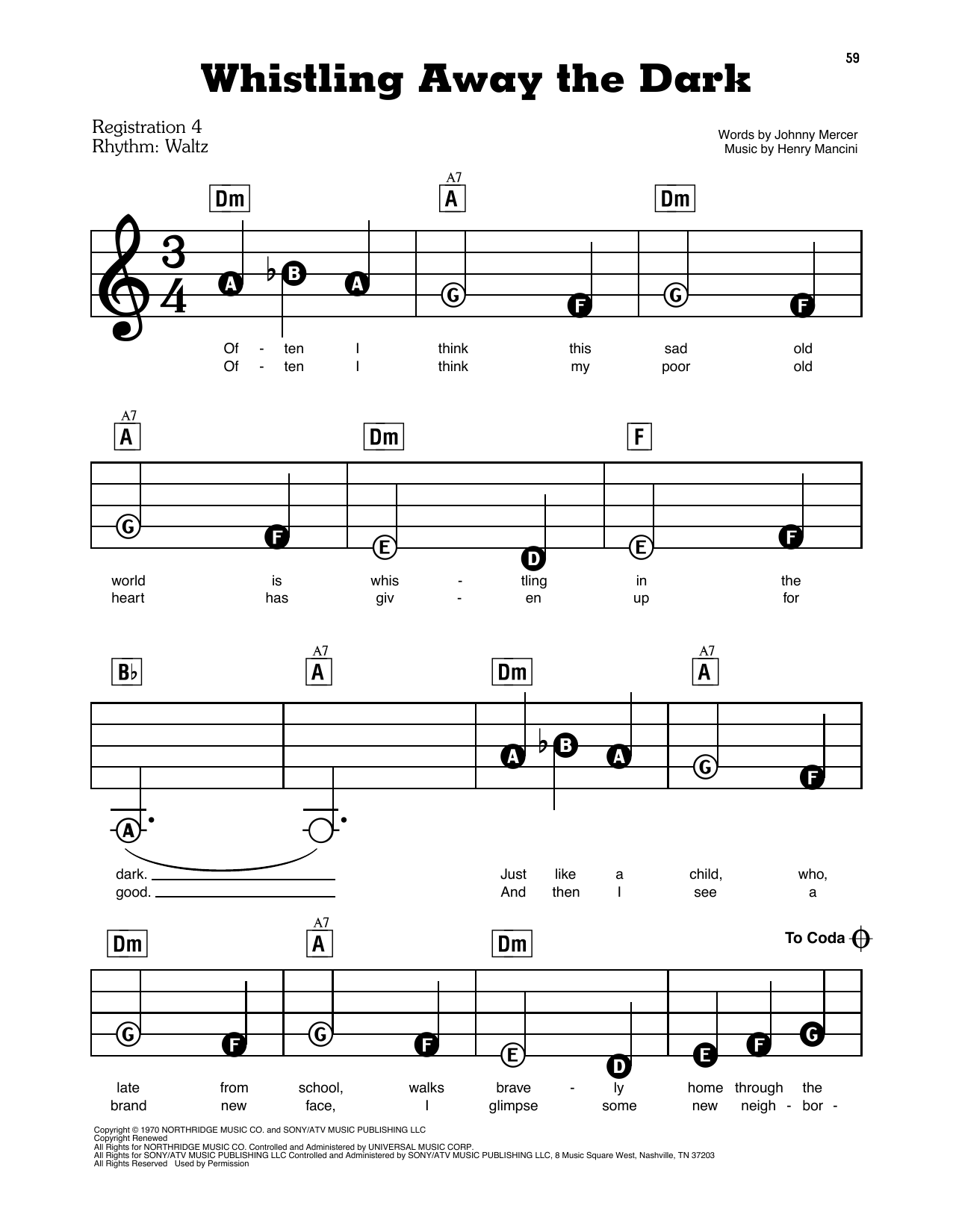
Whistling Away The Dark (from Darling Lili) Sheet Music Preview

Whistling Away The Dark (from Darling Lili): E-Z Play Today

By Henry Mancini

Item: 35-DS00497815

Digital Download
$4.99
Description

Whistling Away The Dark (from Darling Lili): E-Z Play Today isn't in MakeMusic Cloud just yet...but it could be. Let us know you'd like to see it, and you'll help shape what comes next. In the meantime, start a free trial and dive into thousands of interactive titles your students can play along with today.

Sample Audio
No sample audio found.
Sample Video
Additional Details
Publisher: Hal Leonard
Page Count: 3
SKU: 35-DS00497815

More about this title

About the Composer: Henry Mancini

Henry Mancini (1924-1994) was one of the most prolific and respected film composers of the twentieth century. His gift for crafting memorable melodies that served the narrative while standing alone as concert pieces made him a bridge between classical training and popular music. Mancini won four Academy Awards and eighteen Grammy Awards, and his work remains central to music education because it demonstrates how sophisticated harmonic language and orchestration can coexist with immediate accessibility.

Why we love this

Mancini's score for Darling Lili captures the elegance of 1960s film songwriting, and this solo piano arrangement preserves the warmth of the original without requiring orchestral forces. The melody sits naturally on the keyboard, the harmonic progression rewards careful pedaling, and students encounter jazz voicings in a film music context rather than an abstract one. Programming this gives students a tasteful alternative to typical "movie music" selections while introducing them to a composer whose catalog shaped American popular music.

What to expect

The piece radiates a gentle, reflective quality reminiscent of a quiet moment in a film score. There's an underlying sadness balanced by the loveliness of the melody, creating the sense of someone processing emotion through music rather than stating it directly. The accompaniment is unobtrusive but harmonically rich, supporting rather than overwhelming the line.

Who it's for

Pianists at the intermediate level who are ready to interpret beyond the written notes and teachers building a film music unit in their curriculum. This arrangement works for students developing taste in popular song and those exploring how twentieth-century composers blended classical training with contemporary idioms.

How to get the most out of it

  • Balance the melody line so it sings over the accompaniment; Mancini intended this as a tune you remember, not as accompaniment that happens to have a tune in it.
  • Let the pedal sustain the jazz harmonies without blurring them; change strategically rather than holding throughout.
  • Shape the phrase toward natural breathing points rather than playing metronomically. This is a song first, a piano piece second.
  • Approach the harmonies with attention to voice leading in the left hand. The movement between chords creates much of the piece's sophistication.

How to use it

Pair this with other Mancini compositions to demonstrate his stylistic range, or place it in a concert exploring how cinema shaped mid-century songwriting. It also serves as a bridge piece for students transitioning from classical repertoire to jazz and popular music contexts, showing them that the skills they've developed transfer directly.

Skills your students will build

  • Pedaling technique for sustaining jazz voicings without muddiness
  • Melodic phrasing in a popular song context
  • Reading jazz harmony and voice leading in left-hand accompaniment
  • Balancing melody and accompaniment with independence between hands
  • Interpreting film music with appropriate rubato and emotional coloring

You May Also Like