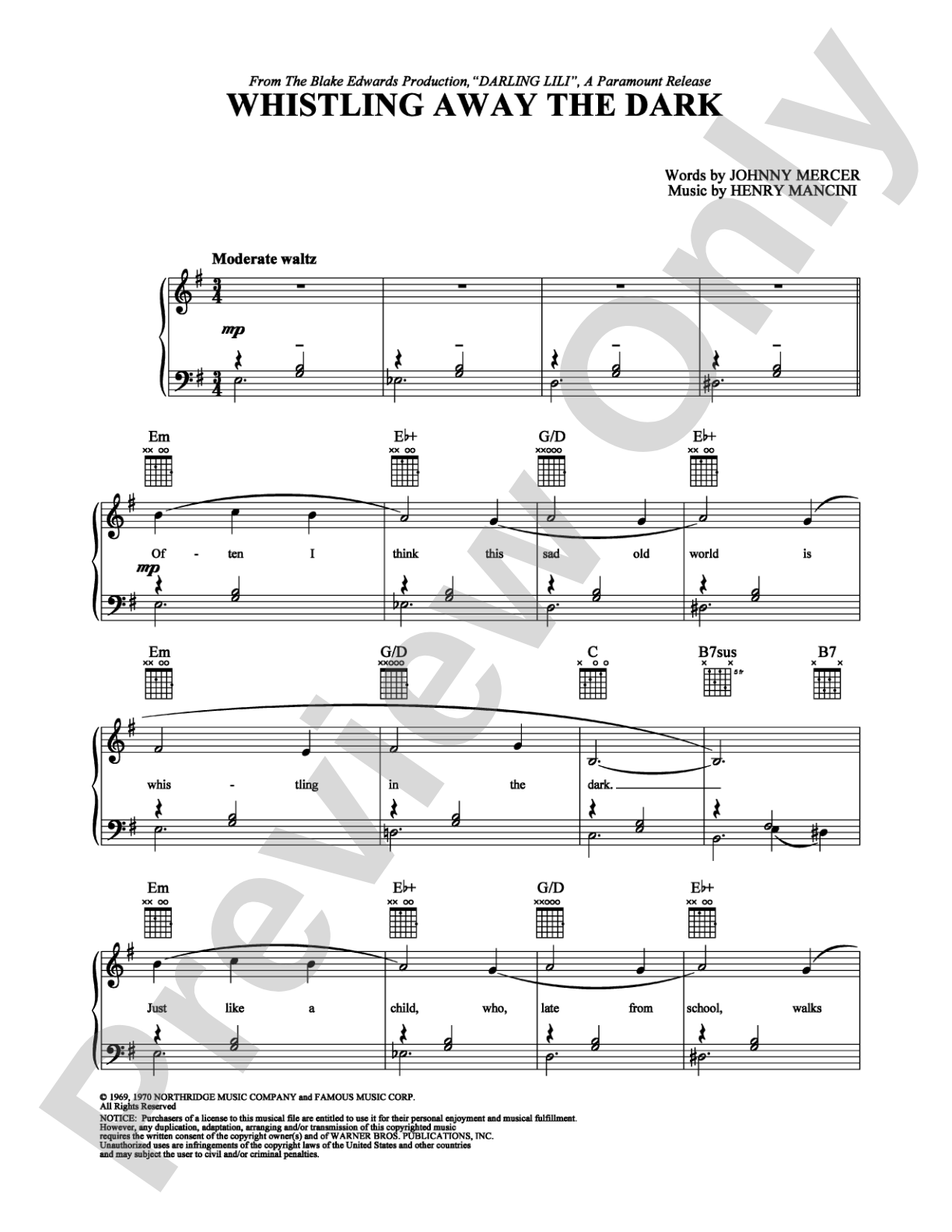
Whistling Away the Dark: Piano/Vocal/Chords Digital Sheet Music

Whistling Away the Dark: Piano/Vocal/Chords Digital Sheet Music

Henry Mancini, Julie Andrews

Item: 00-PS-0004443

Digital Download
$2.95
Description

Whistling Away the Dark: Piano/Vocal/Chords Digital Sheet Music isn't in MakeMusic Cloud just yet...but it could be. Let us know you'd like to see it, and you'll help shape what comes next. In the meantime, start a free trial and dive into thousands of interactive titles your students can play along with today.

Sample Audio
No sample audio found.
Sample Video
Additional Details
SKU: 00-PS-0004443

More about this title

About the Artist: Julie Andrews

Julie Andrews is a soprano and actress whose career spans Broadway, film, and television. Her crystal-clear vocal quality and musicianship made her one of the most recognizable performers of the late 20th century, starring in landmark productions like "The Sound of Music" and "My Fair Lady." For music educators and students, her recordings remain essential examples of legible, expressive vocal performance and interpretive clarity.

Beyond her fame, Andrews is a skilled musician who understands song structure and lyrical communication. Her approach to melody prioritizes clarity without sacrificing emotional depth, making her recordings valuable study material for vocalists learning how to serve both the composer's intentions and the storyteller's arc.

Why we love this

This is a Stephen Sondheim composition from a motion picture soundtrack, which means the song carries both theatrical sophistication and cinematic accessibility. Andrews's original recording demonstrates mature vocal phrasing and emotional restraint, showing singers how to convey introspection without oversinging. The piano/vocal/chords format gives your students a complete, performance-ready resource that honors both the melodic line and the harmonic context.

What to expect

The song unfolds with quiet introspection, creating a sense of gentle reflection rather than grand gestures. The melody moves with conversational phrasing while the harmony provides subtle emotional depth, inviting the singer to inhabit a moment of private acceptance and peace.

Who it's for

Vocalists and singer-pianists exploring art song repertoire and theatrical music will find this a rewarding study. High school and college students developing expressive singing skills benefit from Sondheim's sophisticated melodic and harmonic language. Voice teachers can use this as a bridge between classical song literature and contemporary musical theater standards.

How to get the most out of it

  • Pay attention to the lyrical subtext and let it shape your phrasing; this song gains power through quietness rather than volume.
  • Study how the melody sits in relation to the harmonic rhythm; Sondheim's timing requires precision in coordination between voice and piano.
  • Balance the vocal line clearly without losing the piano's harmonic support; neither element should dominate the intimate quality of the arrangement.
  • Practice the song's dynamic shape carefully; maintaining engagement during soft passages requires technique rather than effort.

How to use it

Include this in a recital program exploring Sondheim's art songs or as part of a contemporary musical theater evening alongside other sophisticated vocal standards. It pairs well with other introspective character songs and works effectively as a closing number that leaves audiences with a contemplative mood.

Skills your students will build

  • Phrasing in dialogue-driven melody with conversational rhythms
  • Coordinating lyrical interpretation with harmonic analysis
  • Managing soft dynamics with vocal control and engagement
  • Reading lead sheet notation and understanding chord symbols in piano/vocal arrangements
  • Interpreting Sondheim-influenced melodic contours and harmonic movement

You May Also Like