
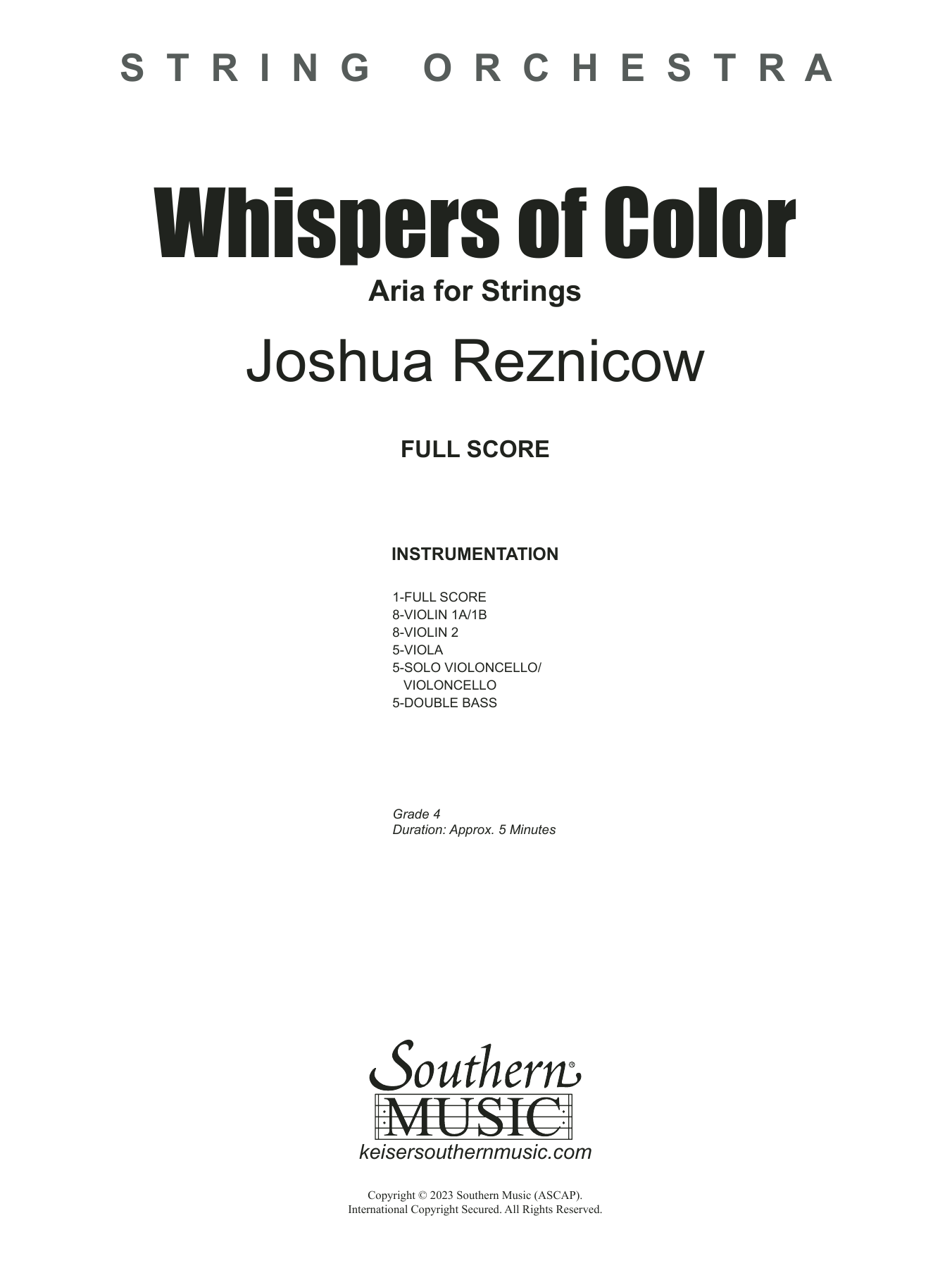

Whispers of Color: Aria for Strings: String Orchestra Conductor Score & Parts
By Joshua Reznicow
Grade: 4
Item: 35-PK01469044
$60.00
Pickup currently not available
Buy Extra Parts (Digital PDF Download)
Parts Added to Cart!
Description
Whispers of Color: Aria for Strings was originally a short sketch written for the Linn-Mar High School Symphony Strings, an ensemble that I have had the privilege and honor to work with and direct each day for over two decades. During the 2020-2021 school year we were under the restrictions of the pandemic which limited groups and ensembles from rehearsing in the same room. This of course posed a problem for many ensembles to function, and creative solutions were needed to keep our students engaged and moving forward. One such creative solution was to produce a short film with our ensemble providing the soundtrack for this film. For the music, we used a combination of new music written by the students and myself. The project was a success for all involved and kept many students engaged during a challenging time. The following year as restrictions were lifted, I decided to expand on what I had provided for our film and finished the sketch to form a fully written composition suitable for a live performance.


Whispers of Color: Aria for Strings: String Orchestra Conductor Score & Parts isn't in MakeMusic Cloud just yet...but it could be. Let us know you'd like to see it, and you'll help shape what comes next. In the meantime, start a free trial and dive into thousands of interactive titles your students can play along with today.
Request This Title
Tell us you want it.
Start Your Free Trial
Explore everything that's ready to play right now.
Sample Audio
No sample audio found.
Sample Video
No sample videos found.
Additional Details
Publisher:
Hal Leonard
SKU:
35-PK01469044
More about this title
About the Composer: Joshua Reznicow
Joshua Reznicow brings classroom experience and compositional vision together in his work with string ensembles. His tenure directing the Linn-Mar High School Symphony Strings has shaped his understanding of what student musicians can accomplish when given music that challenges and engages them.
Reznicow's approach to composition reflects real rehearsal room needs. He writes with clarity of line and purpose, creating pieces that serve both the performers in front of him and the broader string education community.
Why we love this
This piece emerges from genuine ensemble need rather than abstract invention. Reznicow composed it originally to solve a specific pedagogical challenge during the pandemic, then refined it into something fully realized for live performance. That trajectory gives the music authenticity; it knows what student musicians need to engage with.
What to expect
Lyrical and introspective, with the quality of a conversation rather than a proclamation. The music values quiet moments and allows harmonic colors to emerge naturally, creating spaces where student musicians can listen to one another.
Who it's for
String orchestras working at grade 4 level will find a piece that respects their growing technical abilities without condescending to them. This works equally well for high school groups seeking shorter concert openers or chamber pieces that showcase string sound without elaborate arrangements.
How to get the most out of it
- Balance the melodic voices carefully so that shifts in primary line feel intentional rather than accidental. String sections often default to playing the loudest part; direct attention to whoever carries the phrase.
- Let the harmonic colors settle. The piece's title invites patience with sonority, so resist rushing through sustained passages.
- Use the score's dynamic markings as emotional signposts. They're written by someone who understands how a room full of young musicians responds to clear musical direction.
How to use it
Pair this with a larger work to create a program that breathes. Its moderate length and reflective character make it ideal as a concert opener, or use it alongside more dramatic repertoire to demonstrate the range of your ensemble's musicianship.
Skills your students will build
- Balancing inner voices and supporting melodic lines
- Sustaining tone quality across longer phrases
- Responding to subtle dynamic shaping
- Listening across the ensemble for harmonic blend
- Conducting and ensemble synchronization in lyrical contexts