
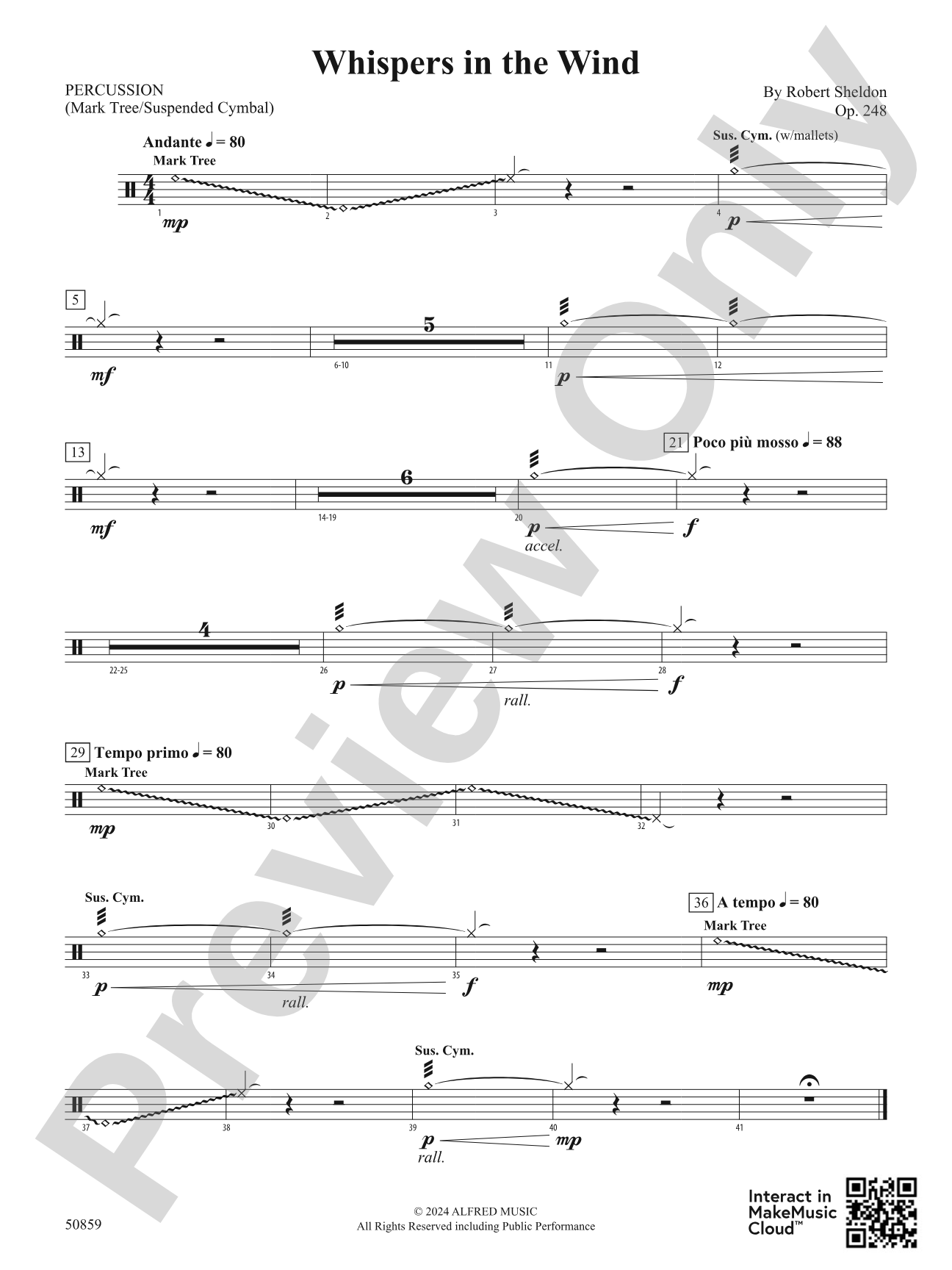

Whispers in the Wind: 1st Percussion
Op. 248
By Robert Sheldon
Grade: 1
Item: 00-PC-0019193_PC1
$3.00
Pickup currently not available
Description
A very playable, gentle piece, Whispers in the Wind, by Robert Sheldon, is written for first-year bands with only one part per instrument, providing security for each section while presenting independence between parts. This allows for maximum harmonic color that promotes interesting interactions between the musicians and allows for many expressive opportunities. (2:05) Correlates to Sound Innovations, Book 1, Level 5.


Don't just read it, hear it, play along with it, and watch your students grow with it. In MakeMusic Cloud, Whispers in the Wind: 1st Percussion comes alive with professional accompaniment, adjustable tempo, and built-in practice tools that turn solo practice into real progress.
Open in the Player
Jump straight in and assign it today.
Start Your Free Trial
Open this title and explore the full library in minutes.
Sample Audio
1
Audio File
--:--
0:00
0:00
Sample Video
Additional Details
Series:
Sound Innovations for Concert Band
Publisher:
Alfred Music
SKU:
00-PC-0019193_PC1
More about this title
About the Composer: Robert Sheldon

Robert Sheldon's compositions appear on contest and concert programs across the globe with remarkable consistency. His works have earned recognition from the American School Band Director's Association, Phi Beta Mu, and ASCAP, and his music reaches ensembles at every level of advancement. Beyond the page, Sheldon serves as guest conductor for All-State and Regional Honor Bands, clinician at universities and state music education conferences, and has led performances of his works in Carnegie Hall, Orchestra Hall, Boston's Symphony Hall, the Sydney Opera House, and the Kennedy Center.
As lead author of Sound Innovations for Concert Band, Sheldon understands firsthand what student musicians need to succeed. His schedule balances commissions, publications, and conducting appearances across North America, Europe, Asia, and Australia. In 2020, VanderCook College of Music awarded him an honorary doctorate in recognition of his sustained contribution to wind band music and music education.
Why we love this
Sheldon writes with a conductor's practicality and a composer's ear for color. This piece gives first-year ensembles a genuine musical experience without the technical barriers that often frustrate early bands; one part per instrument means every player contributes meaningfully, yet the harmonic independence between sections creates sophisticated interactions that keep musicians engaged and audiences listening.
What to expect
Whispers in the Wind unfolds with quiet contemplation. The piece breathes gently, letting individual instruments emerge from and recede into a soft harmonic backdrop, creating intimate conversations between sections rather than loud proclamations. There is space here for listening, both among the musicians and in the audience.
Who it's for
First-year band directors seeking music that sounds more sophisticated than typical beginning repertoire. The single-part-per-instrument design removes the anxiety of doubling while still delivering musical independence and harmonic interest, making this ideal for developing ensembles working at Sound Innovations Book 1, Level 5.
How to get the most out of it
- Shape the melodic line across the full length of each phrase rather than stopping at bar lines; the gentle character invites continuous breath and forward motion.
- Balance the interplay between sections by identifying which instruments carry the primary material in each section and which provide harmonic support; bring out the melody while allowing accompaniment to bloom without drowning it.
- Experiment with subtle dynamic shaping within the softer dynamic range to reveal harmonic color; dynamics can move between p and mp to create interest without disrupting the piece's contemplative mood.
- Encourage clear articulation in the woodwinds and steady resonance in the brass so the gentleness of the piece feels intentional rather than timid.
How to use it
Program this as a centerpiece for a concert section devoted to lyrical, ensemble-building repertoire. It works particularly well early in a concert to establish an attentive audience mood, or as a gentle transition between more energetic selections. The 2:05 duration makes it efficient for festival competitions while still giving the band a complete musical statement.
Skills your students will build
- Sustaining tone quality across soft dynamic ranges (p and mp)
- Responding to conductor's shaping of long melodic phrases
- Listening for harmonic color created by independent part writing
- Balancing sectional independence while maintaining ensemble cohesion
- Executing clear articulation without creating rhythmic fragmentation