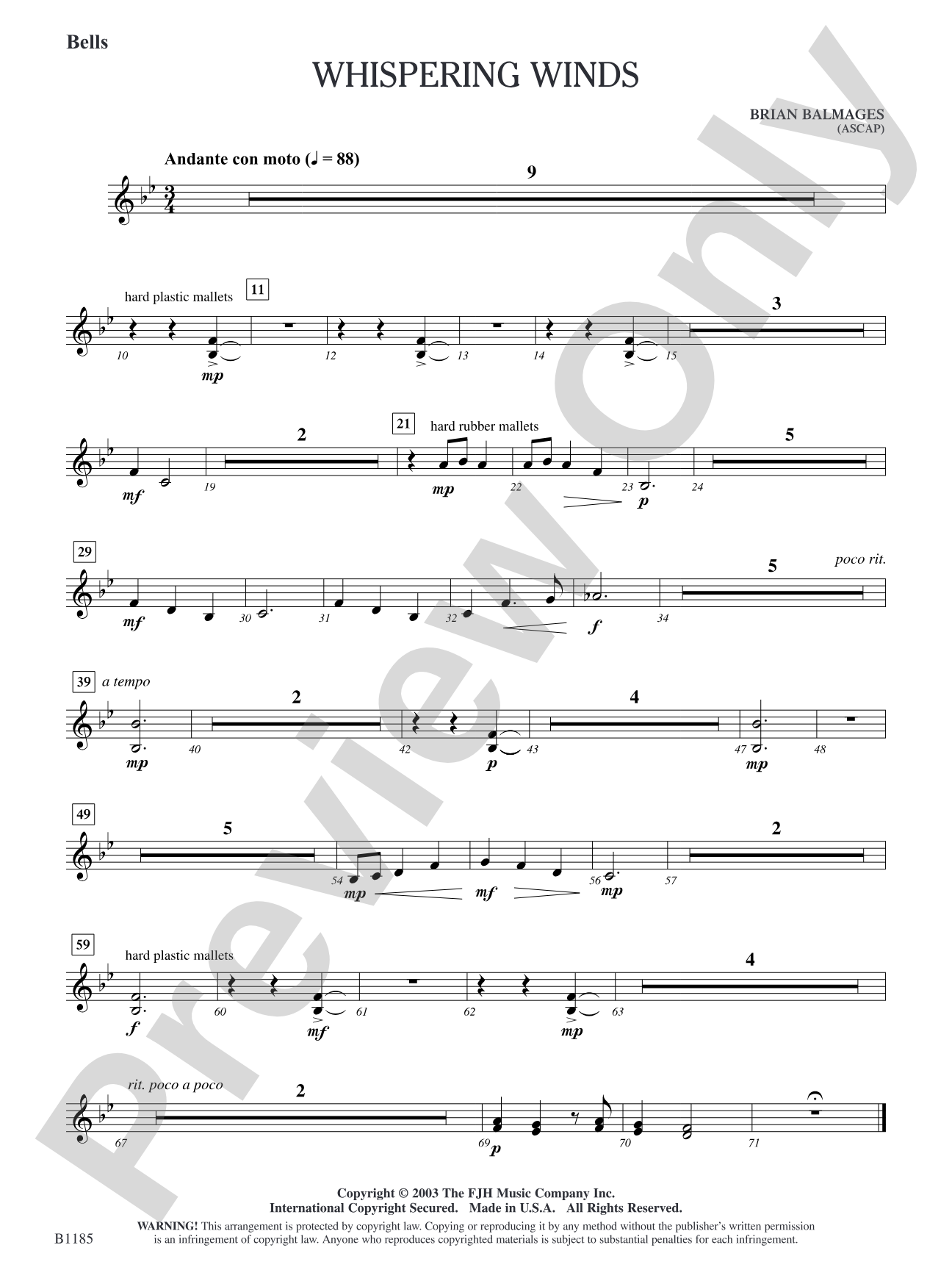
Whispering Winds: Bells Sheet Music Preview

Whispering Winds: Bells

By Brian Balmages

Grade: 1.5

Item: 98-PC-DB1185_B

Digital Download
$7.00
Description
This well-developed lyrical selection hardly sounds like a grade 1.5 and is very appropriate for upper-level ensembles as well. Brian uses some innovative effects as he portrays the sound of a gentle breeze that almost seems to be whispering. Limited range and technical demands move all focus to musicality. Strongly consider this captivating work.

Whispering Winds: Bells isn't in MakeMusic Cloud just yet...but it could be. Let us know you'd like to see it, and you'll help shape what comes next. In the meantime, start a free trial and dive into thousands of interactive titles your students can play along with today.

Sample Audio
0:00
0:00
Sample Video
Additional Details
Series: FJH Developing Band
Publisher: The FJH Music Company, Inc.
SKU: 98-PC-DB1185_B

More about this title

About the Composer: Brian Balmages

Brian Balmages

Brian Balmages has established himself as a composer and conductor across orchestral, band, and chamber music with equal fluency. His works have been performed by ensembles at every level, from professional orchestras at Carnegie Hall and the Kennedy Center to school programs, and he maintains an active guest conducting schedule with all-state groups, university ensembles, and professional orchestras worldwide.

His accolades include the A. Austin Harding Award from the American School Band Directors Association, the 2020 NBA William D. Revelli Composition Contest for Love and Light, and membership in the American Bandmasters Association. Balmages received the inaugural James Madison University Distinguished Alumni Award and was commissioned by the University of Miami to compose for the presidential inauguration. His music was performed at the 2013 Presidential Inaugural Prayer Service. He currently serves as Director of MakeMusic Publications and Digital Education for Alfred and MakeMusic.

Why we love this

Balmages captures something genuinely sophisticated in this Grade 1.5 work. The writing refuses to condescend to its level, instead using limited range and straightforward technical demands as compositional constraints that sharpen the focus on phrase shape, tone control, and ensemble balance. What emerges feels substantial enough for your stronger ensembles while remaining accessible to developing bands.

What to expect

Soft, contemplative, and almost impressionistic. The piece moves like a gentle wind moving through landscape, never rushed or heavy, with a transparent quality that lets you hear each voice clearly. There's an introspective calm here that asks players to listen deeply to themselves and each other.

Who it's for

Developing concert bands that are ready for repertoire with genuine musical substance. This works equally well for upper-level middle school groups and less experienced high school ensembles searching for material that challenges musicianship without overwhelming technique.

How to get the most out of it

  • Shape the gentle breeze effect by layering dynamics across sections; let the winds swell and recede naturally rather than mechanically, which creates the whispering quality Balmages intends.
  • Balance the innovative effects with clarity. These effects only land when the ensemble has secure intonation and steady ensemble pulse underneath them.
  • Avoid rushing through lyrical passages. The limited technical demands give you room to breathe and listen, so encourage players to think in longer phrases than they might typically attempt at this level.

How to use it

Open a concert with this to establish an intimate atmosphere and immediately signal to your audience that this is a thoughtful program. It also pairs beautifully with weightier selections later in the set, providing welcome contrast and demonstrating your band's range.

Skills your students will build

  • Sustaining long lyrical phrases without dynamic sagging
  • Blending and balancing within and across sections
  • Responding to innovative compositional techniques (effects writing) with musical intent rather than mechanical execution
  • Developing sensitivity to intonation in slower, exposed contexts
  • Creating ensemble cohesion when technical demands recede and musicality leads

You May Also Like