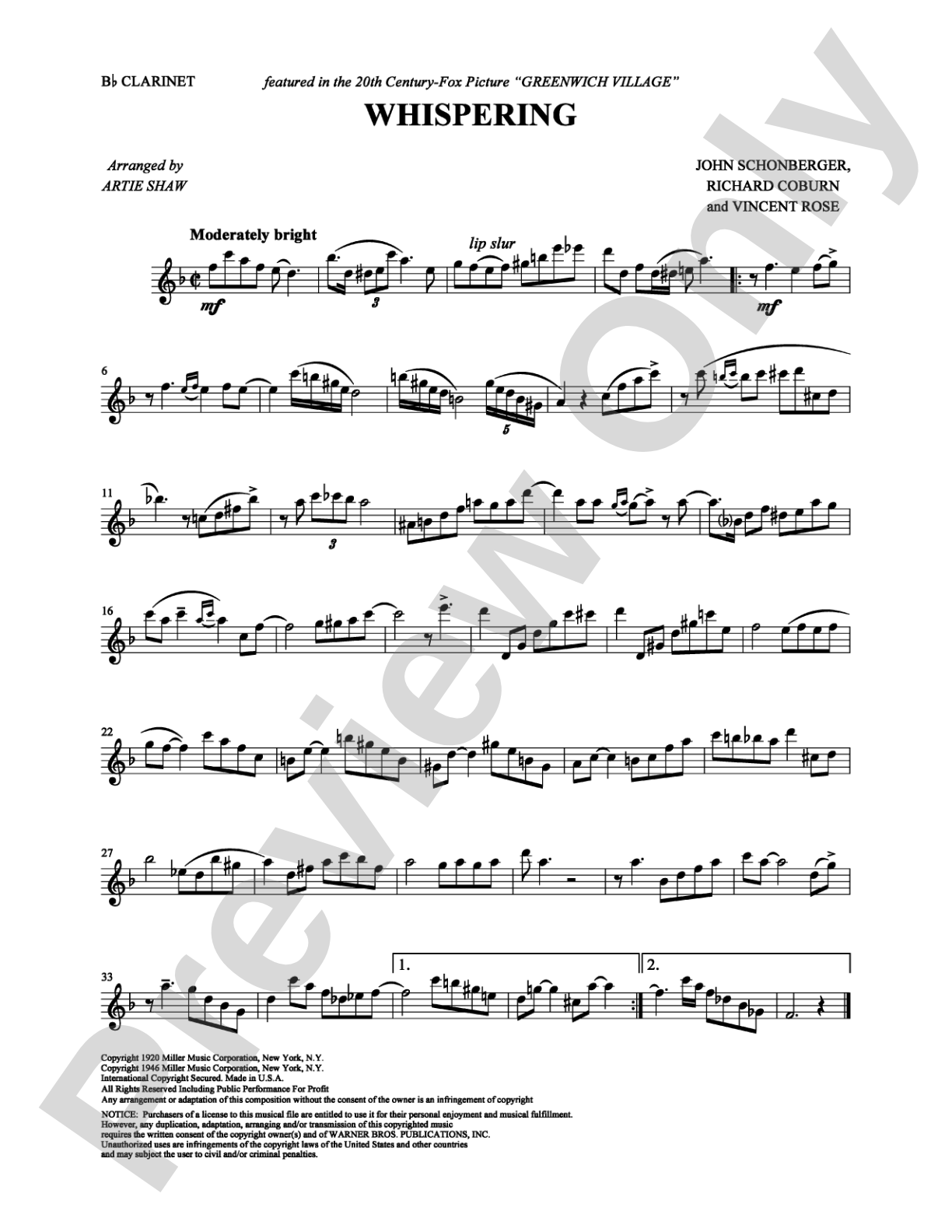
Whispering: Solo & Small Ensemble Digital Sheet Music

Whispering: Solo & Small Ensemble Digital Sheet Music

Artie Shaw, Vincent Rose, Richard Coburn, John Schonberger

Item: 00-PS-0000651

Digital Download
$2.99
Description

Whispering: Solo & Small Ensemble Digital Sheet Music isn't in MakeMusic Cloud just yet...but it could be. Let us know you'd like to see it, and you'll help shape what comes next. In the meantime, start a free trial and dive into thousands of interactive titles your students can play along with today.

Sample Audio
No sample audio found.
Sample Video
Additional Details
SKU: 00-PS-0000651

More about this title

About the Artist: Artie Shaw

Artie Shaw was one of the most technically accomplished clarinetists in jazz history and a bandleader whose orchestrations set standards for swing era sophistication. Active from the late 1920s through the 1950s, Shaw led several influential ensembles and recorded prolifically, earning recognition for both his virtuosic playing and his willingness to experiment with unconventional instrumentation and arranging ideas. His work remains central to understanding how jazz integrated complex compositional thinking with ensemble improvisation.

Why we love this

Whispering showcases Shaw's crystalline tone and improvisational wit on one of jazz's most recorded standards, making it an outstanding model for small ensemble musicianship. The arrangement sits at that perfect intersection of accessibility and sophistication, challenging enough to reward careful listening, simple enough that student groups can focus on phrasing, dynamics, and ensemble blend rather than decoding overly dense harmonies.

What to expect

Relaxed and conversational, with a gentle swing underneath. The tune unfolds as if musicians are talking to each other rather than performing at an audience, creating an accessible entry point into jazz phrasing and listening-based ensemble playing.

Who it's for

Jazz ensemble students and small group programs exploring the swing era repertoire, as well as individual musicians preparing solos for jazz combo or recital contexts. The stripped-down scoring invites both developing and intermediate players to engage with authentic jazz literature without the complexity of full big band arrangements.

How to get the most out of it

  • Emphasize the breathy, intimate quality suggested by the title; avoid overblowing or aggressive articulation that would undermine the piece's conversational character.
  • Listen closely to the harmonic movement and respond to chord changes with subtle tonal adjustments rather than strict metronomic precision; swing jazz rewards rhythmic flexibility.
  • Balance solo lines with ensemble passages by varying transparency and forward placement; smaller ensemble contexts demand that every voice remain audible.

How to use it

Pair this with other swing era small ensemble standards to build a complete picture of 1930s-1940s jazz aesthetics, or use it as a teaching piece within a jazz history unit that traces how composed melodies and harmonic structure anchor improvisation.

Skills your students will build

  • Swing phrasing and rhythmic flexibility in ensemble contexts
  • Responding to harmonic changes through dynamic and tonal shaping
  • Listening to and balancing ensemble voices in small group settings
  • Interpreting jazz articulation and the distinction between notated rhythm and performed swing feel

You May Also Like