
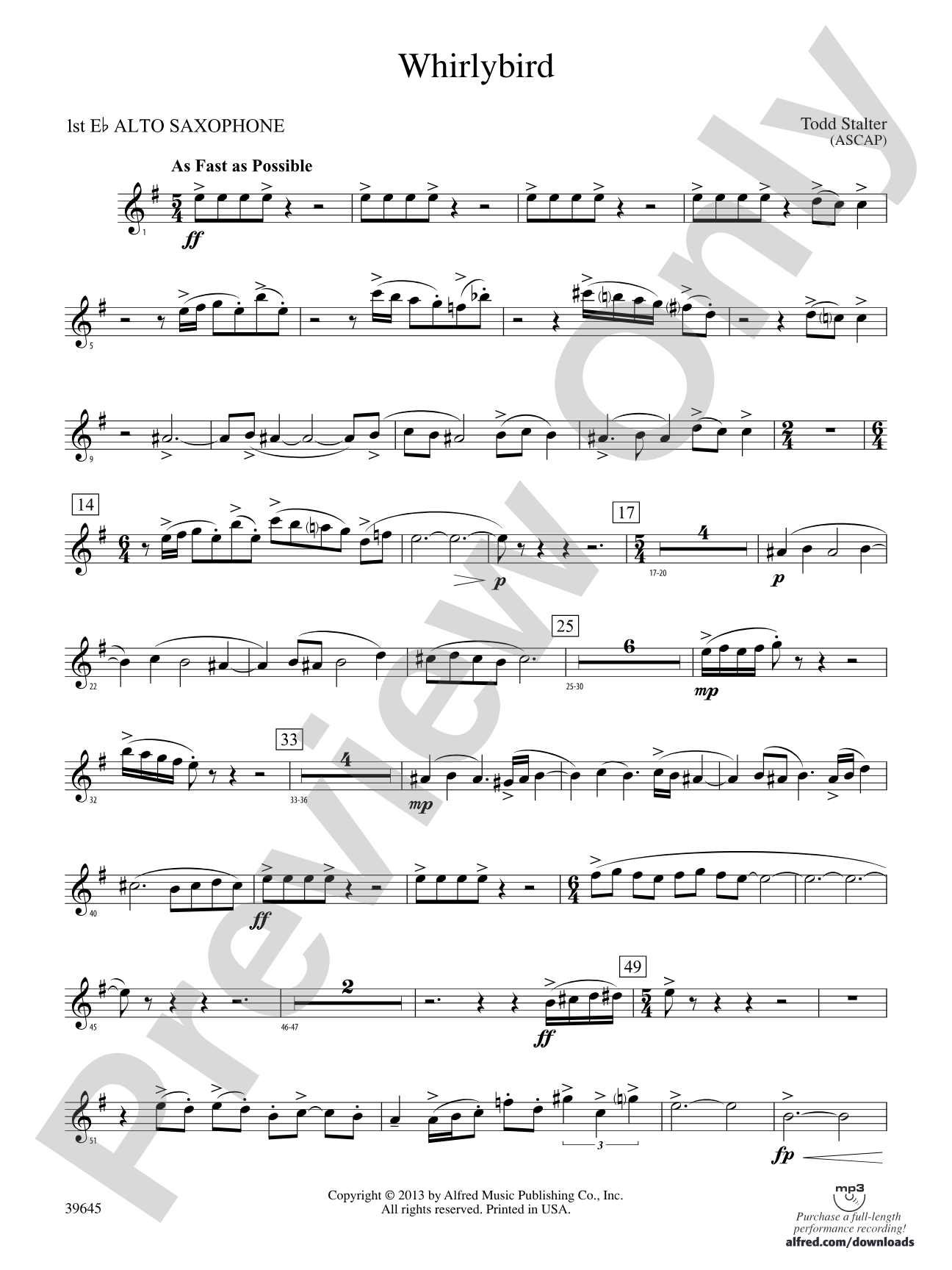

Whirlybird: E-flat Alto Saxophone
By Todd Stalter
Grade: 4.5 (Medium Difficult)
Item: 00-PC-0015919_AX1
$3.00
Pickup currently not available
Description
This fast-paced, swirling vortex of sound, with swift melodies and grooving background rhythms, is woven together with changing time signatures and plentiful use of percussion. It is an aural impression of the whirling rotors and unique maneuvers of a helicopter. (3:05) This title is available in MakeMusic Cloud.


Don't just read it, hear it, play along with it, and watch your students grow with it. In MakeMusic Cloud, Whirlybird: E-flat Alto Saxophone comes alive with professional accompaniment, adjustable tempo, and built-in practice tools that turn solo practice into real progress.
Open in the Player
Jump straight in and assign it today.
Start Your Free Trial
Open this title and explore the full library in minutes.
Sample Audio
1
Audio File
--:--
0:00
0:00
Sample Video
Additional Details
Series:
Alfred Concert Band
Publisher:
Alfred Music
Page Count:
278
SKU:
00-PC-0015919_AX1
More about this title
About the Composer: Todd Stalter

Todd Stalter built one of Illinois's most respected high school band programs during his 34 years as Director of Bands at Eureka High School. His marching bands won 16 Class 1A state championships, his concert ensembles consistently earned Superior ratings at IHSA contests, and his groups performed at Orchestra Hall in Chicago and Walt Disney World, as well as competing as festival champions at the Cotton and Liberty Bowls. He was inducted into the Illinois State Marching Band Championships Hall of Fame.
Beyond his work in the classroom, Stalter has conducted All-State Bands in Georgia and Delaware, led numerous district and honor ensembles, and served as an active adjudicator and clinician throughout the region. His compositions for band and string orchestra are performed internationally and appear frequently on state contest lists. Several of his works are featured in the "Teaching Music Through Performance in Band" series published by GIA. Stalter holds degrees in Music Education and Trumpet Performance from Illinois State University, where he studied with members of the U.S. Marine Band and worked as a conducting assistant.
Why we love this
Stalter writes with unmistakable clarity about what makes a piece engaging to conduct and play. Whirlybird's shifting meters and layered percussion create genuine ensemble coordination challenges without sacrificing the visceral fun of executing tight, propulsive rhythms together. For programs seeking a festival piece that demands musicianship while staying accessible at the 4.5 level, this one delivers.
What to expect
Whirlybird spins with kinetic urgency, its rapid melodic figures orbiting around a steady, grooved underpinning. The changing meters never feel disorienting; instead, they mirror the banking and hovering motions of the aircraft itself, creating a soundscape where multiple rhythmic dimensions operate simultaneously without losing sight of the central propulsive energy.
Who it's for
Concert bands at the advanced high school level or accomplished middle school ensembles ready for metric complexity and sophisticated rhythmic interplay. Directors preparing for festival or contest will find a piece that showcases both technical control and ensemble musicianship without the extreme demands of Grade 5 repertoire.
How to get the most out of it
- Establish the groove in the background rhythmic layers first; the forward momentum depends on lock-step precision in these parts before the swift melodies land on top.
- Mark the meter changes clearly on every player's part during sectionals. The piece uses multiple signatures, and any hesitation in the ensemble will disrupt the intended swirling effect.
- Lean on your percussion section to drive the helicopter impression. Their precision and dynamic control are what transform the composition from clever orchestration into genuine theatrical storytelling.
- Balance the lyrical material against the rhythmic energy; resist the temptation to let faster passages overpower the melodic threads weaving through the texture.
How to use it
Use this as a centerpiece in a festival program where you want to showcase ensemble control and rhythmic sophistication. Its three-minute duration fits well as a concert opener or a powerful mid-program contrast to lyrical or slower works. The percussive emphasis and contemporary orchestration make it especially effective when paired with classic or more traditionally scored repertoire.
Skills your students will build
- Reading and executing mixed meter passages (particularly transitions between time signatures)
- Maintaining locked rhythmic precision in complex layered textures
- Balancing independent instrumental lines within an ensemble context
- Responding to rapid tempo and textural changes while tracking melodic material
- Ensemble coordination in pieces where multiple rhythmic patterns operate simultaneously