
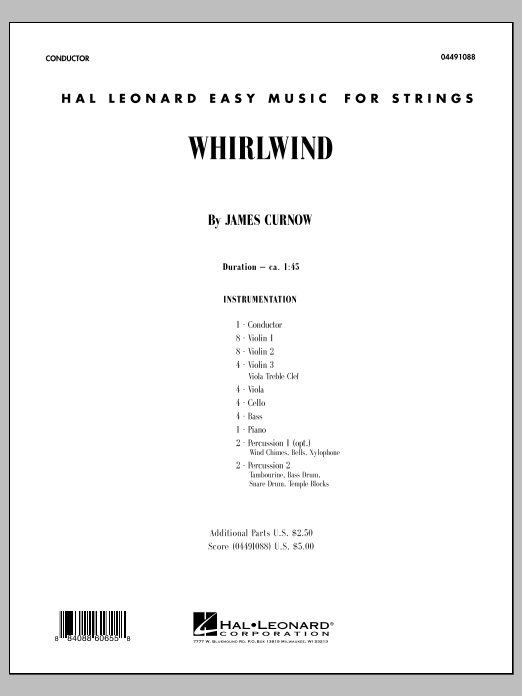

Whirlwind: String Orchestra Conductor Score & Parts
As performed by James Curnow
Grade: 1-1.5
Item: 35-PK00195493
$40.00
Pickup currently not available
Buy Extra Parts (Digital PDF Download)
| Product | Price | Quantity |
|---|---|---|
| Whirlwind - Full Score | $6.00 | |
| Whirlwind - Violin 1 | $7.00 | |
| Whirlwind - Violin 2 | $7.00 | |
| Whirlwind - Violin 3 (Viola Treble Clef) | $7.00 | |
| Whirlwind - Viola | $7.00 | |
| Whirlwind - Cello | $7.00 | |
| Whirlwind - Bass | $7.00 | |
| Whirlwind - Piano | $7.00 | |
| Whirlwind - Percussion 1 | $7.00 | |
| Whirlwind - Percussion 2 | $7.00 |
Parts Added to Cart!
Description
Long known for his effective writing for school groups, James Curnow's newest opus features strong diatonic lines, rhythmic backgrounds, and interesting parts for all players in a one-tempo setting. Dur: 1:45


Whirlwind: String Orchestra Conductor Score & Parts isn't in MakeMusic Cloud just yet...but it could be. Let us know you'd like to see it, and you'll help shape what comes next. In the meantime, start a free trial and dive into thousands of interactive titles your students can play along with today.
Request This Title
Tell us you want it.
Start Your Free Trial
Explore everything that's ready to play right now.
Sample Audio
No sample audio found.
Sample Video
No sample videos found.
Additional Details
Publisher:
Hal Leonard
SKU:
35-PK00195493
More about this title
About the Artist: James Curnow
James Curnow has spent decades writing music that serves the actual needs of school ensembles. His catalog spans band, orchestra, and wind ensemble literature, and his reputation rests on understanding what players at each level can accomplish. He writes with clarity and purpose, creating parts that challenge without frustrating, and melodies that students remember after they stop playing.
Why we love this
Curnow's approach here prioritizes ensemble cohesion over heroic individual moments. Every player has a genuine musical function, and the diatonic writing means students focus on intonation and blend rather than deciphering accidentals. At just 1 minute 45 seconds, it's compact enough to work as a concert opener or as a teaching piece for younger orchestras building foundational skills.
What to expect
Energetic but grounded, with the kinetic drive of a perpetual motion study. The rhythmic background provides a steady current while the strong diatonic lines float cleanly above, creating momentum without chaos. There's real music happening here, not just finger exercises.
Who it's for
Beginning and early intermediate string orchestras that need repertoire teaching fundamental musicianship without oversimplifying the experience. Teachers looking for a piece that sounds assured in performance but doesn't demand virtuosic technique or unusual string crossings.
How to get the most out of it
- Establish a steady pulse in rehearsal before worrying about dynamic shaping. The rhythmic backgrounds need to lock in first, which gives the diatonic lines room to sing.
- Balance the string sections carefully during the opening statement so one voice doesn't overwhelm the harmonic foundation.
- Keep the tempo consistent even though there's only one tempo marking. Young orchestras often rush energy-driven passages without realizing it.
- Record a section rehearsal with just the violin parts, then layer in violas and cellos so everyone hears how their contribution fits the architecture.
How to use it
Open a concert with this to establish confidence and set a bright tone, or use it as the confident closer to a program built around longer works. It also works well as a mid-season rehearsal milestone when you want to demonstrate that the orchestra can execute a complete piece with shape and energy.
Skills your students will build
- Maintaining steady rhythm while supporting harmonic lines
- Balancing multiple simultaneous voices in diatonic progressions
- Reading in multiple clefs and positions across the string section
- Sustaining tone quality during repeated note passages