
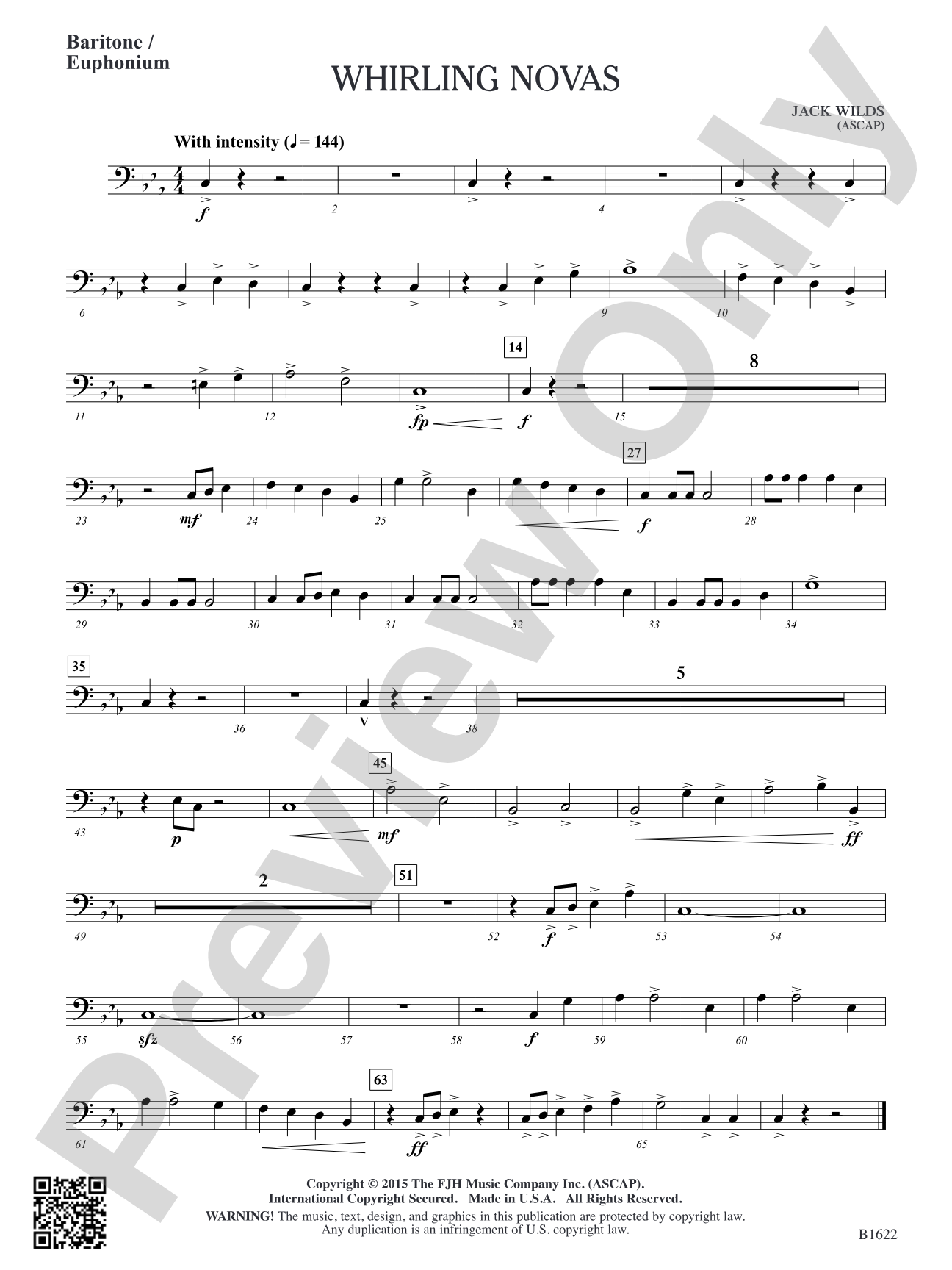

Whirling Novas: Baritone / Euphonium
By Jack Wilds
Grade: 1
Item: 98-PC-DB1622_BBC1
$7.00
Pickup currently not available
Description
Buckle up and take your audience on a flight into the turbulent heart of a nebula! Booming percussion and sparkling woodwind lines conjure images of celestial bodies spinning and crashing together in the chaos of an interstellar star factory. Fabulous music for young musicians!


Don't just read it, hear it, play along with it, and watch your students grow with it. In MakeMusic Cloud, Whirling Novas: Baritone / Euphonium comes alive with professional accompaniment, adjustable tempo, and built-in practice tools that turn solo practice into real progress.
Open in the Player
Jump straight in and assign it today.
Start Your Free Trial
Open this title and explore the full library in minutes.
Sample Audio
1
Audio File
--:--
0:00
0:00
Sample Video
No sample videos found.
Additional Details
Series:
FJH Beginning Band
Publisher:
The FJH Music Company, Inc.
SKU:
98-PC-DB1622_BBC1
More about this title
About the Composer: Jack Wilds

Jack Wilds composes across a wide range of ensembles and age groups, from children's choirs to professional orchestras. His catalog spans chamber works performed by ensembles like the Attacca Quartet and members of the New York Philharmonic, as well as over 40 publications for developing musicians in band and choral settings. His work has been featured at major festivals including the International Trombone Festival, the American Trombone Workshop, the International Horn Symposium, and New Music on the Bayou, and appears on contest repertoire lists across multiple continents.
Wilds draws creative inspiration from visual art, literature, philosophy, and religious texts alongside purely musical ideas, resulting in compositions that meet performers at their current level while pushing toward genuine artistry. A former public school band director, he lectures in composition, music theory, ear training, and music technology at Texas State University and serves as Co-Director of Music at First Presbyterian Church in San Marcos. He maintains an active schedule as clinician and adjudicator throughout the United States.
Why we love this
Wilds captures the visceral excitement of cosmic imagery without losing sight of what young musicians can handle musically. The combination of booming percussion with sparkling woodwind textures gives the piece immediate appeal and memorable character, making it engaging for both performers and audiences while remaining solidly within the Grade 1 technical range.
What to expect
A wild ride through space rendered in musical terms. Chaotic energy alternates with moments of crystalline clarity as the celestial imagery shifts from collision and turbulence to the sharp, bright geometry of stars and nebulae. The piece captures wonder and dynamism without requiring sophisticated musicianship to execute effectively.
Who it's for
Young concert bands at the earliest level of repertoire, particularly those ready to move beyond purely educational pieces into music with narrative and character. This works well for bands building foundational technique while also needing repertoire that excites performers and draws audience engagement.
How to get the most out of it
- Balance the woodwind lines so their shimmer cuts through the percussion, particularly in moments where both are scoring the nebula imagery simultaneously.
- Shape the percussion entrances with precision; booming effects work best when players attack together and let the resonance develop naturally rather than trying to sustain the attack.
- Use the opening passage to establish ensemble unity in fundamental things like vertical alignment and vibrato consistency before the more soloistic moments arrive.
How to use it
Program this early in a concert to establish energy and capture attention immediately, or pair it with contrasting selections that highlight its unique character. It works equally well as a festival piece where judges reward composers' engagement with young ensembles, since Wilds writes idiomatically for the developing musician without compromising artistic vision.
Skills your students will build
- Maintaining balanced ensemble sound across changing textures
- Reading and performing rhythmic figures with precision and clarity
- Responding to visual imagery and program music concepts
- Sustaining focused articulation in sustained passages
- Coordinating between sections with independent rhythmic roles