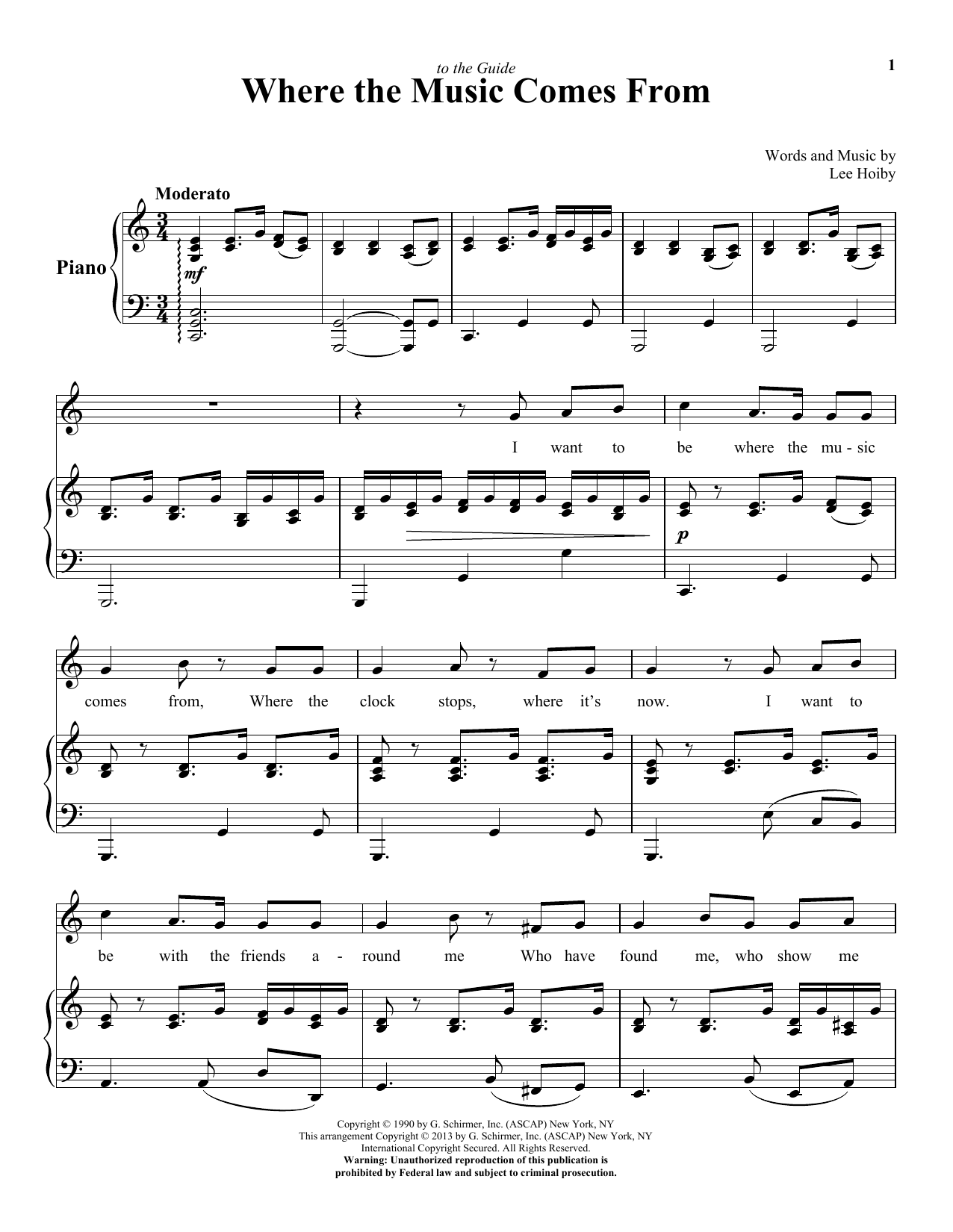
Where The Music Comes From Sheet Music Preview

Where The Music Comes From: Piano Vocal

As performed by Lee Hoiby

Item: 35-DS00297091

Digital Download
$5.99
Description

Where The Music Comes From: Piano Vocal isn't in MakeMusic Cloud just yet...but it could be. Let us know you'd like to see it, and you'll help shape what comes next. In the meantime, start a free trial and dive into thousands of interactive titles your students can play along with today.

Sample Audio
No sample audio found.
Sample Video
Additional Details
Publisher: Hal Leonard
Page Count: 5
SKU: 35-DS00297091

More about this title

About the Artist: Lee Hoiby

Lee Hoiby (1926-2011) was an American composer who built his reputation on accessible, lyrical vocal music rooted in the American song tradition. His gift lay in setting texts with directness and emotional clarity, creating works that singers find both gratifying to perform and audiences find immediately moving. Hoiby's output includes numerous art songs, chamber operas, and choral works that have become staples in voice studios and recital programs across the country.

Why we love this

Hoiby writes for the voice with uncommon generosity. The piano part supports rather than overwhelms, and the melodic line sits naturally in the passaggio without pushing singers into uncomfortable territory. This is the kind of piece a skilled high voice can deliver with full musicality in a single rehearsal or two.

What to expect

Direct and warmly human. Hoiby's harmonic language is tonal but sophisticated, never saccharine. The piece conveys genuine feeling without sentimentality, inviting the singer and listener into a moment of quiet reflection.

Who it's for

High voice soloists preparing recital material, upper-level voice students, or experienced community choir singers looking for a quality contemporary art song. This is not beginner territory; it demands secure breath control and musical maturity.

How to get the most out of it

  • Keep the piano accompaniment conversational rather than illustrative. These are intimate moments, and overplaying the harmonic language will dull the effect.
  • Shape the vocal line by phrase rather than by measure. Hoiby's melodies breathe; find the natural punctuation and let the line sing through it.
  • Honor the text clarity completely. Lyrical writing only works if listeners can follow what is being said.

How to use it

Pair this with other 20th-century American art songs to show the breadth of vocal literature beyond art song traditions from Europe. It also works beautifully in a recital organized thematically around music, creativity, or introspection.

Skills your students will build

  • Sustaining legit legit singing across sustained phrases without tension
  • Balancing vocal projection with interpretive subtlety in an intimate context
  • Collaborating with a pianist to shape lyrical content as an ensemble
  • Understanding text setting in contemporary American composition

You May Also Like