
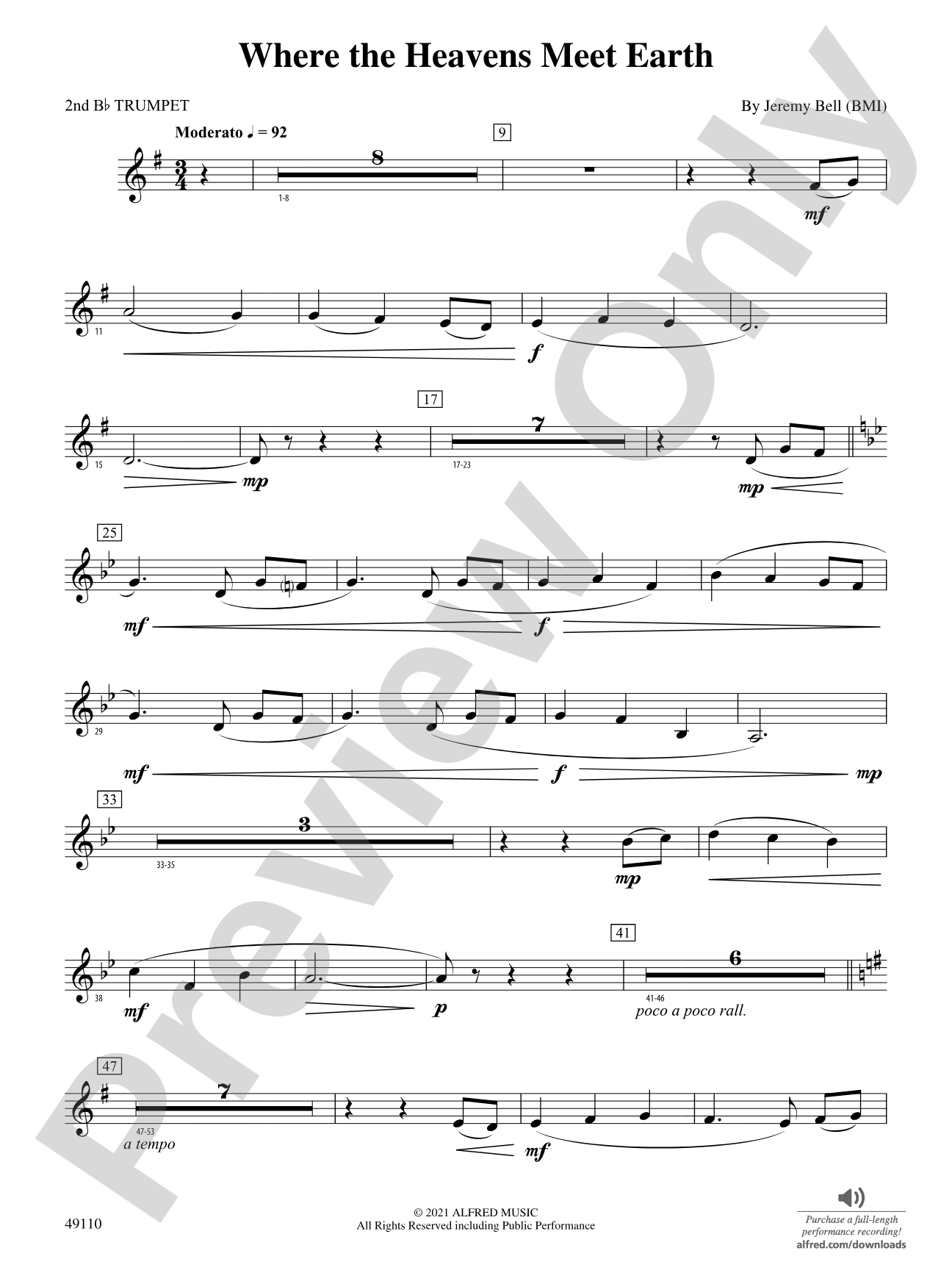

Where the Heavens Meet Earth: 2nd B-flat Trumpet
By Jeremy Bell
Grade: 2.5 (Medium Easy)
Item: 00-PC-0018684_T2
$3.00
Pickup currently not available
Description
Where the Heavens Meet Earth is a beautiful, lyrical work for young band. Featuring flowing melodic lines and a beautiful four-note motive that transfers throughout the ensemble, the piece is a perfect mid-program work to feature the colors of the different instrumental sections, permitting opportunities to teach about blend and balance within the group. This original Jeremy Bell piece was inspired by the picturesque salt flats in Bolivia called Salar de Uyuni. Located in the Southwest near the Andes, the flats were formed by the transformations of several prehistoric lakes. With variations in elevation that average around a meter, the extreme flatness following a rain turns the 80-mile landscape into the world's largest mirror, reflecting the sky above. (3:30)


Don't just read it, hear it, play along with it, and watch your students grow with it. In MakeMusic Cloud, Where the Heavens Meet Earth: 2nd B-flat Trumpet comes alive with professional accompaniment, adjustable tempo, and built-in practice tools that turn solo practice into real progress.
Open in the Player
Jump straight in and assign it today.
Start Your Free Trial
Open this title and explore the full library in minutes.
Sample Audio
1
Audio File
--:--
0:00
0:00
Sample Video
Additional Details
Series:
Young Symphonic
Publisher:
Alfred Music
Page Count:
144
SKU:
00-PC-0018684_T2
More about this title
About the Composer: Jeremy Bell

Jeremy Bell studied composition at Bradley University under Dr. Stephen Heinemann, then earned his Master's degree from Arizona State University, where he worked with Dr. Rodney Rogers and Dr. Jody Rockmaker. His output spans band and choral literature alongside a growing portfolio of television and film scores, reflecting his versatility across both concert and commercial music.
Beyond the concert hall, Bell serves as Entertainment Manager at The SHOUT! House Dueling Piano bar in Glendale, Arizona, a role that keeps him connected to live performance and collaborative musicmaking.
Why we love this
Bell writes with genuine attention to orchestration and color, and this piece demonstrates exactly that sensibility at an accessible grade level. The four-note motive traveling through the band gives young players something cohesive to listen for and creates natural sectional spotlight moments without requiring advanced technical facility. You'll find it works beautifully as a mid-program centerpiece because it rewards careful listening and balance work without burning rehearsal time on complicated rhythms or ranges.
What to expect
Serene and contemplative, with a quality of vast openness. The flowing melodic lines and the motive that threads through different instrumental colors create a sense of discovery and reflection, evoking the otherworldly clarity of a landscape mirroring sky.
Who it's for
Grade 2.5 bands with solid fundamentals and enough maturity to work on ensemble cohesion and color balance. This piece suits groups that thrive on melodic, through-composed writing and benefit from repertoire that builds listening skills across the full ensemble.
How to get the most out of it
- Shape the four-note motive consistently each time it passes between sections. Have players mark where it appears in their part so they understand how the piece unfolds thematically.
- Use transitions between sections as opportunities to practice blend. When the motive moves from woodwinds to brass, adjust dynamics and articulation so the musical line remains seamless.
- Let the landscape imagery guide your tempo choices. The stillness of the salt flats before rain suggests space and breath; resist rushing the lyrical passages.
- Balance the flowing melodic lines against supporting material. Young bands often cover the accompaniment voices, but clarity in all four parts makes the full orchestration sing.
How to use it
Program this as a confident mid-concert work that signals a shift in mood and showcases the band's ability to blend and balance. It pairs naturally with more rhythmic or energetic pieces and provides an ideal vehicle for festival or contest performance where artistry and ensemble cooperation matter as much as technical display.
Skills your students will build
- Tracking a motive as it moves through different instrumental sections
- Blending ensemble colors and adjusting balance across woodwind, brass, and percussion families
- Sustaining lyrical phrasing in supported melodic lines
- Listening to and responding to sectional balance in real time