Where The Blue Of The Night (Meets The Gold Of The Day) Sheet Music Preview

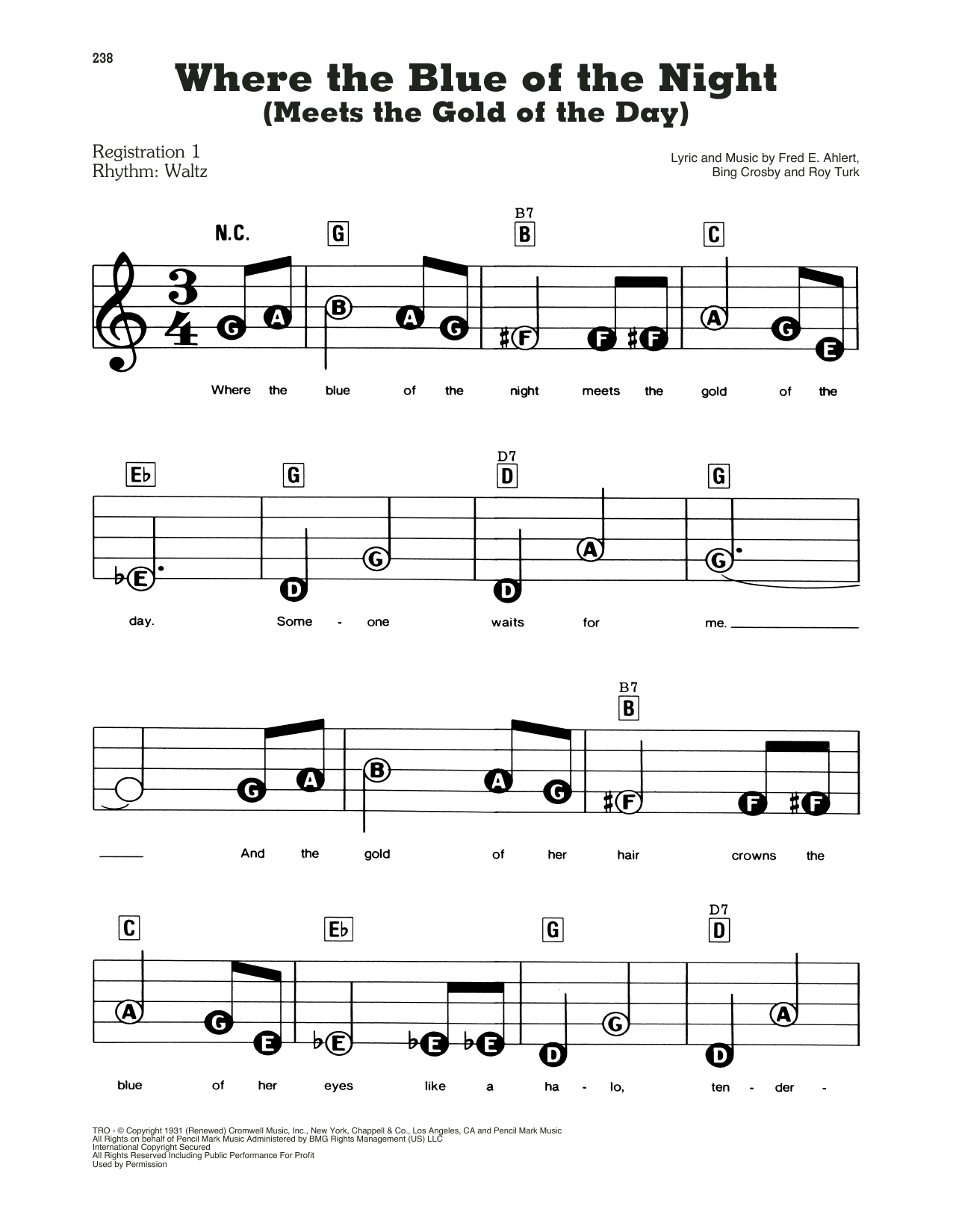
Where The Blue Of The Night (Meets The Gold Of The Day): E-Z Play Today

As performed by Bing Crosby

Item: 35-DS00451025

Digital Download
$4.99
Description

Where The Blue Of The Night (Meets The Gold Of The Day): E-Z Play Today isn't in MakeMusic Cloud just yet...but it could be. Let us know you'd like to see it, and you'll help shape what comes next. In the meantime, start a free trial and dive into thousands of interactive titles your students can play along with today.

Sample Audio
No sample audio found.
Sample Video
Additional Details
Publisher: Hal Leonard
Page Count: 2
SKU: 35-DS00451025

More about this title

About the Artist: Bing Crosby

Bing Crosby defined American popular song across five decades, from the 1930s through the 1970s. His crooning baritone and conversational phrasing set the standard for vocal interpretation in jazz and pop standards, influencing generations of singers who followed.

Why we love this

This is a foundational standard that every jazz and pop pianist should know. The E-Z Play arrangement gives students access to Crosby's signature tune without the technical demands of a classical piano reduction, making it immediately playable while preserving the song's essential character.

What to expect

Warm and nostalgic without sentimentality. The song captures that golden-hour quality of old Hollywood, intimate and reflective, with a gently swaying rhythm that invites rubato.

Who it's for

Piano students working into the standard repertoire, particularly those studying jazz voicings and American songbook material. Teachers seeking accessible arrangements that preserve musical integrity will find this valuable for intermediate players.

How to get the most out of it

  • Lean into rubato during the opening phrases; this song breathes like a vocal line, not a metronomic march.
  • Catch the harmonic shifts that define the bridge. Those changes deserve gentle emphasis to guide listeners through the modulation.
  • Balance the melody against the accompaniment so it sits forward without drowning out the supporting harmonies.

How to use it

Feature this as a solo piano piece in a concert celebrating American standards, or pair it with other Crosby-era repertoire for a themed program. It works equally well as a recital opener that sets a sophisticated tone.

Skills your students will build

  • Rubato and vocal phrasing at the keyboard
  • Jazz harmony and chord substitution recognition
  • Balancing melody and accompaniment in simplified textures
  • Interpreting lead sheet style notation

You May Also Like