
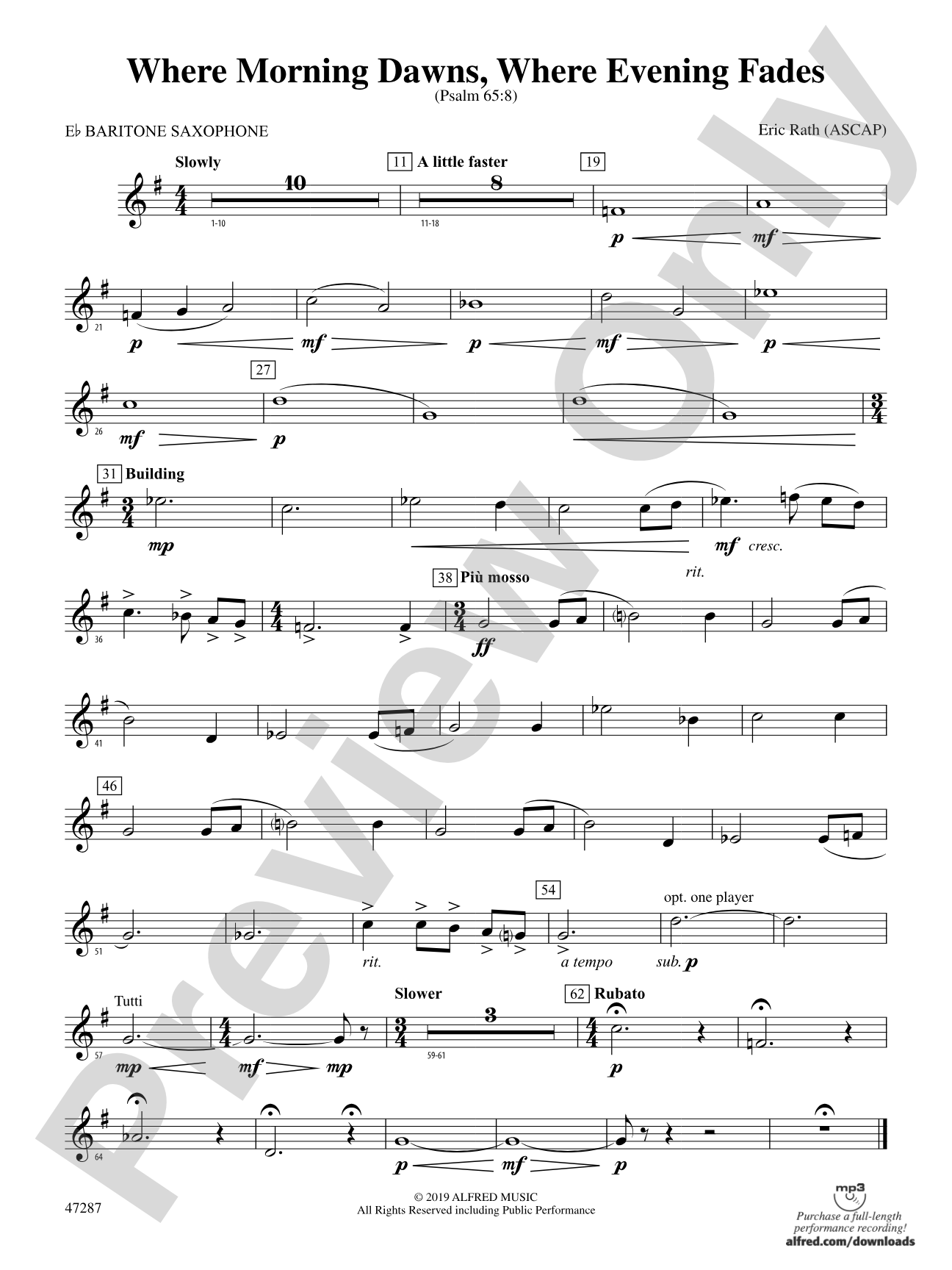

Where Morning Dawns, Where Evening Fades: E-flat Baritone Saxophone
By Eric Rath
Grade: 3 (Medium)
Item: 00-PC-0017900_BTX
$3.00
Pickup currently not available
Description
Harkening back to a time when the rising and setting of the sun was the only way that time was measured, this lovely piece portrays that time with contemporary harmonies, enhanced chords, and aleatoric elements.


Don't just read it, hear it, play along with it, and watch your students grow with it. In MakeMusic Cloud, Where Morning Dawns, Where Evening Fades: E-flat Baritone Saxophone comes alive with professional accompaniment, adjustable tempo, and built-in practice tools that turn solo practice into real progress.
Open in the Player
Jump straight in and assign it today.
Start Your Free Trial
Open this title and explore the full library in minutes.
Sample Audio
1
Audio File
--:--
0:00
0:00
Sample Video
Additional Details
Series:
Young Symphonic
Publisher:
Alfred Music
Page Count:
184
SKU:
00-PC-0017900_BTX
More about this title
About the Composer: Eric Rath

Eric Rath brings decades of experience as an educator, clinician, and working musician to his compositions and arrangements. He has directed bands and orchestras at the secondary level, taught percussion at Amarillo College, and maintains an active performance schedule as a freelance percussionist with the Amarillo Symphony Orchestra and Opera. His published works appear through Alfred Music, FJH Music, Tapspace Publications, and TRN Music, earning recognition for being "very exciting for performers and audiences alike."
Rath's music has been heard at the Midwest Clinic, Texas Music Educator's Association Convention, and the International Double Reed Society's Convention. Beyond composition, he has co-authored several pedagogical resources including the percussion ensemble collection "Beyond Basic Percussion" and the drill books "Five Minute Drill" and "Nine Minute Drill." A graduate of West Texas A&M University, Rath holds memberships in the Percussive Arts Society, Texas Music Educators Association, and the American Society of Composers, Authors and Publishers.
Why we love this
Rath's use of contemporary harmonies and aleatoric writing transforms a simple concept into something genuinely fresh at the Grade 3 level. The piece captures something poetic about natural time without relying on program notes to land the emotional weight, which means your students will feel the sunrise and sunset rather than just reading about them. Its contest and festival designation means your band can approach it with serious artistry while remaining accessible to developing musicians.
What to expect
The piece moves through the natural world at a contemplative pace, beginning with the quiet anticipation of dawn and culminating in the calm reflection of dusk. The contemporary harmonic language and aleatoric elements prevent it from feeling nostalgic or precious; instead, the music feels grounded in the present moment while honoring something timeless about marking time by sunlight.
Who it's for
Band directors seeking a Grade 3 concert piece with musical substance and contemporary style that engages both performers and audiences. This work suits programs building toward festival and contest seasons, where bands need repertoire that demonstrates musicianship without excessive technical demands.
How to get the most out of it
- Establish a clear pulse that allows the aleatoric sections to breathe and feel intentional rather than chaotic; the controlled randomness needs a strong rhythmic foundation underneath.
- Balance the contemporary harmonic language by listening carefully to how chords are voiced across your sections; tuning becomes more noticeable when the harmony is unexpected.
- Shape the arc from morning to evening as a gradual journey; resist the temptation to treat each section as isolated moments.
- Encourage players to listen across the ensemble during aleatoric passages rather than focusing solely on their own parts.
How to use it
Program this as an opener or closer on a concert where you want to set a reflective tone without sacrificing musical sophistication. It pairs well with more energetic repertoire on the same program, offering audiences a moment of stillness and inviting bands to demonstrate control and ensemble listening in a piece that rewards careful attention.
Skills your students will build
- Performing aleatoric notation and understanding when control releases into structured freedom
- Balancing and tuning contemporary harmonic structures
- Shaping long-term musical arcs across a multi-section composition
- Listening across the ensemble to maintain ensemble cohesion during complex passages
- Interpreting programmatic intent through purely musical means