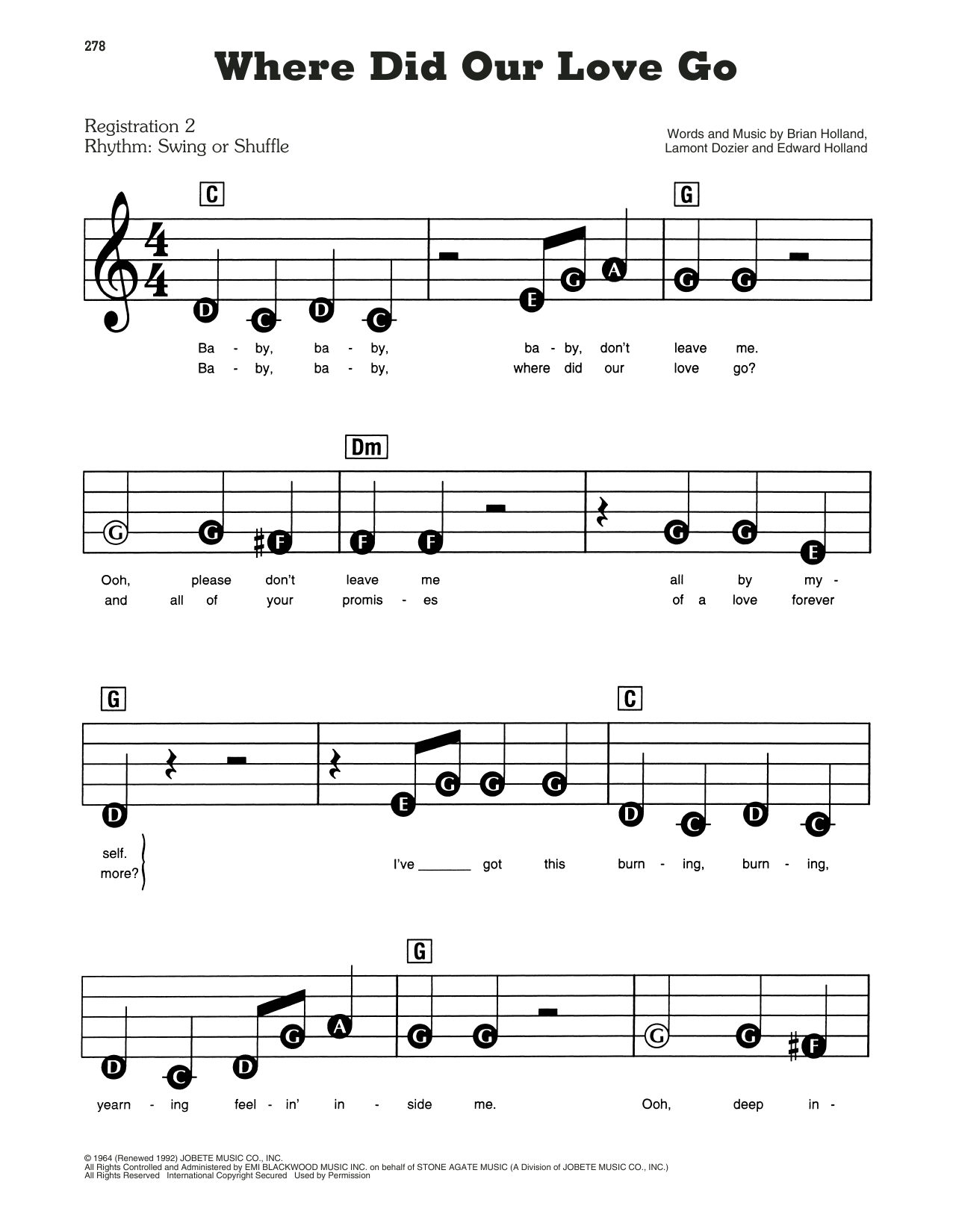
Where Did Our Love Go Sheet Music Preview

Where Did Our Love Go: E-Z Play Today

As performed by The Supremes

Item: 35-DS00456378

Digital Download
$4.99
Description

Where Did Our Love Go: E-Z Play Today isn't in MakeMusic Cloud just yet...but it could be. Let us know you'd like to see it, and you'll help shape what comes next. In the meantime, start a free trial and dive into thousands of interactive titles your students can play along with today.

Sample Audio
No sample audio found.
Sample Video
Additional Details
Publisher: Hal Leonard
Page Count: 4
SKU: 35-DS00456378

More about this title

About the Artist: The Supremes

The Supremes became the most successful vocal group of the 1960s while reshaping popular music and breaking racial barriers in mainstream entertainment. Diana Ross, Mary Wilson, and Florence Ballard (later Jean Terrell) recorded a string of Motown hits that combined meticulous studio production, sophisticated vocal arranging, and accessible melodies. Their influence extended far beyond pop radio; their recordings and live performances demonstrated how disciplined ensemble singing and production craft could achieve both commercial success and artistic credibility.

For music educators, The Supremes represent a pivotal moment when popular music and craft intersected. Their records offer students concrete examples of vocal blend, phrasing control, and how arrangements shape a song's emotional impact. Teaching their material opens conversations about production history, gender representation in the music industry, and the mechanics of what makes a recording memorable.

Why we love this

This Motown standard sits perfectly between accessibility and substance. The chord progressions reward solid harmonic thinking, the left hand patterns establish a clear rhythmic pocket, and the melody invites expressive phrasing. Students hear immediately why this song endured; they learn how a well-crafted pop recording translates to solo piano without losing its essential character.

What to expect

Nostalgic without feeling dated. There's warmth in the progression and a gentle melancholy beneath the accessible melody. The piece carries the sophistication of 1960s pop production: everything purposeful, nothing wasted, and the emotional core unmistakable.

Who it's for

Piano students at the intermediate level who want to engage with popular standards and understand how arrangement works in a real recording. Teachers looking to bridge the gap between classical technique and popular music literacy will find this a natural fit for students ready to explore beyond method books.

How to get the most out of it

  • Keep the rhythmic groove steady in your left hand. The song's appeal depends on a consistent pulse, not rubato or hesitation.
  • Shape the melody with your voice as you play. Think of your right hand as a vocalist interpreting a lyric, not simply hitting notes.
  • Balance texture and clarity. This isn't a thick, orchestral arrangement. Your right hand voice should sing forward while the accompaniment stays supportive.
  • Observe the dynamic arcs in the original recording. The Supremes' vocal performance suggests where to build and where to pull back on piano.

How to use it

Feature this in a popular standards or American songbook unit where students explore the intersection of chart success and enduring appeal. It works equally well as an assignment for a single student performance or as a group listening and analysis exercise. Consider pairing it with recordings to help students understand how arrangement and production choices shape a song.

Skills your students will build

  • Voice leading through Motown chord progressions
  • Distinguishing between accompaniment texture and melodic content
  • Maintaining steady rhythmic pulse in pop and soul idioms
  • Interpreting a melody based on the original vocal performance
  • Understanding arrangement principles in popular music production

You May Also Like