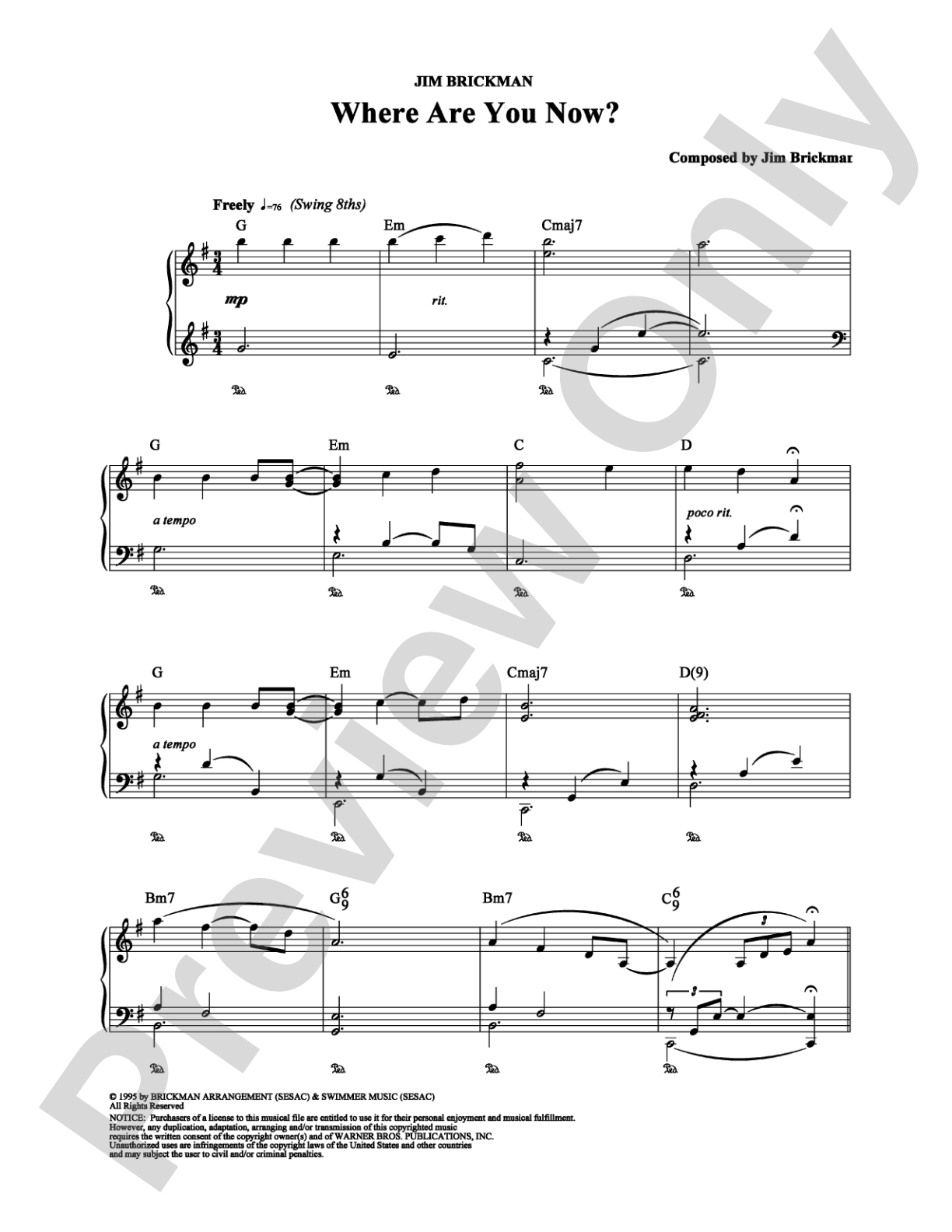
Where Are You Now?: Piano Digital Sheet Music

Where Are You Now?: Piano Digital Sheet Music

Jim Brickman

Item: 00-PS-0010093

Digital Download
$3.99
Description

Where Are You Now?: Piano Digital Sheet Music isn't in MakeMusic Cloud just yet...but it could be. Let us know you'd like to see it, and you'll help shape what comes next. In the meantime, start a free trial and dive into thousands of interactive titles your students can play along with today.

Sample Audio
No sample audio found.
Sample Video
Additional Details
SKU: 00-PS-0010093

More about this title

About the Artist: Jim Brickman

Jim Brickman

Jim Brickman stands as one of the defining voices in contemporary instrumental music, with a catalog that has consistently topped charts and touched millions of listeners. His approach to songwriting centers on emotional clarity: he composes with the explicit intention to comfort, motivate, mark celebrations, and accompany life's pivotal moments. That philosophy has made him the best-selling solo pianist of his generation and a central figure in the resurgence of instrumental music as a mainstream force in American popular culture.

Brickman's live performances are known for their intimacy and connection with audiences, a quality that carries directly into his recorded work. His distinctive touch at the keyboard and gift for melody have earned him a devoted following among both pianists and listeners who seek music that speaks without words.

Why we love this

Brickman's fingerprints are all over contemporary piano repertoire, and "Where Are You Now?" reflects the emotional sophistication that separates his writing from more formulaic adult contemporary work. The piece carries the hallmark balance of accessibility and substance that makes his music equally rewarding for pianists exploring contemporary classical styles and audiences attending recitals seeking music that speaks to real life.

What to expect

The title itself invites reflection, and the music mirrors that contemplative quality. Brickman's melodic writing is direct and warm, with the kind of harmonic language that feels immediate and personal without sentimentality.

Who it's for

Pianists working in contemporary styles who want repertoire that bridges classical technique with modern sensibility. This piece also serves teachers and intermediate to advanced students seeking material that develops musicality and emotional expression without excessive technical demands.

How to get the most out of it

  • Honor the lyrical phrasing; treat the melody line as if it were a vocalist's phrase, allowing space for breath and the natural arc of musical ideas.
  • Pay attention to dynamic subtlety in the accompaniment figures. Brickman's writing often calls for restraint in the left hand so the melody can float without competition.
  • Shape the piece's emotional arc rather than playing at a uniform tempo. Small rubato, used judiciously, will bring out the conversational quality of the work.

How to use it

Pair this with other contemporary piano works for a recital dedicated to modern American composers, or place it as a moment of reflection within a program that spans classical and contemporary repertoire. Its approachable style and emotional resonance make it equally effective as a concert opener or a quieter moment in the middle of a longer program.

Skills your students will build

  • Phrasing lyrical lines with structural coherence
  • Dynamic control and balance between melody and accompaniment
  • Musical interpretation of contemporary harmonic language
  • Tempo flexibility and expressive rubato in a modern context

You May Also Like