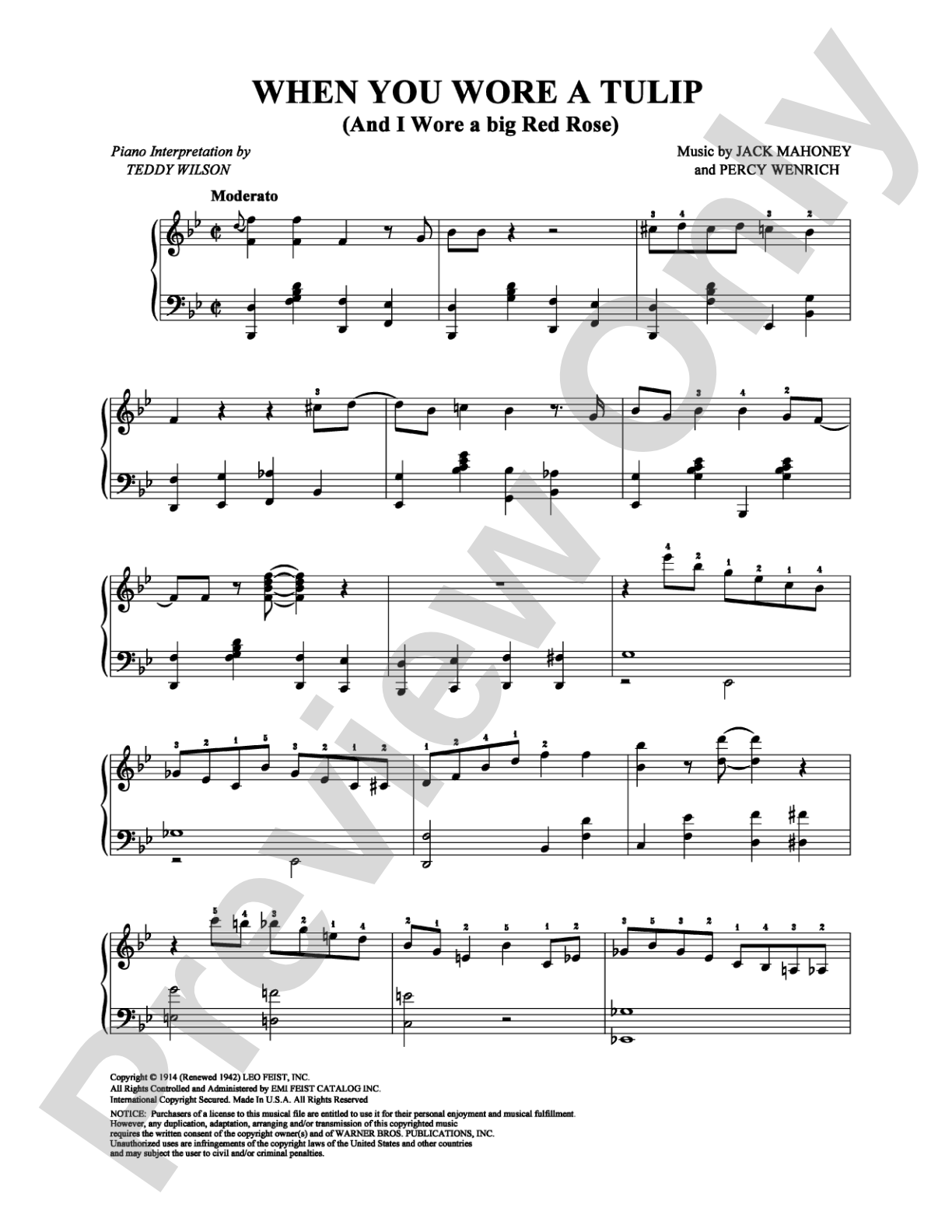
When You Wore a Tulip (And I Wore a Big Red Rose): Piano Digital Sheet Music

When You Wore a Tulip (And I Wore a Big Red Rose): Piano Digital Sheet Music

Percy Wenrich, Teddy Wilson, Jack Mahoney

Item: 00-PS-0007224

Digital Download
$3.99
Description

When You Wore a Tulip (And I Wore a Big Red Rose): Piano Digital Sheet Music isn't in MakeMusic Cloud just yet...but it could be. Let us know you'd like to see it, and you'll help shape what comes next. In the meantime, start a free trial and dive into thousands of interactive titles your students can play along with today.

Sample Audio
No sample audio found.
Sample Video
Additional Details
SKU: 00-PS-0007224

More about this title

About the Artist: Teddy Wilson

Teddy Wilson (1912-1986) was a pianist and bandleader whose elegant touch and harmonic sophistication made him one of the most influential jazz pianists of the swing era. He led his own bands, collaborated with Benny Goodman's integrated ensembles during a period when such partnerships were rare, and recorded prolifically across the 1930s and 1940s, establishing the template for lyrical, bebop-adjacent jazz piano that balanced stride tradition with modern harmony.

Wilson's playing emphasized melodic clarity and refined voicings over flashy technique. His interpretations of popular standards became models for jazz education, demonstrating how a trained classical pianist could reshape American song material through jazz sensibility without sacrificing musicality or structural integrity.

Why we love this

This is a piece that rewards careful listening to harmonic voice leading and jazz-era reharmonization. Wilson's interpretation of this early-20th-century pop standard reveals how a master pianist approaches phrasing, rubato, and the subtle architectural choices that make swing-era jazz sound effortless rather than mechanical. It's an excellent study piece for pianists working to understand period jazz aesthetics beyond surface-level rhythm.

What to expect

Warm and conversational, with a relaxed swing that makes you want to settle in and listen rather than tap your foot. The melody floats gently over subtle harmonic movement, like watching a skilled dancer glide across the floor without apparent effort. There's an underlying sophistication here that belies the tune's humble popular origins.

Who it's for

Jazz pianists at the intermediate level and above who want to study authentic swing-era interpretation and harmonic thinking. Students of American popular song who are exploring how jazz standards evolved from Tin Pan Alley material. Teachers seeking recordings that model sophisticated jazz piano comping and soloing for ensemble rehearsals or private studio study.

How to get the most out of it

  • Listen closely to Wilson's touch and note how he voices the melody against walking bass patterns; the interplay between right and left hands drives the swing feel rather than strict metronomic timing
  • Pay attention to his use of space and silence; jazz piano at this level often hinges on what you don't play as much as what you do
  • Approach reharmonizations and substitutions as logical extensions of the melody rather than ornamental flourishes; each chord choice serves the phrase

How to use it

Use this as a listening model when teaching jazz history or swing-era styles, pairing it with score study so students can see how Wilson voices chords and constructs his solo sections. It works well in a unit exploring jazz reinterpretation of American standards, helping pianists understand the difference between playing a lead sheet and inhabiting a jazz tradition. Consider including it in a jazz appreciation context alongside recordings of the original popular version.

Skills your students will build

  • Recognizing and executing swing-era harmonic voicings and substitutions
  • Understanding rhythmic flexibility and rubato in jazz contexts
  • Analyzing the relationship between melody, comping, and left-hand accompaniment patterns
  • Developing listening skills for subtle phrasing and dynamic control in jazz piano
  • Adapting classical training to idiomatic jazz interpretation

You May Also Like